Official Website of Philippine Senator Pia Cayetano

News

  • Message to the Oplan Balik Eskwela virtual kickoff program

    I’d like to send my warm greetings to Secretary Briones and to my colleague, of course, Senator Win Gatchalian, to my former colleagues in the House of Representatives and to all the whole DepEd family and stakeholders who are listening and watching us today.

    Magandang umaga po sa inyong lahat.

    I want to keep this very brief, but I’d also like to instill in the minds of every educator out there, and that includes also myself as a parent, that truly, the Bayanihan Spirit is called upon now more than ever to make our education effective for our young children.

    I know that the urgent task at hand appears to be the delivery of the education materials. So we are now rushing to determine and to set into place other modes of delivery because the usual physical presence of the teachers and the students in the classroom setting will not be happening anytime soon.

    However, I’d like to include in the discussion – and I know, of course, the Secretary and the Usecs. are on this – that beyond the simple delivery of education is our perennial problem on reaching every single child. Because we live in a time where we have all the data analytics, we have all the information that we need, the data. Learning analytics is available to us. We can measure, we can collect, we can analyze the data about every learner in order to optimize the learning for each child. And yet, our country, like many other countries, not just us, [is] still teaching in the mode of a hundred years ago, where there is a blackboard, there is a teacher, and there are students.

    And we need to get past that. I want to be able to use this crisis that we are in to jump-start the education of the future. I am so happy that Secretary Briones and I see eye to eye on this, the Usecs. that attend our hearings are on board. But we need to be able to translate this into actual action on the ground with our teachers. We need them to understand. Because even I continue to see that image of a blackboard, a teacher, and students. There’s going to be quarterly exams, and there’s final exams.

    But we have all the data that tells us that the learning curve shows that some are advanced and fast learners, and some are slow learners. And we need to get away from that, the model that we have because it perpetuates the stigma against slower learners, when they may not even be slow learners at all, they just may have other intelligence, multi-intelligence that are not seen on the spectrum immediately.

    And that is why I have been a proponent for blended learning and I also want to be sure that in our haste to set into place this new modalities of delivery, we do not simply deliver education in a different format, meaning from blackboard it became a computer. Because that is not blended learning. We really need to make use of every instrument that we have, including the parents… every tool that we have, the parents, the society, retired teachers, all the tools available to us to reach children. And especially those children who live in urban centers. The information and knowledge that they receive outside of the classroom is so abundant that we also need to help them filter this and maximize those learnings outside of the classroom to make it relevant to them in the classroom.

    I read a study that said the Math curriculum of the United States is “turn of the century,” 1900’s. US na nga ‘yun, ‘no? I don’t think we can say that mas advanced tayo sa US. So I also have concerns of that nature. And I trust that in the years to come, or actually, in the weeks and months to come… Because when I… we have hearings, I know and recognize that the DepEd officials know this. It’s really a matter of cascading all this information and bringing our teachers up to speed.

    So I believe that is the bigger challenge. Not simply the fact that our students will not be able to go to the classroom, but the reality that we need to be able to reach every single child and to be able to deliver education to them at each level that each child needs to hear, needs to understand.

    So on that note, I do believe that the best time for the Bayanihan spirit to come alive is now. A lot of people know the reality that great things happen in the time of crisis, great ideas come about in the time of crisis. And so I challenge and I support all the initiatives of DepEd to make the most of these challenging times and really revolutionize education for our young people today.

    Thank you very much and God bless you all! #
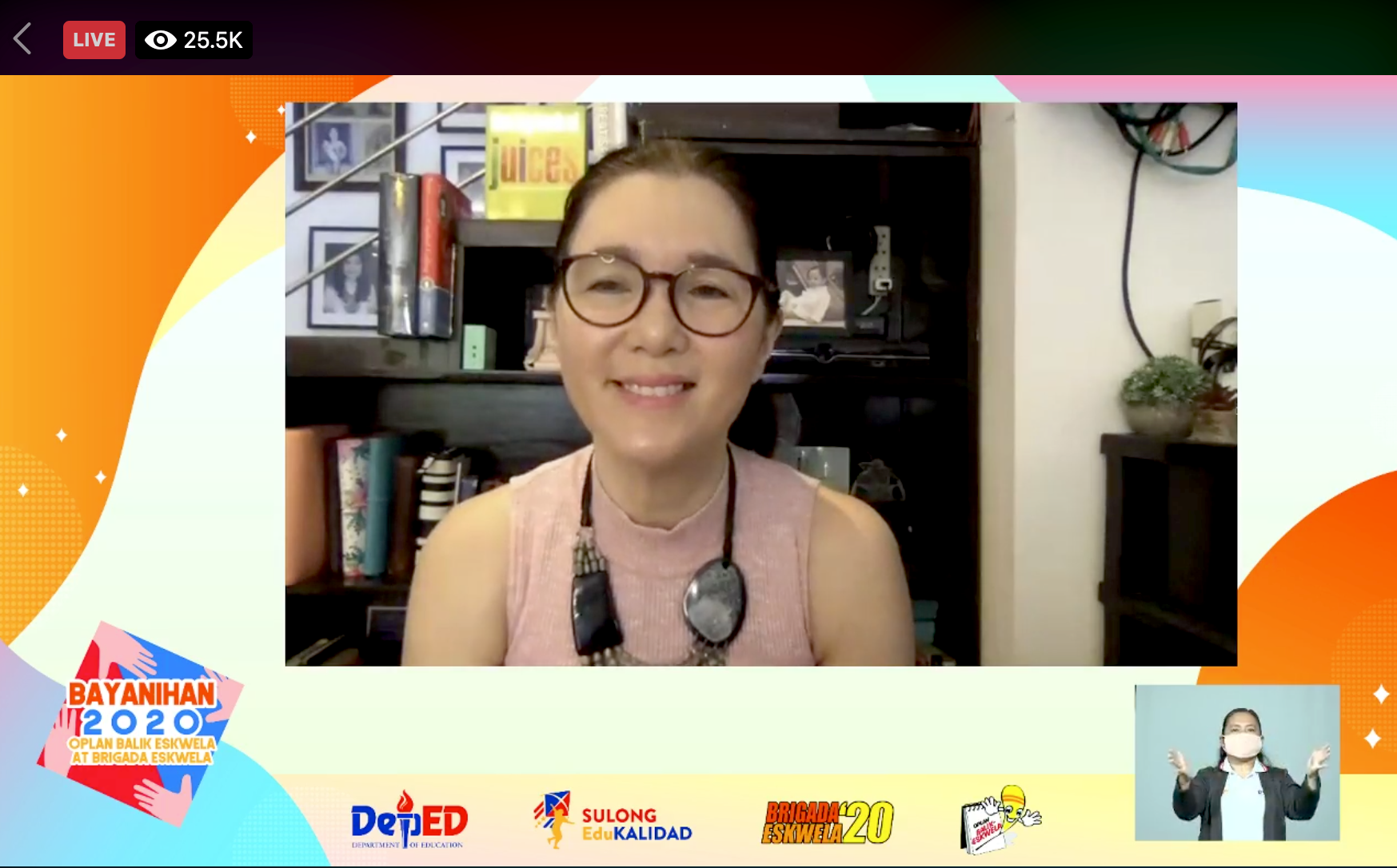
    Sen. Pia Cayetano said educators can turn current challenges into opportunities to jumpstart education for the future.

  • Pia: Bike lanes to protect delivery bikers, open new income opportunities for bike riders

    Building safe networks of bicycle lanes in the country stands to benefit frontline workers, including those in delivery services for food and other essential items.

    At the same time, bike lanes could open new income opportunities for Filipinos as essential services sectors have been employing bike riders for their short-distance deliveries.

    This was among the key takeaways of Senator Pia S. Cayetano from her panel’s first public hearing on proposals to accelerate policies promoting sustainable transportation.

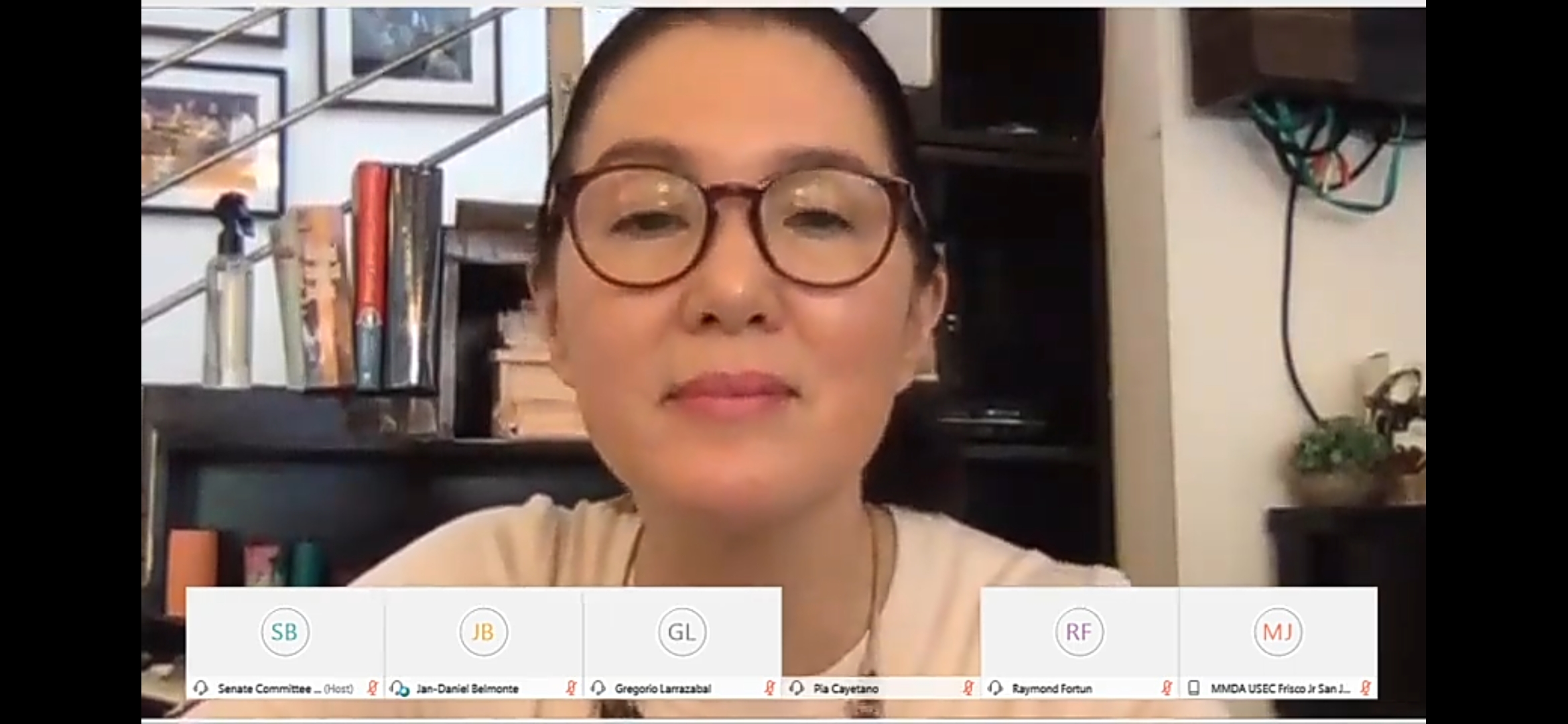
    The Senate Committee on Sustainable Development Goals, Innovation, and Futures Thinking, which Cayetano chairs, conducted a hearing on Thursday (May 28) to discuss with government officials, advocacy groups, and other stakeholders the need for a comprehensive infrastructure plan for sustainable modes of transportation, including biking, walking, and non-motorized transportation (NMTs).

    Among the senator’s proposals is the immediate establishment of pop-up bike lanes and walkways in Metro Manila’s major roads, following the imposition of safety restrictions on the public transport system that prompted more Filipinos to turn to alternatives like biking or walking.

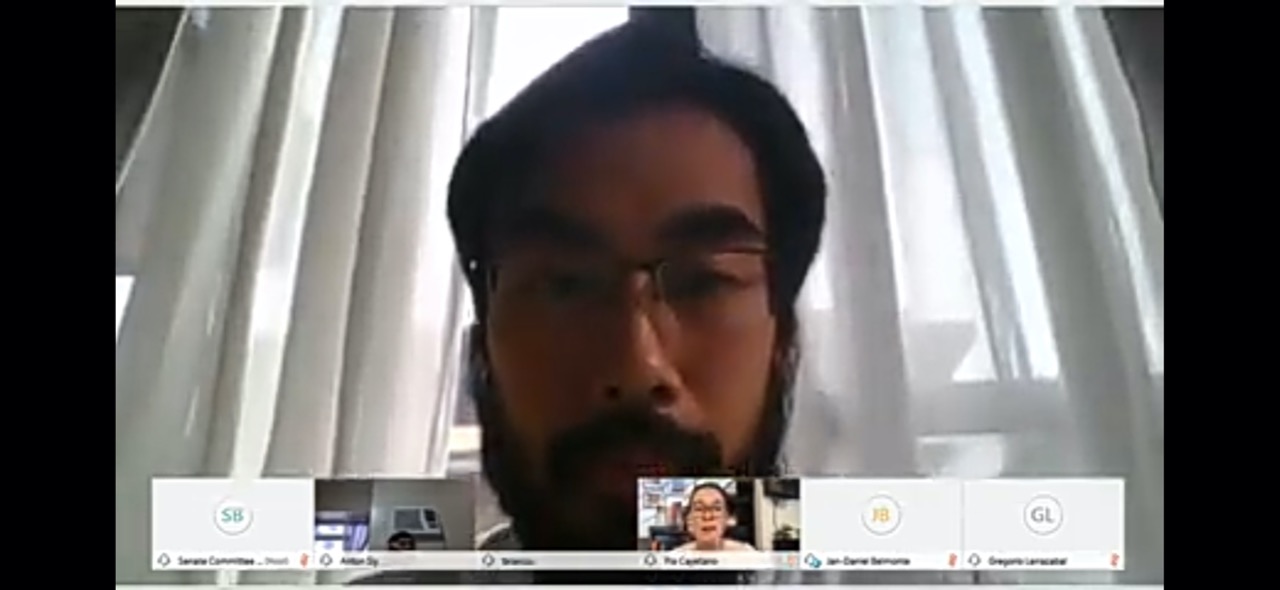
    Grab Philippines President Brian Cu, who was among the resource persons in the hearing, supported plans to improve the country’s road network for cyclists, stressing that it would benefit the company’s delivery partners who use bikes.

    Around seven percent of GrabFood and GrabExpress active rider-partners are cyclists, Cu cited. Currently, they are allowed to accept bookings within a 1.5-kilometer radius, which is half the distance allowed for Grab riders using motorcycles (3 km).

    However, Cu noted that both riders take the same delivery time on an average, one of the reasons for which is the lack of access to safe pathways for those using bikes. He also raised the issue of safety for Grab bikers.

    As such, he said Grab Philippines is supportive of current proposals being heard in the Senate on setting up networks of protected bicycle lanes in the country, to be utilized during the pandemic and after.

    “We support this discussion about creating specific pathways for bikers, so they don’t have to worry about their safety on the road. [Moreover,] it will definitely help speed up travel time [for Grab bikers] and potentially increase the radius that they cover, which leads to higher incomes,” he explained.

    He added that apart from benefiting existing delivery partners, the initiative could also encourage more Filipinos to be Grab bikers.

    “Adding safer networks of roads and better paths [for cyclists] can allow more individuals to join our platform. They can join at a very low cost, but still make very decent living,” Cu said, citing that Grab bikers earn around 45 percent above the minimum wage.

    Grab Philippines President Brian Cu: “We support this discussion about creating specific pathways for bikers, so they don’t have to worry about their safety on the road.”

    Cayetano, for her part, backed Cu’s statement on the need to improve our road system for cyclists to ensure their safety as well as to generate new and more livelihood opportunities for Filipinos during this health crisis.

    “I am sure there are many more opportunities that we can give for Filipino cyclists, one of which is through your platform. But there are a lot of unmet needs as far as delivery by bicycles is concerned. I am happy to hear [your inputs] and be reminded of the need to address these,” Cayetano said.

    “Now is really the time for people to have income opportunities. And something as basic as decent and safe biking skills could provide jobs for them… We have to be able to support them with the right infrastructure,” she added.

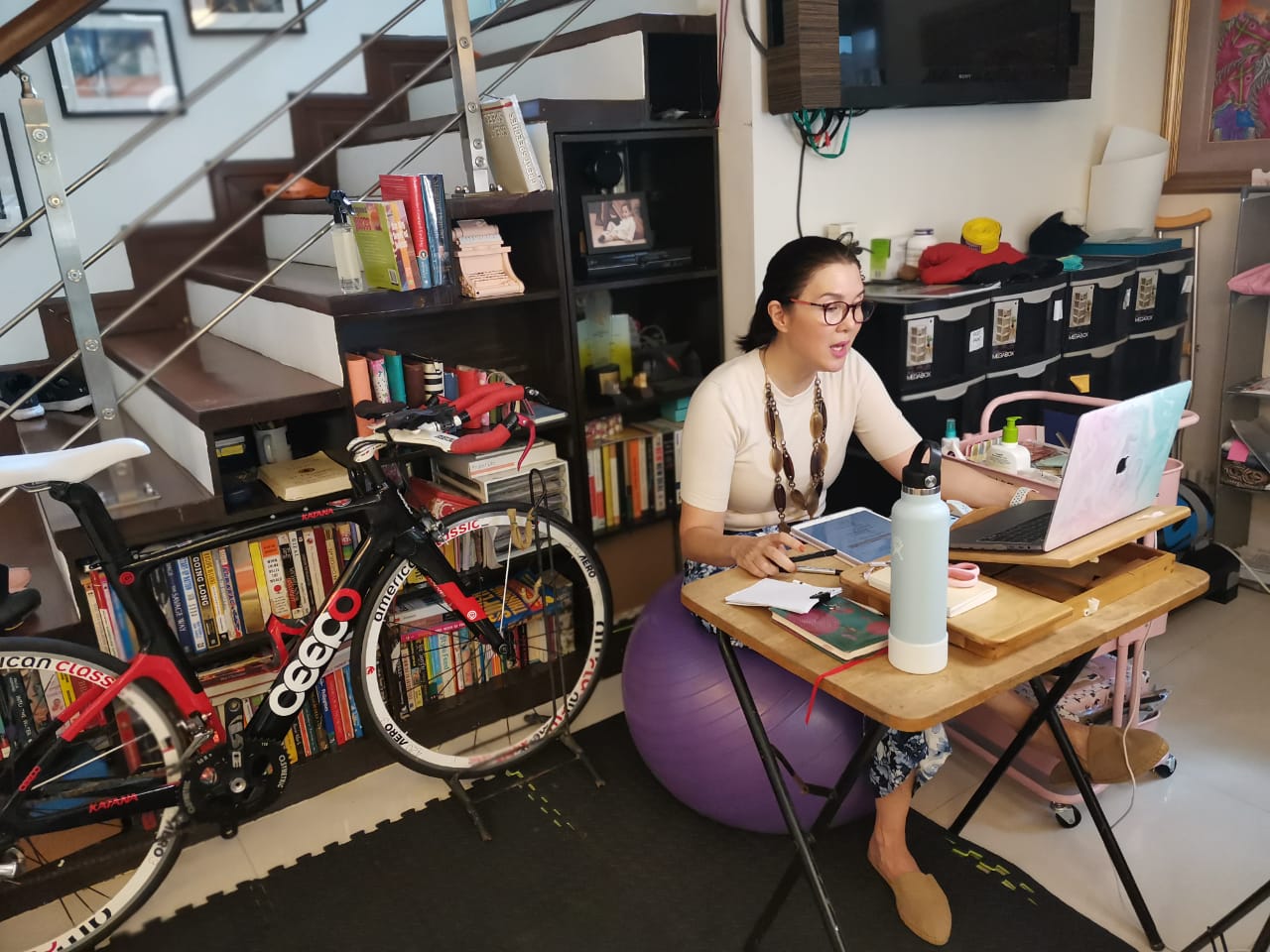
    Senator Pia Cayetano leads the public hearing of the Senate Committee on SDGs, Innovation, and Futures Thinking from her home with her triathlon bike in the background.

    The senator recently filed Senate Bill No. 1518 or the “Safe Pathways Act,” which seeks to create a network of pop-up bike lanes and emergency pathways connecting people to essential destinations during the lockdowns, while still ensuring that physical distancing is maintained.

    Moreover, adequate parking spaces for bicycles and non-motorized vehicles shall be set up in all public places, government offices, schools, places of work, and commercial establishments, including malls, banks, and hospitals.

    Lastly, the bill shall mandate appropriate government agencies to prepare the permanent adoption of the established bike lanes, emergency pathways, non-motorized parking spaces, and other appropriate infrastructure, after COVID-19 is no longer a threat. #

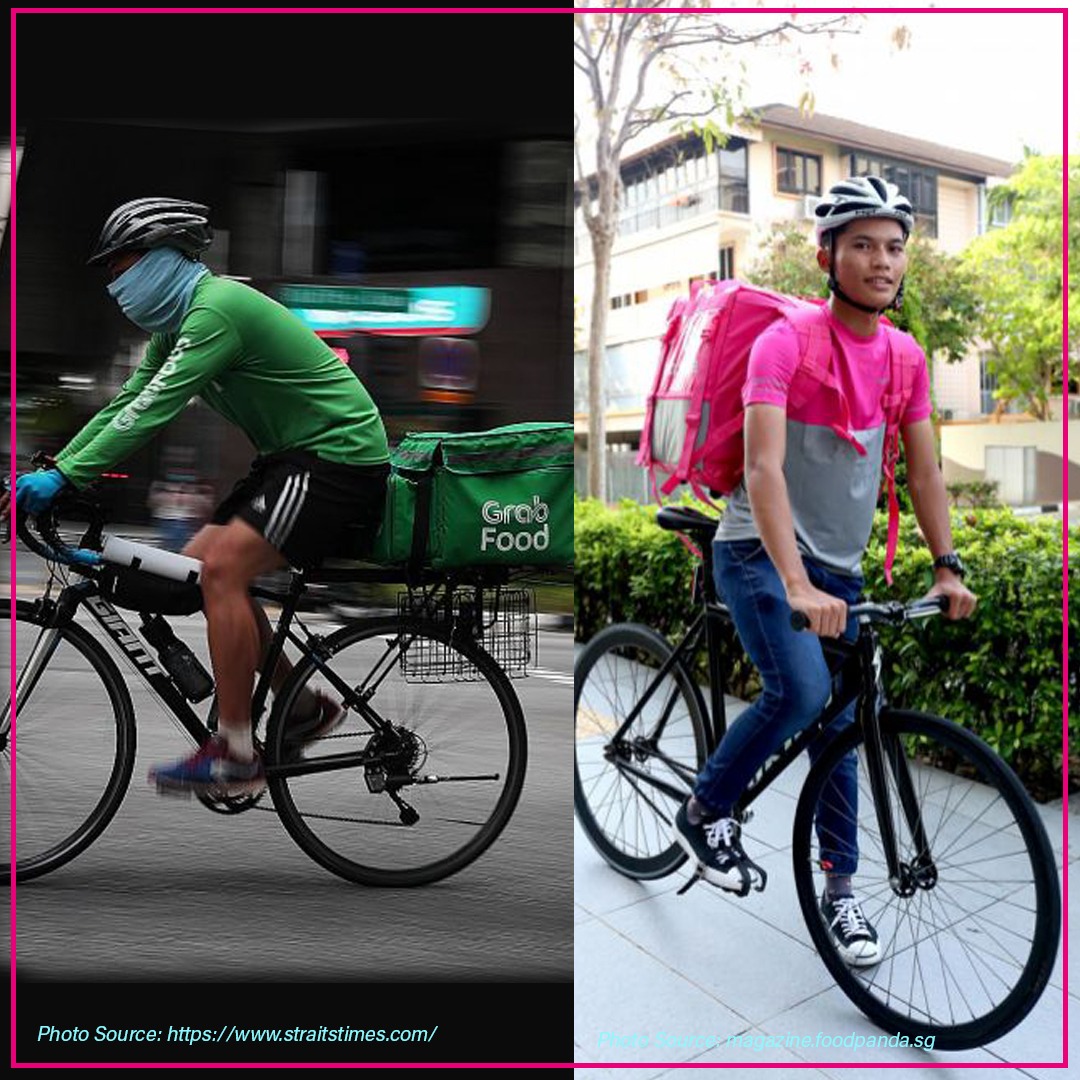
    Food deliveries by bicycle in Singapore. Building a network of bike lanes in the country could encourage companies offering delivery services to hire more bike riders for their crew.
  • Pia bats for ‘hospital loops’: Prioritize bike lanes to protect frontliners

    Senator Pia S. Cayetano is supporting a proposal that would prioritize the establishment of pop-up bicycle lanes and emergency pathways in roads connecting to hospitals, which will serve as safety loops for healthcare workers and frontliners reporting for work during the COVID-19 pandemic.


    The Senate Committee on Sustainable Development Goals, Innovation, and Futures Thinking conducted a hearing on Thursday (May 28) to discuss proposals seeking to promote sustainable modes of transportation in the country, including biking, walking, and non-motorized transportation or NMTs.

    “We need to protect the people who protect us. I want to help address this need to establish safe pathways for our frontline workers.”


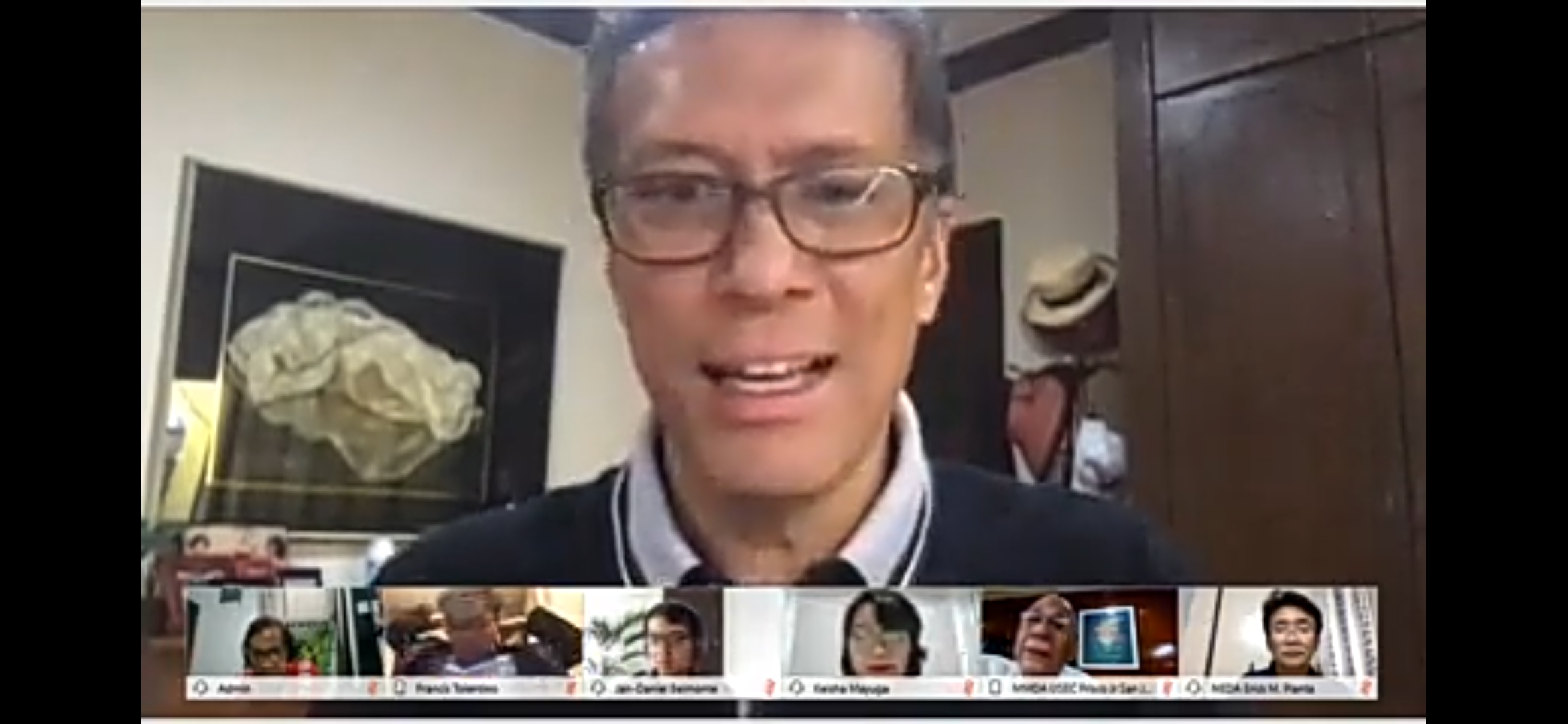
    Dr. Antonio Dans, a professor at the University of the Philippines’ College of Medicine, made an appeal to government agencies to prioritize building a “loop” of bikeway systems that would link roads along several hospitals in Metro Manila.

    Dr. Dans: Healthcare workers are in a “special situation” since they need to practice more safety precautions and social distancing measures in the time of COVID-19.


    “My appeal is when we build these loops [of safe pathways], we think of our healthcare workers,” Dr. Dans said, noting that healthcare workers are in a “special situation” since they need to practice more safety precautions and social distancing measures in the time of COVID-19.


    “Since we are [already] thinking about how to build these [bike lanes and walkways], maybe we can start in areas near hospitals to improve frontliners’ access [to their places of work],” he added.


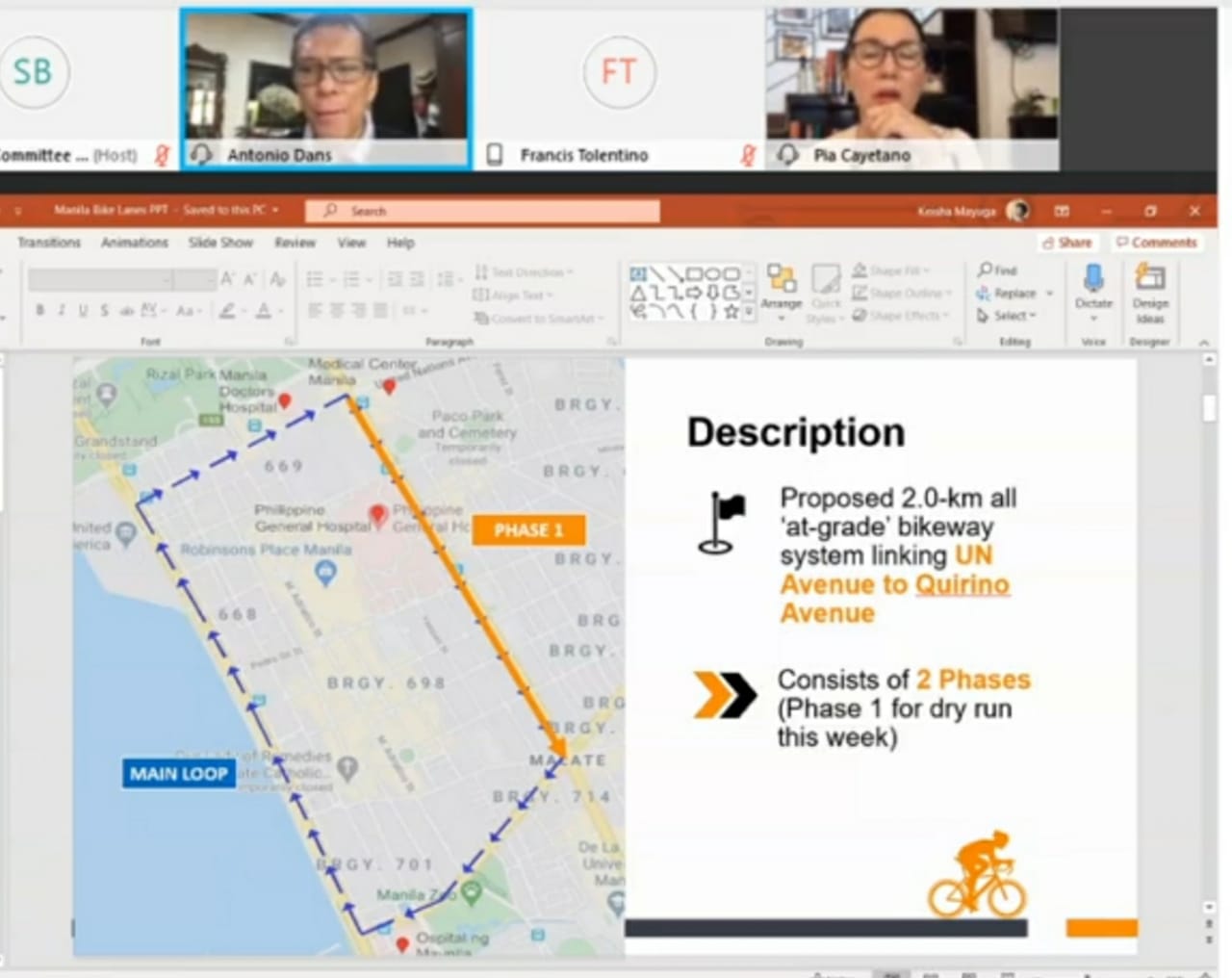
    The proposal seeks to benefit frontliners working in four hospitals in Manila: the Philippine General Hospital (PGH) along Taft Ave., the Ospital ng Maynila Medical Center along Quirino Ave., and the Manila Doctors Hospital and Manila Medical Center, both along United Nations Ave.

    The 6-kilometer hospital bicycle loop proposed by Dr. Tony Dans.


    The six-kilometer loop shall serve as a “safe haven” to ensure frontliners’ safety while going to work on their bikes. Dr. Dans said nearly a quarter of PGH’s hospital staff have requested for bicycles as their access to work had been limited due to the cancellation of public transport.


    “We hope that our policymakers, the local government units (LGUs), and even officials at the executive branch, would give us this option to get to work safely during the COVID-19 crisis and after,” he said.


    Cayetano, for her part, expressed her full support for the proposal, stressing that priority should really be given to initiatives that would ensure the safety of all frontliners who are leading our fight against the virus.


    “We need to protect the people that protect us. I want to help address this need to establish safe pathways for our frontline workers,” she stated, adding that similar hospital loops can be allotted in areas with a big concentration of hospitals like Quezon City.


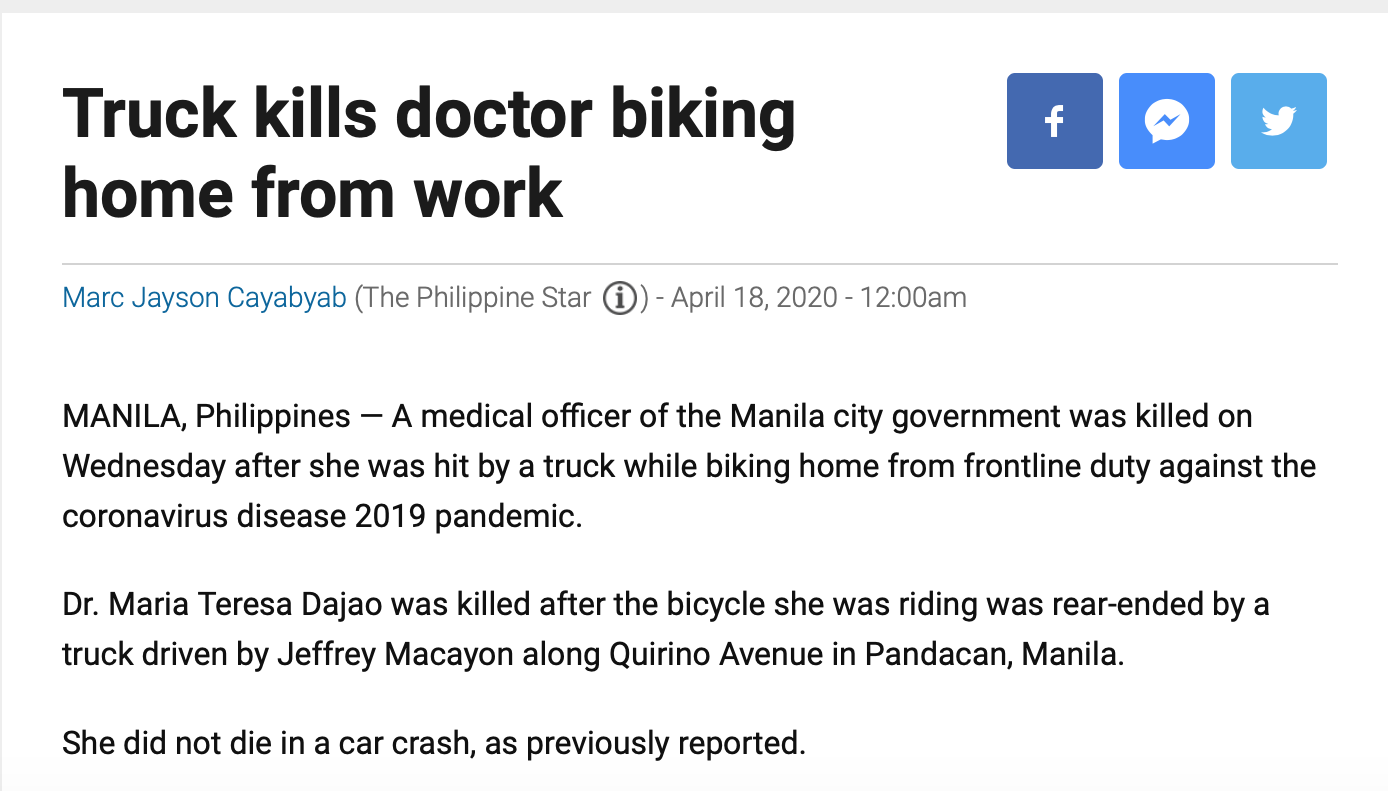
    It should be recalled that last month, Dr. Maria Teresa Dajao, a medical officer of the Manila city government, was killed after she was hit by a truck while biking home from frontline duty.

    Screengrab from the Philippine Star website

    Cayetano recently filed Senate Bill No. 1518 or the “Safe Pathways Act,” which shall create a network of pop-up bike lanes and emergency pathways to connect people to essential destinations during the pandemic, all while ensuring that physical distancing is maintained.


    She earlier said that the bill’s primary objective is to provide safe spaces and priority lanes for frontliners going to work through biking or walking. Some of these pathways may even directly lead to hospitals, Cayetano had earlier explained.


    “We want to be able to protect all of our frontliners; even the hospital staff exposed to admin work and cleaning services, the security personnel, the barangays workers, and so on. We need to keep finding ways to keep them all safe, which also means keeping our roads safe for them to travel on,” the senator said.


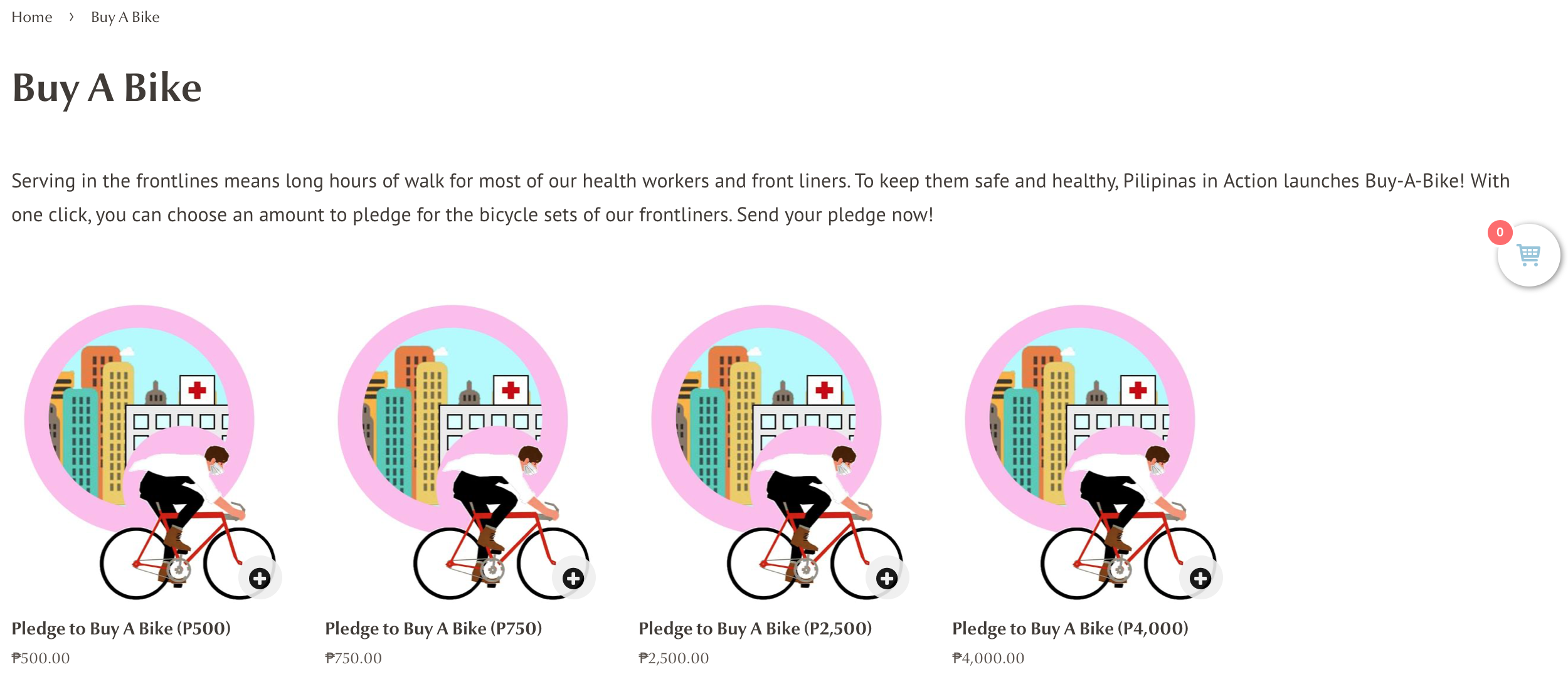
    Apart from her legislative work, Cayetano had started the Pilipinas In Action initiative, which recently launched the “Buy A Bike” project where donors can pledge for bicycle sets to be donated to COVID-19 workers. The initiative was able to donate bikes to PGH staff, in coordination with Dr. Dans.

    Screengrab from pilipinasinaction.ph


    Meanwhile, the senator also commended the PGH for its plan to construct its own bike parking lot for employees.


    “We really have to be able to promote these sustainable modes of transportation in the country with the right infrastructure. We should seize this moment brought about by the crisis to foster this change now,” said Cayetano, who is also the principal author of the National Bicycle Act (SBN 285), and the Sustainable Transportation Act (SBN 66). #


  • Statement on Inquirer reporter’s tweets

    “Never let a good crisis go to waste.” – Winston Churchill

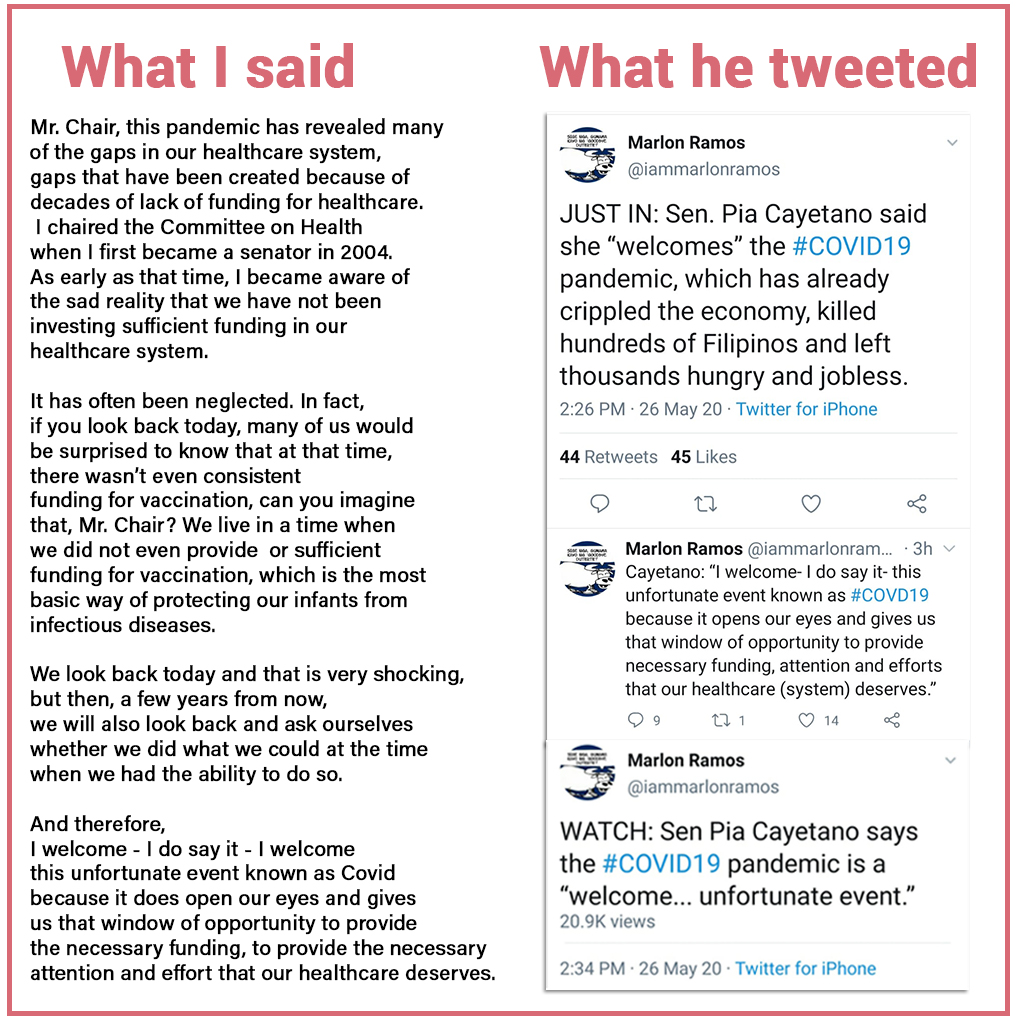
    I call out Mr. Marlon Ramos of the Philippine Daily Inquirer for his irresponsible & unethical tweet, wherein he twisted a statement I made during this morning’s Senate Committee on Health hearing.

    During my manifestation, I was explaining how urgent the health bills I filed were and was giving context by saying that historically, health infrastructure and health needs were not prioritized. But this time of COVID-19 opened people’s eyes and gave us the opportunity to use the crisis to improve our healthcare system.

    It doesn’t take a rocket scientist to understand my statement. But someone with a malicious mind like Mr. Ramos chose to use my words and give it a different meaning. Perhaps the Inquirer reporter did not bother to listen to my manifestation – which wasn’t even that long – or read the transcript, wherein I was referring to the improvement of healthcare, as attached to this post.

    Clearly he chose to maliciously twist the sense of my manifestation, when he tweeted that I “welcome” the negative impacts of the pandemic on our economy, as well as on Filipinos’ lives. Who in their right mind would wish this upon anyone?

    Years ago, I lost a child due to a genetic condition that he had since birth. I chose to cope with his death by helping other children in need. I ran and biked to raise funds for these kids. Despite the pain, I gave thanks to God and welcomed that time in my life because it brought so much good. Does it mean I’m happy I lost my son? Of course not.

    It saddens me and at the same time outrages me that a reporter would choose to twist words to confuse people and impute malice on a statement urging support for better health infrastructure all over the country. I trust that the intelligent Filipinos know better than to give value to his twisted words.

  • COVID-19 an ‘eye-opener’ on the urgency to raise health infra budget

    Senator Pia S. Cayetano stated that the COVID-19 pandemic has revealed the need to address the gaps in the country’s healthcare system, as she pushed for measures seeking to ramp up health infrastructure for the safety and protection of Filipinos.

    “COVID-19 opens our eyes and gives us that window of opportunity to provide the necessary funding, attention, and effort that our healthcare deserves,” the senator said during the Senate Committee on Health and Demography’s hearing on Tuesday (May 26).

    “This pandemic has revealed many of the gaps in our system, gaps that have been created because of decades of lack of funding for healthcare,” added Cayetano, who formerly chaired the health panel in 2004.

    The senator expressed hope that the health crisis today would bring forth reforms in the future and push the government to invest more in our healthcare system, particularly to build more adequate health infrastructure.

    “Knowing how open-minded people are now and how much people see the importance of healthcare, there would be a much stronger support for whatever budget we would be proposing,” she stressed.

    Last year, Cayetano filed Senate Bill No. 63, or the ‘Build, Build, Build for Health Infrastructure’ Bill, which mandates the Department of Health (DOH) to identify priority needs for health infrastructure, and establish a long-term plan to provide for health facilities in priority areas.

    Under the measure, a proposed amount of P10 billion shall automatically be included in DOH’s annual appropriation for the next five years for the implementation of the infrastructure plan.

    “My intention [in filing the bill was] very simple, that health infrastructure be included in the flagship projects of this administration in the remaining years that it has, and that this continues throughout the years,” Cayetano said during the hearing.

    She stressed that ensuring adequate funds for health infrastructure is consistent with the newly enacted Universal Health Care (UHC) Law, Goal 3 of the Sustainable Development Goals (SDGs) of which the country is a signatory, as well as the government’s own Philippine Development Plan 2017-2022.

    Meanwhile, the senator pushed anew for the passage of another bill she filed, Senate Bill No. 1442, which seeks to provide for the establishment and operation of additional quarantine stations, grounds, and anchorages in all strategic areas in the country.

    “This is a [Covid-response] measure that also will ensure that we are prepared for future health crises,” stressed Cayetano who now chairs the Senate Committee on SDGs, Innovation, and Futures Thinking.

    She also expressed support for a proposal to authorize the DOH to set bed capacities in various public hospitals. Current regulations only allow the agency to increase bed capacity and improve service capability of hospitals through legislation.

    “I am a big supporter of this, because what I have seen in all the years that I chaired the [Senate] Committee [on Health] was, nauuna po ang mga ospital na may masigasig na congressman o senador na tumutulong. Kawawa naman po ang mga tao o lugar na walang nagla-lobby para sa kanila,” Cayetano cited.

    “Their need for healthcare is in no way diminished by the lack of a piece of paper filed in the House or in the Senate. That’s why I have always believed that DOH should be given full authority,” she further noted.#

    Cayetano’s ‘Build, Build, Build for Health’ bill proposes P10 billion for DOH’s health infrastructure budget over the next five years.
  • Ensure safe pathways for frontliners, bikers, pedestrians

    Senator Pia S. Cayetano reiterated her call for government agencies to come up with a holistic action plan governing the use of public roads and transportation during the ‘new normal,’ with priority given to frontliners and essential industry employees reporting back to work.

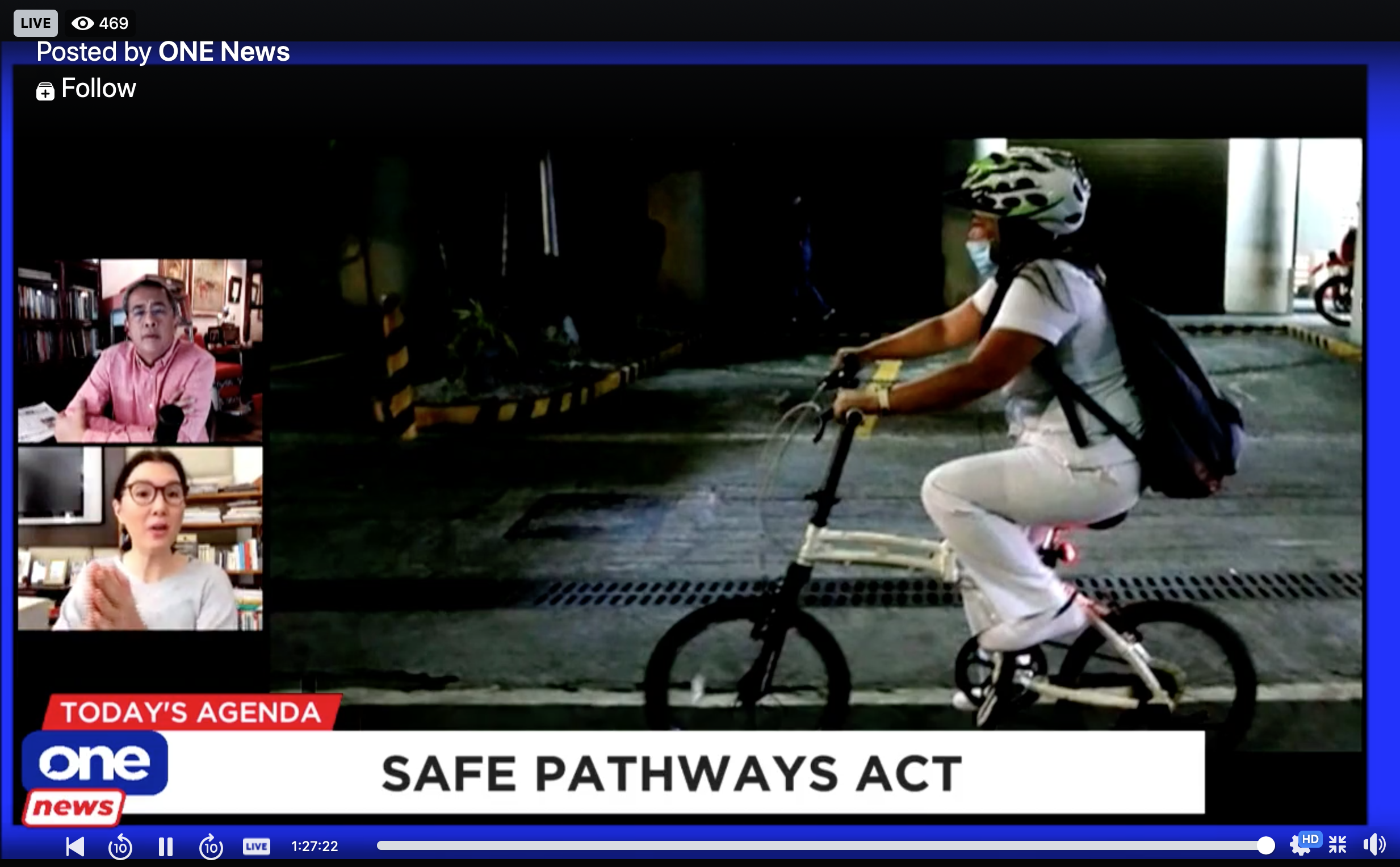
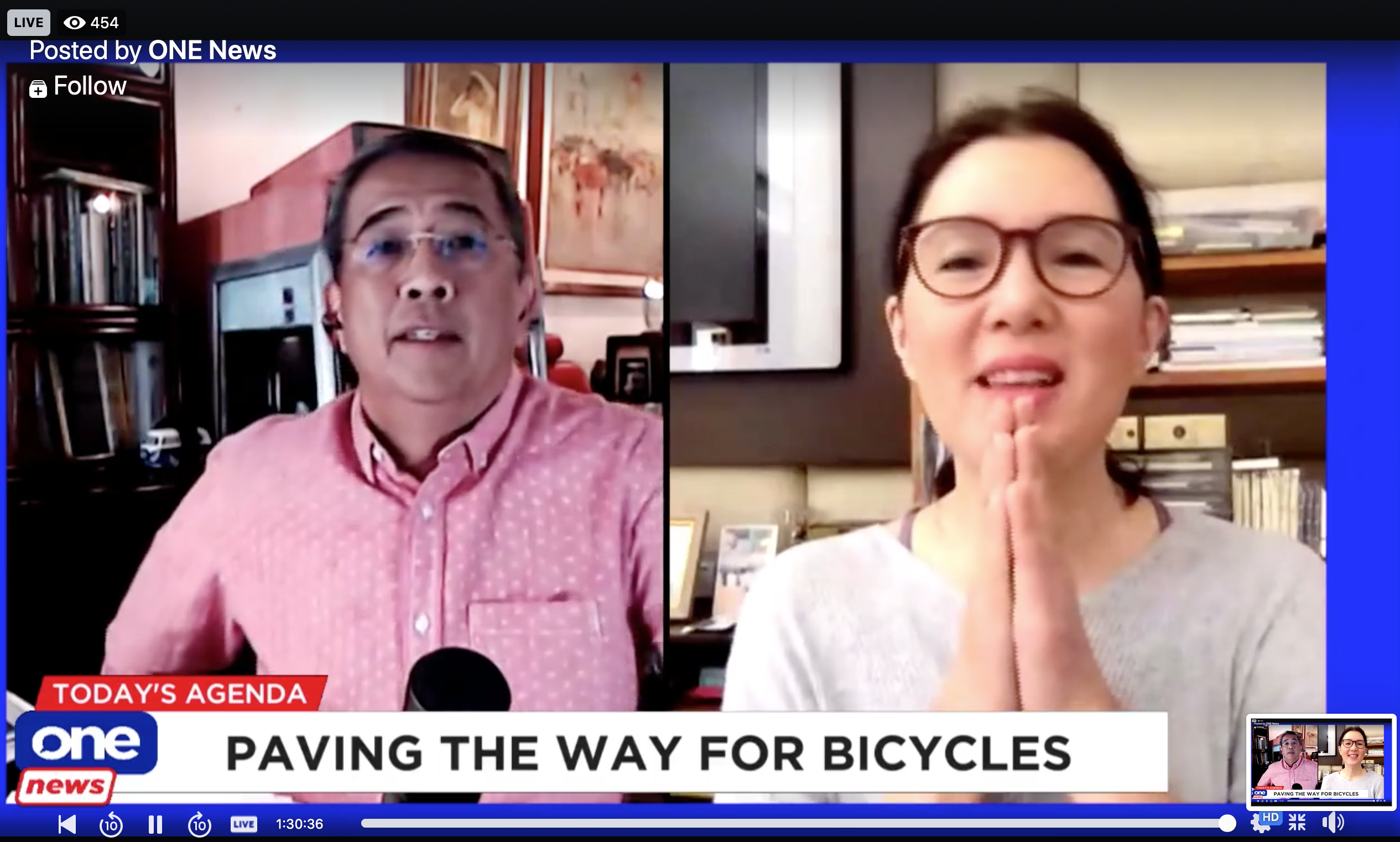
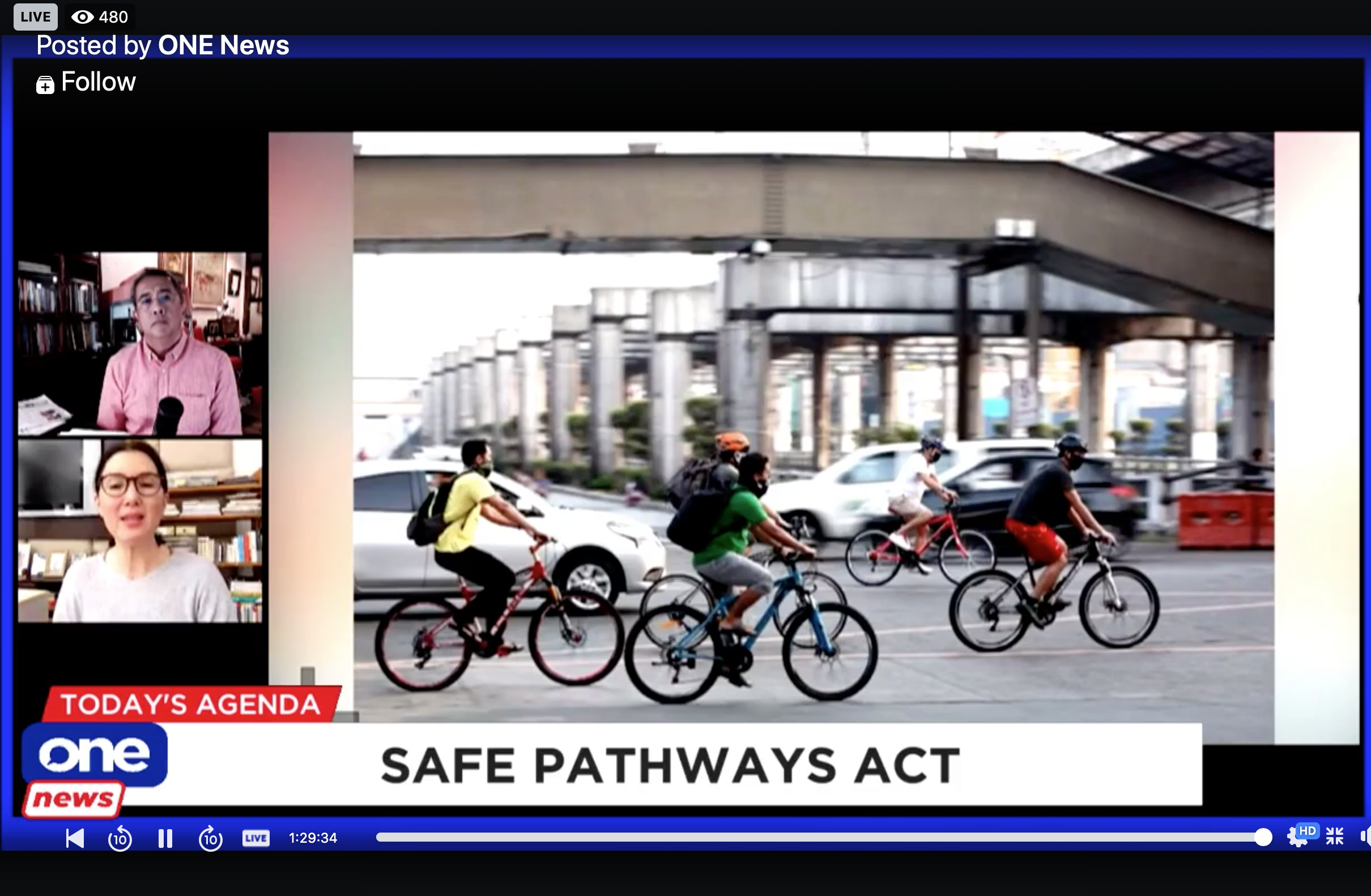
    In an interview with One News’ Cito Beltran, the senator on Friday (May 22) talked about Senate Bill No. 1518 or the ‘Safe Pathways Act,’ which she filed this month to offer alternative modes of transportation and mobility for communities that are gradually being opened up following lockdowns due to the COVID-19 contagion.

    Cayetano’s proposal seeks to create a network of pop-up bicycle lanes and emergency pathways that would connect people to essential destinations during the community quarantines, all while ensuring that physical distancing is maintained.

    “It’s called the ‘Safe Pathways Act’ since our priority is to ensure the safety for our frontliners who need to get to work during this pandemic. Ideally, the safe spaces and priority lanes for those going to work through biking or walking should be color-coded or barricaded. [The pathways] may even directly lead to hospitals,” Cayetano explained.

    She noted that major cities around the world are shifting to alternative modes of transportation, particularly biking, amid concerns that allowing cramped mass transportation systems could trigger a new wave of COVID-19 infections.

    “All over the world, people are being more careful and authorities don’t want to risk resuming public transportation since the lack of social distancing leads to the faster spread of the virus. So we now have this golden opportunity to promote biking and walking,” she cited.

    A cyclist and a long-time advocate of non-motorized transport, Cayetano stressed the need to set up safer pathways for bicycles and pedestrians as community quarantines are being lifted and public transportation is gradually being restored.

    “It’s not just a matter of creating bicycle lanes, considering the way our streets are currently being used. Clear demarcation for cyclists and pedestrians is needed so they would not be eased out once there are more cars on the road,” she said.

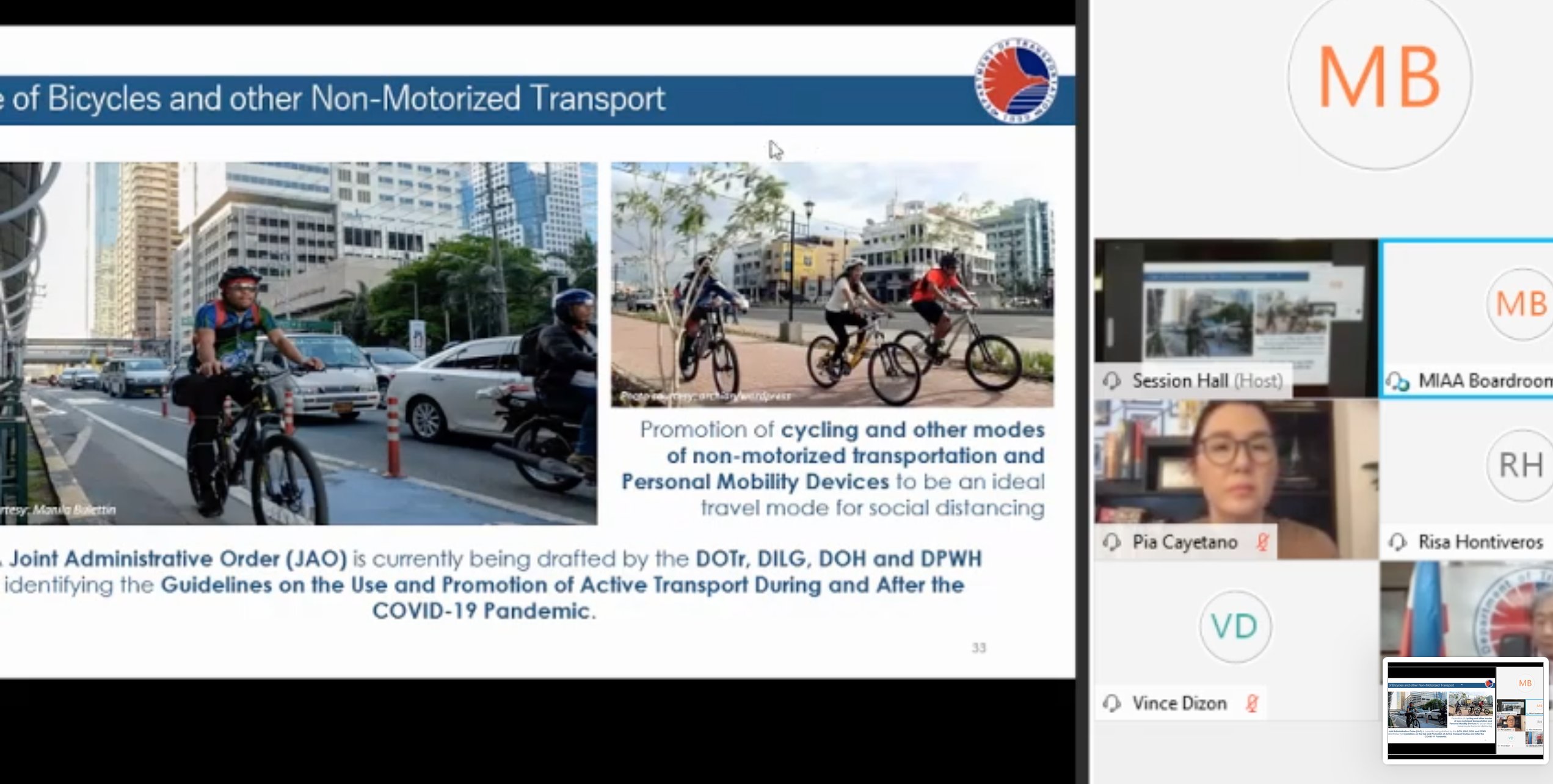
    She noted that during Tuesday’s hearing of the Senate Committee of the Whole, no less than Secretary Arthur Tugade gave senators the assurance that the Department of Transportation (DoTr) is including bicycles in its plan to establish safer transportation systems during the ‘new normal.’

    “The DoTr gave assurance that they are handling it on a holistic level. Because if there would be no coordination involving other modes of public transportation, [then] it’s going to be hard to work because the space is limited,” Cayetano said, adding that the measure she recently filed is also in line with another bill she filed last year, the “Sustainable Transportation Act” (SBN 66).

    SBN 66 promotes sustainable and alternative modes of transport – including walking, biking, and efficient mass transportation – to reduce greenhouse gas emissions, cut time and travel costs, and encourage citizens to take on an active and fit lifestyle. #

    Healthcare worker uses a bike to get to her workplace.
    Senator Pia S. Cayetano talks about her proposed ‘Safe Pathways Act’ (SBN 1518) in a video interview with One News/Agenda host, Cito Beltran
    Cayetano’s proposal seeks to create a network of pop-up bicycle lanes and emergency pathways that would connect people to essential destinations.
  • Pia to DOT: finalize safety guidelines for tourism sector

    Senator Pia S. Cayetano is calling for a detailed government action plan to help the country’s tourism sector adapt to the “new normal” following the disruption caused by COVID-19.

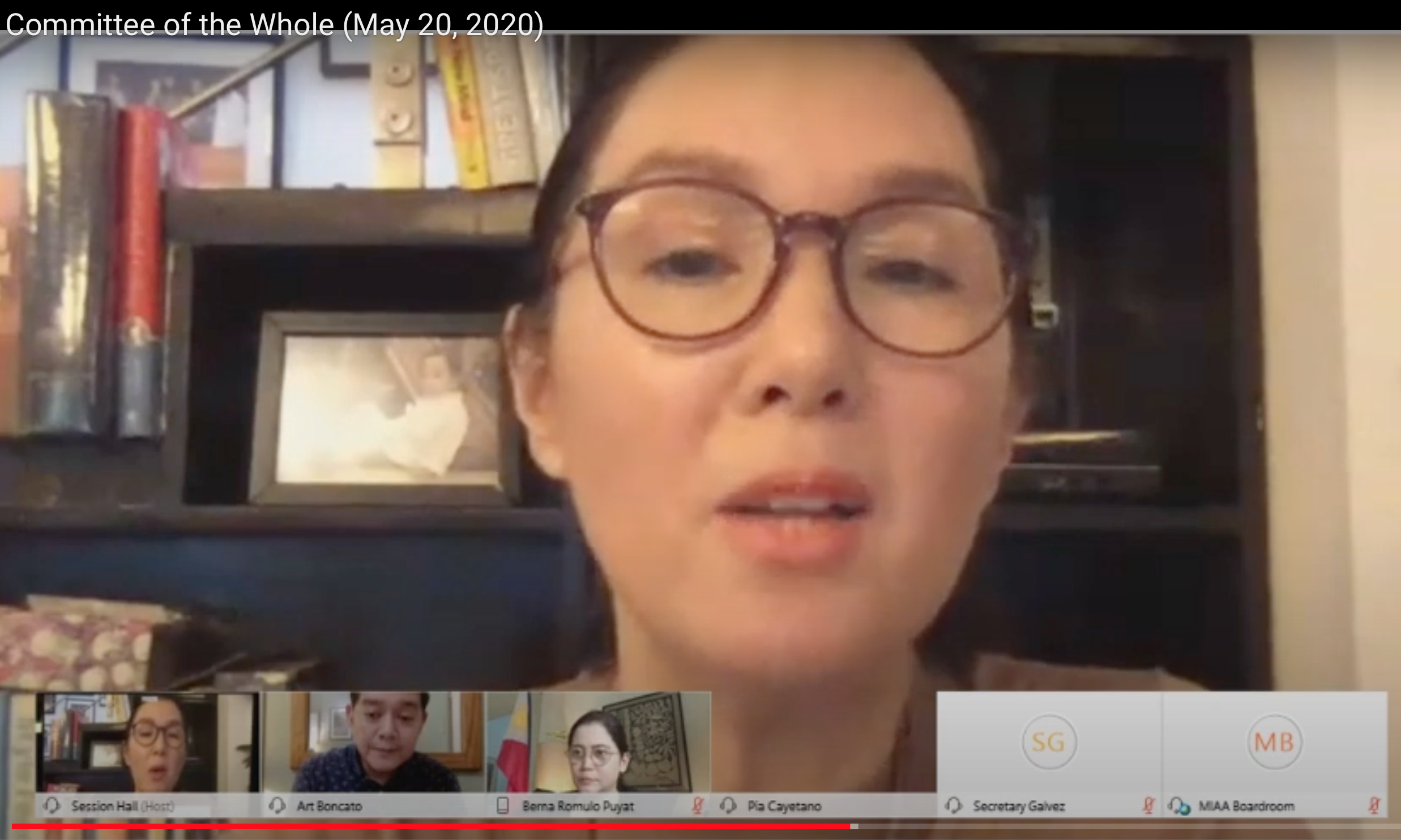
    During the second day of the Senate Committee of the Whole hearing on Wednesday (May 20), the senator urged the Department of Tourism (DOT) to come up with a clear set of guidelines for the tourism industry, which should be in line with national and global health standards.

    “The reality is, in order to get travelers and tourists to have confidence in our country, our health policies on COVID-related exposures should be consistent with what is set worldwide,” Cayetano said.

    The senator also asked the DOT to start finalizing the guidelines for local travels. She said any best practices we intend to replicate from other countries should be properly evaluated to make sure they are effective and suitable in the Philippine context.

    “There are practices out there that may be best for one country but not necessarily for ours. So we would like to know very specifically where any recommendation would come from so that we can assess. I know the pressure for our tourism sector to open up is there. I offer my support, but we also want to ensure that we keep safety in mind,” Cayetano noted.

    “Maybe [the DOT] can identify the safe activities to do [in particular tourist destinations]. You may come up with strict guidelines early on so that when the time comes, whether it’s 60 or 180 days from now, we can be more ready and we don’t have to debate on it anymore,” she added.

    As a response, DOT Undersecretary Art Boncato Jr. said the agency is set to roll out “omnibus revised tourism standards anchored on new normal standards, as espoused by the Department of Health and the World Health Organization, and also anchored on best practices all around the world.”

    This covers areas of accommodation, tourist transport, restaurants, hotels, and tour guides, among others. The common themes expected to be included in the standards are protocols on social distancing, deep sanitation, protective gear, as well as investments of tourism stakeholders in health plans both for their employees and their guests.

    In terms of accommodation, the DOT said it plans to mandate a maximum of double occupancy for all hotels. Restaurants, meanwhile, will be mandated to have a 50-percent occupancy for dine-in operations, Usec. Boncato said.

    Sen. Pia Cayetano to DOT: “Come up with strict guidelines early on so that when the time comes [to open up tourism], we will be ready.”
    File photo (2019): Senator Pia S. Cayetano meets with displaced workers of Boracay following the 6-month rehabilitation of the island, considered as the top draw of Philippine tourism.
  • Turn COVID crisis into an opportunity to shift to biking, walking, sustainable transport

    Senator Pia S. Cayetano is urging the government to view the current COVID-19 crisis as a ‘golden opportunity’ to push for a shift to sustainable forms of mobility and transportation, including biking, walking, and other non-motorized means.

    Cayetano stressed the point at the Senate Committee of the Whole hearing on Wednesday which tackled the status of government programs in response to the COVID-19 pandemic.

    “We now have this golden opportunity to fast-forward ourselves into the future that should have been part of our present, which is the use of sustainable modes of transportation, including walking, biking, and other non-motorized vehicles,” explained the senator, a biking advocate and triathlete.

    The senator said using a bicycle has particularly become essential for workers and frontliners because it offers a safe, efficient, and healthy mode of transport in the ‘new normal.’

    She further noted that the current state of the country’s public transport system could not possibly accommodate the huge volume of employees projected to go back to work following the shift to modified enhanced community quarantine and general community quarantine status of several regions, including Metro Manila.

    “We need more planning and coordination. [It is estimated that] 50-75 percent of the workforce can go back to work physically within a certain period of time. [But] there is no way that our public transportation, as it stands, can sustain them considering the [situation] we are in,” she explained.

    “That is why the messaging and the planning for this shift to a sustainable program for transportation must be considered carefully,” she added.

    In response, transportation secretary Arthur Tugade said his agency is ready to promote bicycles as an alternative means of travel during the new normal. He added that the Department of Transportation (DoTr) will submit to the Senate its detailed plan to implement this initiative.

    The chair of the Senate Committee on Sustainable Development Goals, Innovation, and Futures Thinking, Cayetano has filed three bills promoting sustainable modes of transportation in the country, namely the Sustainable Transportation Act (Senate Bill No. 66); the Bicycle Act (SBN 285), and the Safe Pathways Act (SBN 1518), which seeks to set up pop-up bike lanes and emergency pathways for the use of frontliners and essential workers during the pandemic.
    Meanwhile, Cayetano pressed various government agencies to fast-track the release of guidelines for the operation of public transportation, including the use of alternative modes of travel, in areas under community quarantine.

    The senator has called on agencies including the Department of Interior and Local Government and the DOTr to hasten the issuance of guidelines for the use of public transportation, especially in Metro Manila.

    “ [The plan] can elaborate what other agencies like DOLE and DTI, local government units, and groups directly working with companies can do to be more mindful of employees’ welfare while commuting to work,” Cayetano noted.

    She said employees whose workplaces are within the immediate vicinity of their communities, like 10 kilometers below, should be supported to be able to walk and bike comfortably to work.

    “We want to ensure that these people will be biking within a reasonable time, not three hours of biking per day. These are shifts made by other countries in the past. It requires a little bit more planning and rethinking. But this is the perfect time to do it,” she concluded.#

    Cayetano: “The messaging and the planning for this shift to a sustainable program for transportation must be considered carefully.”
    Cayetano: The COVID-19 crisis should be viewed by the government as a ‘golden opportunity’ to push for a shift to sustainable forms of mobility and transportation, including biking, walking, and other non-motorized means.
    Cayetano: “The current state of the country’s public transport system could not possibly accommodate the huge volume of employees projected to go back to work.”
  • Pia to DBM: don’t slash SUCs’ budget for infra dev’t

    Senator Pia S. Cayetano is imploring the budget department to ensure adequate funding for the infrastructure projects of state universities and colleges (SUCs) amid the urgency to realign government funds for the country’s COVID-19 response.
    The senator made the pronouncement on Tuesday (May 19) during the Senate Committee of the Whole inquiry into the government’s response to the coronavirus pandemic.
    “Just to put on record my concern for our budget of higher education. They are very underfunded to begin with, and we’re very slow to provide infrastructure funding for our SUCs,” Cayetano told Secretary Wendel Avisado of the Department of Budget and Management (DBM).
    “If we look at the record, we give them funds not on a continuing basis, but based on a request that they make, which takes many years to be granted. And then we do not give the succeeding funds because we say that the project is already fulfilled. But we know that they get one project at a time, if at all,” she lamented.
    The senator further stressed the need to prioritize education, saying that promoting innovations in higher education is essential in adapting to the ‘new normal.’ She added that supporting education is also aligned with the President’s directive to restart and accelerate the Build, Build, Build infrastructure program to reboot the country’s economy.
    “It is really a deep appeal that I have for the administration to consider this because it is a win-win [solution]. We know [that the administration is bent on accelerating] Build, Build, Build. So why don’t we also keep building on infrastructure needed for higher education? We hope that we can really make it happen,” she said.
    In response, Sec. Avisado assured Cayetano that the budget department will give prime importance to education in terms of budgeting.
    The senator filed last year Senate Bill No. 64 or the Build, Build, Build Program for Education bill (Public Higher Education Institutions Act), which maps out a five-year priority infrastructure plan for the improvement of facilities in tertiary education.
    She also filed SBN 62 or the ‘Educational Roadmap Act,’ which seeks to institutionalize an education roadmap that incorporates the needed skills and competencies that industries constantly look for in new graduates.
    The senator said by ensuring proper funding for the infrastructure needs of SUCs, the government will not lose track of delivering quality education under Sustainable Development Goal (SDG) 4 despite the pandemic.
    “Saan po ba manggagaling ang innovation natin kung hindi sa mga kabataan? Futures Thinking, which is a different way of thinking, is really a skill and an academic pursuit [that requires that our students have access to quality education.] So it is really something that I feel strongly about,” stressed Cayetano, chairperson of the Senate Committee on SDGs, Innovation, and Futures Thinking.
    The senator is promoting Futures Literacy among the youth to help the country prepare for future pandemics and other emergencies.
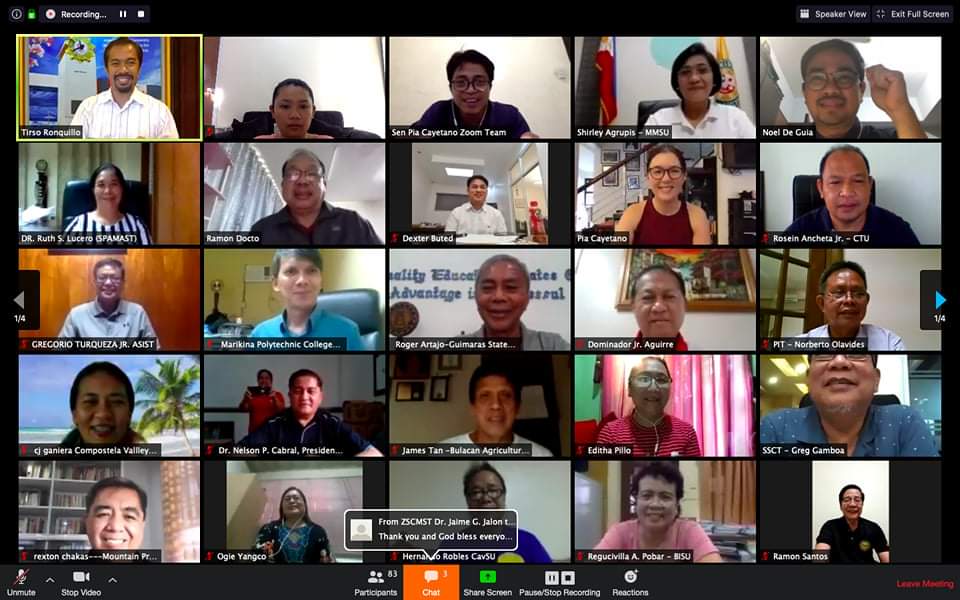
    Last May 2, Cayetano hosted a virtual consultation with more than 80 SUC presidents from the Philippine Association of State Universities and Colleges (PASUC) to listen to their concerns and recommendations in pushing for alternative learning systems for tertiary students during the ‘new normal.’ #
    Senator Pia S. Cayetano hosts a virtual consultation with SUC presidents from the Philippine Association of State Universities and Colleges (PASUC) to listen to their concerns and recommendations in pushing for alternative learning systems for tertiary students during the ‘new normal.’ (May 2, 2020)
    Postscript:
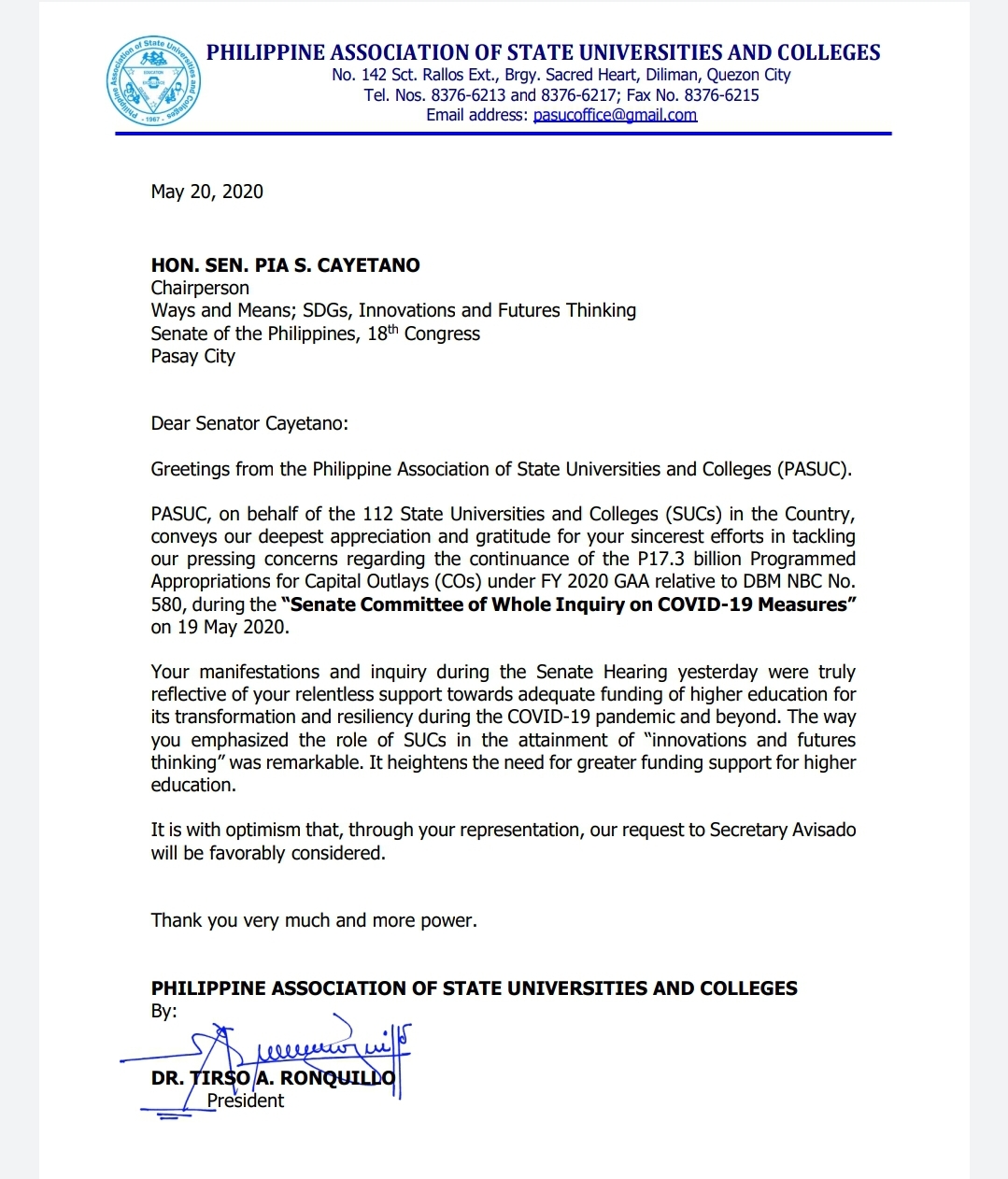
    In a letter dated May 20, the  Philippine Association of State Universities and Colleges (PASUC) thanked Senator Cayetano for her “efforts in tackling our pressing concerns regarding the continuance of the P17.3 billion Programmed Appropriations for Capital Outlays (COs) under FY 2020 GAA relative to DBM NBC No. 580.” 
    “Your manifestations and inquiry during the Senate Hearing yesterday were truly reflective of your relentless support towards adequate funding of higher education for its transformation and resiliency during the COVID-19 pandemic and beyond. The way you emphasized the role of SUCs in the attainment of ‘innovations and futures thinking’ was remarkable. It heightens the need for greater funding support for higher education,” read the letter signed by PASUC President Dr. Tirso A. Ronquillo.
    “It is with optimism that, through your representation, our request to Secretary Avisado will be favorably considered.”
    Letter of the Philippine Association of State Universities and Colleges (PASUC) thanking Senator Pia S. Cayetano for raising the issue of the infrastructure budget of SUCs at the Senate Committee of the Whole hearing on May 19.
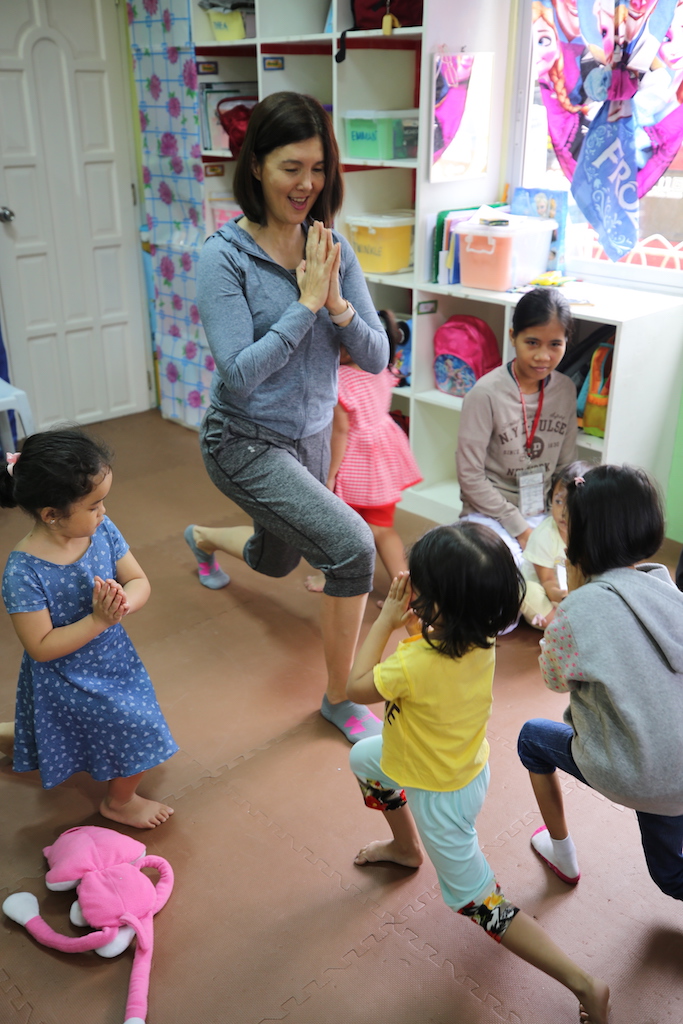
  • Don’t forget PE classes under ‘new normal’ curriculum

    Senator Pia S. Cayetano is pushing for the inclusion of Physical Education (PE) among the classes to be offered under the Department of Education’s (DepEd) proposed blended learning modalities for the ‘new normal.’

    “Physical well being is something we cannot simply set aside, especially in this time of COVID-19. We need to keep promoting physical education and regular exercise among our children,” Cayetano said.

    The senator made the statement on Thursday (May 14) at the virtual hearing of the Senate Committee on Basic Education, Arts, and Culture on the impact of the COVID-19 pandemic on the country’s education system.

    During the hearing, Cayetano urged DepEd officials to come up with innovative ways to ensure that PE subjects will continue to be taught to students and tailored for different grade levels.

    The senator pointed out that various media platforms, including television and the internet, can be used as tools for this purpose, being key components of blended learning. She added that students need not leave their homes to be encouraged to exercise.

    She suggested educational programs that promote regular exercise among children, as this could lead to many health benefits and potentially prevent respiratory illnesses.

    “Physical education does not have to take up too much space. Government channels can easily air these kinds of shows for students. There are many things that can be done. What matters is we do not disregard PE, and the need to teach our children the importance of taking care of their health while at home,” she added.

    DepEd, for its part, informed the Senate panel that it is in the process of coordinating with private sector partners in preparing downloadable videos that teach kids how to learn certain sports and other physical skills.

    Meanwhile, Cayetano also pressed DepEd to fast-track its plan to seek assistance from the Presidential Communications Operations Office (PCOO) in using government-run television and radio stations as platforms for delivering lessons during the pandemic.

    Tapping state-run channels, including PTV 4, to air educational shows for children was among the recommendations that the senator forwarded to the executive department following the President’s weekly reports to Congress.

    Cayetano said that she has repeatedly cited in the Senate’s weekly comments the need to use government TV stations to air educational shows. “The concerned agencies should be coordinating with each other about that by now… Can we get a follow up on that?” she asked DepEd, adding that the agency should take charge of deciding which types of programs PCOO would air in their channels.

    “We need to secure the best content for our students. There are many materials out there. But just like textbooks, these need to be filtered. In fact, my suggestions were very detailed to the effect that you have time slots for different age groups: from preschool- to college-level programs,” she noted.

    DepEd then assured the panel that it is now finalizing specific strategies to make this proposal possible, including converting educational materials into scripts for TV- and radio-based instructions.

    Finally, Cayetano reiterated the need to adopt a Futures Thinking approach in addressing the challenges in basic education, following the disruption caused by COVID-19.

    “We have to look into [all possible] futures. This really requires long-term planning, and it never happens at the level that we are discussing it if we are always in the now. That is precisely why I funded the Futures Thinking division in DepEd so that we can plan in this way,” said Cayetano, who chairs the Senate Committee on Sustainable Development Goals, Innovation, and Futures Thinking.

    “This is not just for June. This is not for the opening of classes, this is for the long-term quality of our children’s education,” she added. #

    Cayetano urged DepEd officials to come up with innovative ways to ensure that PE subjects will continue to be taught to students and tailored for different grade levels.