Official Website of Philippine Senator Pia Cayetano

Category: Health

  • Cayetano raises Sin Tax revenue concerns in Universal Healthcare Interpellation

    Cayetano raises Sin Tax revenue concerns in Universal Healthcare Interpellation

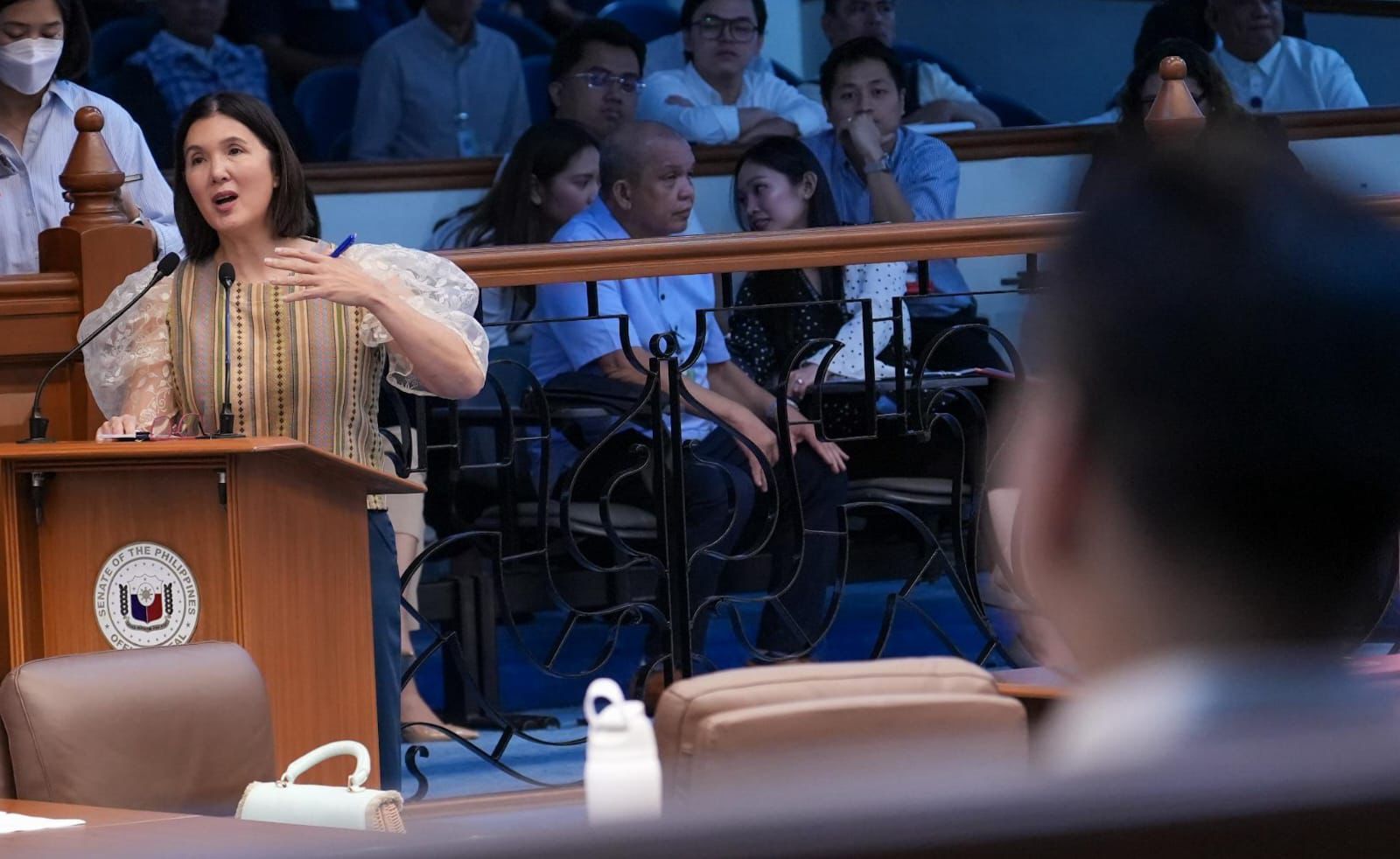
    Senator Pia S. Cayetano, in her interpellation on Sen. JV Ejercito’s privilege speech on the Universal Healthcare program, explained how the risk-sharing scheme under PhilHealth’s YAKAP package works. She explained how P1,700 per person is pooled for an entire community and spent according to members’ varying health needs, “similar to how an HMO works.” The senator also cited the model of a U.S.-based HMO, Kaiser Permanente, which rewards members for engaging in healthy activities, noting that “the aim is to keep people healthy before they become patients.”

    FInally, Cayetano raised the failure to appropriate the earmarked sin tax revenues to PhilHealth. “For 2025, P69.81 billion ang sin tax collection para sa PhilHealth, pero ang pumasok sa GAA is zero,” she said, adding that she will file as an intervenor in the pending Supreme Court case. “Kaya natin inearmark yon dahil nga yung mga bisyo na nakakasama sa tao, sana man lang may nakukuha doon pambayad sa gamot nila. Tapos hindi natin nakukuha.”

  • Public health wins in SC decision upholding FDA’s authority

    Opening statement of Senator Pia Cayetano
    News conference with health advocates
    24 June 2022, Philippine Senate

    I am delighted to talk about this landmark Supreme Court (SC) decision that is very science-based and upholds the right of Filipinos to health.

    And this decision is the case (GR 2200431) where the SC ruled that the Food and Drug Administration (FDA) has the power and the authority to regulate cigarettes.

    This decision of the SC is so relevant because when I worked on the FDA law (RA 9711) – that was 2009 in the 14th Congress, and I was just on my fifth year as a senator – I was already fighting that the FDA should regulate all products that affect health, kasi yun ang definition sa FDA Law. ‘Health product’ refers to any product that may have an effect on health. In 2009, pinaglalaban ko na yun.

    Fast-forward to this Congress, in the last six months prior to the campaign period, pinaglaban ko na naman, because of this new product called the e-cigs and the vapes. In-explain ko na ang health products, as defined by law, is anything that affects health. And the example I gave, sabi ko shampoo, conditioner, insect repellant, lotion, cosmetics, food products – lahat yun nire-regulate ng FDA. So, dapat ang vapes and e-cigs, i-regulate din.

    And now, the SC has upheld basically that principle – that if it is a product that affects your health, the FDA should regulate. So talagang nagpapasalamat ako na after all these years, this law can now be implemented.

    (more…)

  • SC landmark ruling a victory for Filipinos, youth

    By Senator Pia S. Cayetano

    • Principal sponsor, RA 7911
    • Intervenor, GR 200431 (DOF and FDA as petitioners, Cayetano and Drilon as petitioners-intervenors vs. Philippine Tobacco Institute, Inc. as respondent)

    The Supreme Court just affirmed the right of every Filipino to good health by upholding the power of the Food and Drug Administration (FDA) to regulate cigarettes and tobacco products. This is a major victory for our people and advocates for tobacco control and public health.

    Thirteen years ago, I sponsored and defended what became the FDA Act of 2009. RA 9711 mandated the FDA to regulate all products affecting health, including cigarettes and tobacco. The tobacco industry rejected FDA’s authority, and went to court to prevent the FDA from regulating them.

    The health hazards of tobacco cannot be denied, and are backed by strong medical evidence. It is common sense that these products be subjected to strict regulation by a competent health authority.

    After a long judicial process, the SC has ruled in our favor by affirming FDA’s jurisdiction over cigarettes and tobacco products. As principal sponsor of RA 9711 and later, as an intervenor in this case along with Sen. Franklin Drilon, I laud our SC for this landmark decision.

    This win is for the Filipino people and will benefit future generations. It may have taken 13 years, but it’s these victories that remind me to keep fighting the good fight. It’s what makes my job worthwhile.

    This triumph wouldn’t have happened without the guidance and support of my fellow health advocates, including the late health secretary, Dr. Alberto ‘Quasi’ Romualdez.

    (more…)

  • Pia sponsors bill creating PH’s own CDC

    Creating the Philippine Center for Disease Control and Prevention

    Sponsorship speech by Senator Pia S. Cayetano

    February 2, 2022

    Mr. President, distinguished colleagues, I rise today to sponsor Senate Bill No. 2505, under Committee Report No. 586, entitled ‘An Act Creating the Philippine Center for Disease Control and Prevention, Defining its Powers and Functions, and for Other Purposes,’ which is the output of the Sub-Committee on the Center for Disease Control that I chaired.

    This measure is also known as the Philippine Center for Disease Control and Prevention (CDC) Act.

    Mr. President, it’s been two years since the country recorded its first COVID-19 case. During those two years, we have realized the importance of strengthening our healthcare system, to protect Filipino families from existing and emerging health emergencies that pose a threat to their lives.

    If there’s one lesson we learned from this pandemic, it’s the importance of being more prepared for other future crises, including the possibility of another pandemic. According to the Center for Global Development, there is a 47-57 percent chance of another global pandemic as deadly as COVID in the next 25 years.

    This bill particularly seeks to establish the CDC, an agency under the Department of Health that will act as the technical authority on forecasting, preventing, controlling, and monitoring communicable and non-communicable diseases in the country.

    Through this measure, we aim to adopt a framework that fosters a whole-of-system, whole-of-government, and whole-of-society approach that would streamline science-based decision-making, especially during public health emergencies.
    The CDC shall have different established centers that shall lead and coordinate the agency’s major functions. These are as follows:

    •The Center for Health Statistics
    •The Center for Surveillance and Epidemiology
    •The Center for Health Evidence, and
    •The Center for Reference Laboratories.

    These centers shall be created through the harmonization of functions and reorganization of the existing offices and units within the DOH.

    Mr. President, globally, nations are scrambling for solutions to end the pandemic and defeat the virus. But COVID is not the only health threat out there.

    As the Chairperson of the Senate Committee on Sustainable Development Goals, Innovation, and Futures Thinking, it’s my duty to ensure that we are on track with our targets under the SDGs, including SDG 3 on Good Health and Well-being. One of the targets under SDG 3 is to strengthen the capacity of all countries, in particular developing countries, for early warning, risk reduction, and management of national and global health risks.

    Now more than ever, we need to invest in our healthcare system to prepare us better for other possible health emergencies, and to help us build a more sustainable future beyond COVID-19.

    And this, we ask for our colleagues’ support, Mr. President, for this urgent and most important measure. Thank you, Mr. President. #

    A woman senator
    In her sponsorship of the proposed Center for Disease Control and Prevention (CDC) Act, Senator Pia Cayetano stressed the need to invest in the healthcare system to prepare the country better for public health emergencies, and to help build a more sustainable future beyond COVID-19.


  • Unmasking the Vape Bill

    Vape bill protects the interest of industry, not people

    Manifestation on the Senate’s ratification of the bicameral conference committee report on the Vape Bill

    By Senator Pia S. Cayetano

    January 26, 2022

    Mr. President, the bicameral report was read past 9:00 pm last night. And as I manifested, it was not on the agenda and therefore, I was not aware that it was going to be taken up. And I had then said that I would make my manifestation today, because at that point, it was already ratified by the time I logged on. Traditionally, we are allowed to ask the sponsor questions during the report on the bicam. But as I said, since it was already ratified, I will simply make my manifestation:

    I recognize the efforts that the sponsor put into this measure. Unfortunately, it is a version that supports the industry and not the Filipino people. More than 60 health associations and civil society organizations, the Department of Health, and former health secretaries have strongly opposed this measure. In fact, time and again, since December, they have called for the veto of the measure.

    For the record, during the sin tax debates in this Congress, there were colleagues and even health professionals calling for the banning of these products. But we decided to regulate the same provided that key safeguards were put in place. Those 3 key safeguards are the following: 1) FDA regulates, 2) age of access is 21 and 3) limiting the flavors to plain tobacco and plain menthol.

    Barely a year after the Sin Tax was passed, the Senate started to tackle the subject bill. This measure included Senate Bill No. 2099, which I filed, and other bills that were originally referred to the Committee on Health, and yet these bills were transferred to the Committee on Trade, which went on to tackle the same.

    Included in this (Committee Report) were provisions that overturned the safeguards in the Sin Tax Law. And sadly, they were passed by the Senate and carried in the bicam, which are the following:

    1. Exclusive jurisdiction transferred to DTI
    2. Age of access lowered to 18
    3. No key restrictions on flavors

    Here are the details.

    On the first point, DTI, a trade agency, that has nothing to do with the healthcare of people, is given the exclusive jurisdiction over any and all issues, requirements, and subject matters related to e-cigs. Based on their mandate, DTI is responsible for investments and export promotion, industry development, and MSME development. As I have said, and will not tire of saying, nowhere in their mandate does it say that the DTI can determine the health effects of products, let alone vapor products, which are detrimental to public health. Even the industry cannot say… Thousands of flavors were rejected by the US FDA. Does the DTI have the political will or the expertise to do the same? To reject flavors that will be proposed to be carried in the market? We know very well that their mandate is to promote business. I submit that they will not have the political will nor the capacity to regulate the flood of flavors that we will be exposed to and our young children.

    On the second point, the minimum age of sale and purchase is now pegged at 18 years of age. These products will now be accessible even to senior high school students. According to experts, the brain continues to mature until the age of 25, and that early exposure to nicotine through vapor products could impair the brain’s development.

    On the third point, other flavors are still allowed. Despite the restrictions on the descriptors, we know very well that the wide array of flavors will make the product more attractive especially to the youth.

    So those are the 3 main points, your honor, that were carried in the bicameral report that we continue to oppose. Changes in the bicam report that further relax regulation on e-cigs. These are but a few examples, your honor:

    Sponsorships are now allowed even beyond industry associations and trade events.

    In the version of the Senate, which was our proposal, originally sponsorships were only limited in industry associations and trade events. This was our specific amendment to address events being targeted to all and not just to those who are already within the vaping industry. Now, it will be open to all.

    It also allows companies to conduct corporate social responsibility related activities. Mr President, under the WHO Framework Convention on Tobacco Control, Principle 6, Corporate Social Responsibility activities should be prohibited. We are now in clear violation of an international agreement that we have historically honored.

    Let me end with this Mr President.

    As we honor and throw our support behind the efforts of our health workers with the right hand, with our left hand, we are giving a free pass to a line of products that directly affects our health. It boggles the mind that as we deal with over 5.63 Million deaths around the world and more than 53,000 deaths in the Philippines due to COVID, we allow this industry to promote their products touted as a lesser evil by the industry and its proponents.

    I will not be a party to a bill that is masquerading as a health regulation. As I said, over 60 health associations and civil society organizations, the Department of Health, and former health secretaries have expressed strong opposition to this measure and continuously warned us about these products and the need to regulate the same by the one agency tasked by our laws, to ensure that products that affect our health are regulated. That is the FDA. Not the DTI.

    Once again, I must state for the record that I disassociate myself from this measure. Thank you, Mr. President. #

    “I will not be a party to a bill that is masquerading as a health regulation,” stressed Senator Pia S. Cayetano as she manifested her opposition to the bicameral version of the Vape Bill that was adopted by the Senate.

  • Uphold FDA’s regulatory authority over vapes, heated tobacco products

    Senator Pia S. Cayetano has called on her colleagues in the Senate to uphold the Food and Drug Administration (FDA)‘s jurisdiction to regulate vapes and heated tobacco products (HTPs) in the market, saying that the agency’s mandate to protect public health is firmly established in two laws previously passed by Congress in 2020 and 2009.

    In her interpellation on the controversial Vape Bill (SBN 2239) last week, Cayetano questioned the bill’s objective to transfer the government’s regulatory power over vapes and HTPs from the FDA to the Department of Trade and Industry (DTI).

    Explaining the coverage of health products under the FDA’s jurisdiction, Cayetano noted that the FDA Law of 2009 included “health-related devices,” which refer to “any device not used in health care, but has been determined by the FDA to adversely affect the health of the people.” (Section 9-C of RA 9711).

    “I think it is quite clear that in his previous statements, when his honor says that this product [e-cigarette] is ‘less harmful,’ then that is already an admission that it is a product that has health effects. Because why would you even mention the words ‘more harmful.. less harmful,’ if it’s not a health-related product?” Cayetano asked the bill’s sponsor, Sen. Ralph Recto.

    “Moreover, if lotions, creams, and perfumes applied on the skin and other cosmetic products that come in contact with external parts of the body are regulated by the FDA, then what more for e-cigarettes, which are inhaled  by its users, sending harmful chemicals to the lungs and internal organs?” the senator further asked.

    She also noted that under the Sin Tax Law of 2020, the FDA is clearly mandated to regulate, consistent with evolving medical and scientific studies, “the manufacture, importation, sale, packaging, advertising, and distribution of vapor products and heated tobacco products,” including the “sale to nonsmokers or persons below twenty-one (21) years old.” (Sections 144-B and 144-C of RA 11467)

    In addition, she said that the FDA Law declared as policy that the State shall “protect and promote the right to health of the Filipino people,” and “help establish and maintain an effective health product regulatory system based on the country’s health needs and problems.” (Sections 3-A and 3-B of RA 9711)

    The senator pointed out that Sen. Recto’s statements that e-cigarettes are ‘less harmful’ than conventional cigarettes amounted to a health claim, and an admission that these products are indeed ‘health-related devices’  that clearly fall under FDA’s jurisdiction as mandated by RA 9711.

    Cayetano’s interpellation on SB 2239 is scheduled to resume this week.#

    Senator Pia Cayetano
    Solid legal ground: Senator Pia Cayetano says that FDA is mandated to regulate e-cigarettes by virtue of RA 11467 and RA 9711.

  • Pia: POGO Tax Law to raise funds for healthcare, SDGs

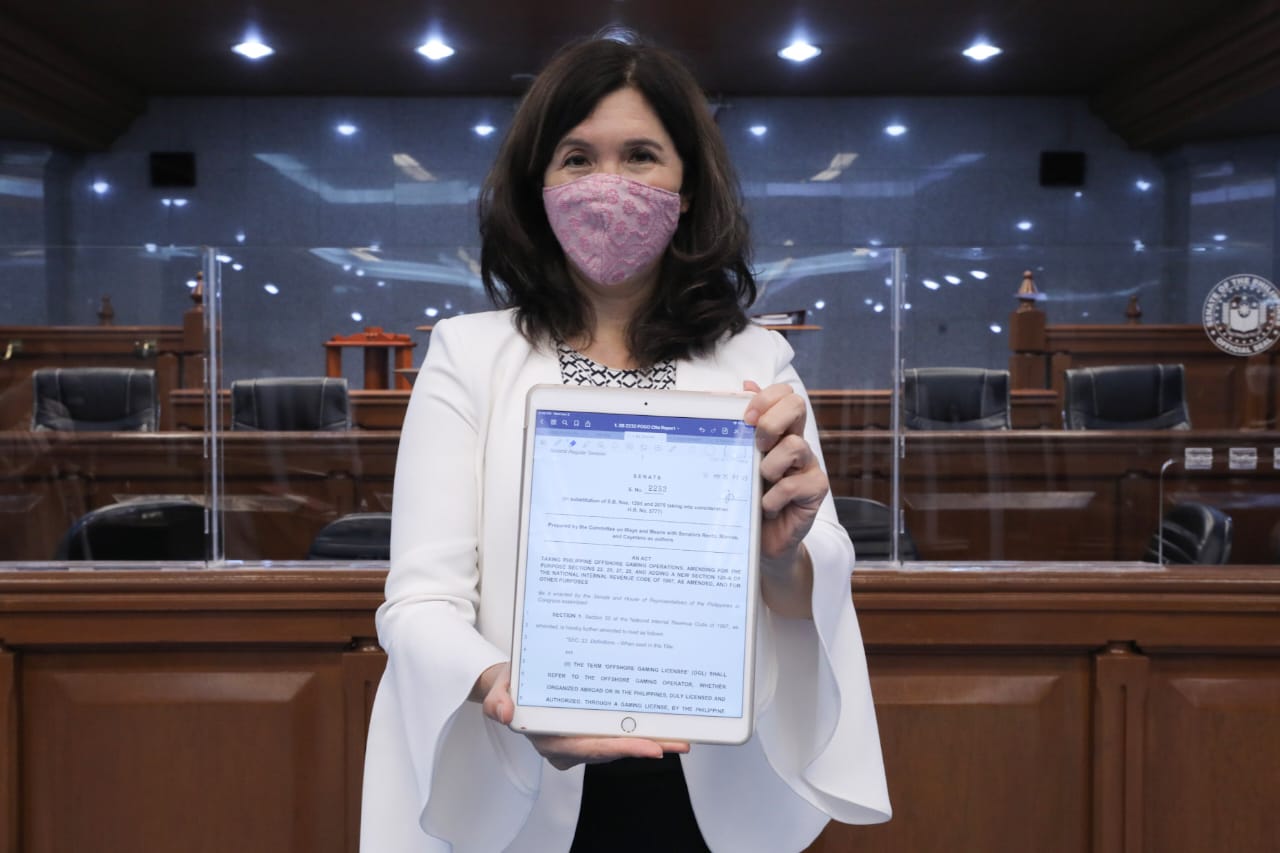
    Senator Pia S. Cayetano today described Republic Act No. 11590 – the newly signed law taxing Philippine Offshore Gaming Operations (POGOs) – as a ‘major win’ for the country because it will generate billions in additional funds for public services, but without burdening Filipino taxpayers.

    “For years, many of these POGOS have been operating without paying the proper taxes. By virtue of this law that I sponsored and defended, they will now be taxed,” said Cayetano, chairperson of the Senate Ways and Means Committee and principal sponsor of the POGO Tax Law.

    “POGOS are offshore gaming operators. That means only foreigners abroad may gamble in POGOs. So the taxes do not come from Filipinos, or even foreigners residing in the country,” she explained.

    “I’d rather tax the POGOs than see a proliferation of gambling in the country, which sadly seems to be the direction that our colleagues in the House are taking with the recent passage of a bill allowing online gambling,” she emphasized.

    She further noted that under the new law, 60 percent of total revenues from the gaming tax imposed on offshore gaming companies will be earmarked by the government, and allocated for the following purposes:

    •60% for the implementation of the Universal Health Care Act;
    •20% for the Health Facilities Enhancement Fund; and
    •20% for the attainment of the SDGs, provided that the specific SDG targets shall be determined by NEDA.

    “We made sure that the revenues from POGOs will be earmarked for much-needed health programs amid the pandemic, and contribute to the attainment of our Sustainable Development Goals (SDGs),” added the senator, who also chairs the Senate Committee on the SDGs, Innovation, and Futures Thinking.

    Based on estimates of the Department of Finance (DOF), Cayetano said RA 11590 is projected to generate P22.9 billion in 2022, through the 5 percent gaming tax imposed on the gross gaming revenues of POGO licensees.

    In addition, the government is expected to collect P9.2 billion in 2022 from the 25 percent final withholding tax imposed on foreign POGO employees.

    Combined, she said the total projected revenues from RA 11590 would amount to P32.1 billion in 2022. #

    Senator Pia Cayetano
    Senator Pia Cayetano at the Senate session hall

  • On the proposed budget of DOH & attached agencies

    Mr. President, it is my honor to take on the herculean task of sponsoring the budget of the Department of Health and its attached agencies, including PhilHealth.

    Our country’s people are its biggest resource. Thus their health should be a priority. COVID-19 pandemic has exposed gaps in our country’s healthcare and response system. As we deliberate on our national budget, our vision should be geared towards closing these gaps.

    Investments in healthcare should help us build back better, guided by the principles of sustainable development and futures thinking.

    This requires that we focus and further strengthen Primary Health Care, pursuant to the principles of the Universal Health Care Law.

    These initiatives also form part of the country’s commitments under SDGs, [particularly] SDG 3 (Good Health & Wellbeing).

    Mr. President, I thought it wise, and in my interest to save time, I would like our colleagues to take note of some of the facts and data that I will share now because they may be relevant to the questions you may ask. So I will spread it on the record now.

    On the COVID-19 Vaccines:

    According to the World Health Organization, at least 60-70% of the population needs to have immunity to break the chain of transmission. This means around 65 million Filipinos (60% of our current population) need to be vaccinated.

    At present, the Department has identified priority groups of around 24M vulnerable Filipinos, which make up around 20% of our population. This includes frontline health workers, senior citizens, indigent population, and uniformed personnel.

    They also have a tier 2 of priority, but this is 20%. Why do I mention 20%? Because as I will explain a little bit more later in the course of interpellation, since we are part of the COVAX, we have the assurance of getting vaccines for 3-20 percent of our population.

    So how much do we have to allocate to cover these priority groups? Based on the costing of DOH, we need to allocate at least Php 15 billion if we purchase Aztrazeneca vaccine, which is the cheapest at around Php 610 per person. Or on the other extreme, Php 436.3B for the Sinopharm vaccine, which is the highest priced at around Php 17,690 per person for two doses, while the others fall in between. For the record, may vaccine na ganoon kamahal. The other vaccines fall in between.

    Experts recommend that we purchase from various suppliers. Why? Well, given that there may be possible side effects, we would rather spread out our risk throughout the population and minimize the chances that we are all exposed to one particular vaccine and any particular side effects they have. For the record, I am a vaccine advocate. And lahat naman meron, hindi naman ho tayo pwedeng matakot sa side effects, pwedeng masakit ang ulo, pwedeng ano pa man. Normal naman po yun, huwag lang ang masama at malalang side effect.

    It cannot be overemphasized that these amounts only cover the cost of vaccines and do not include consumables and other logistics that go into delivering the vaccine to the individual that needs it.

    Apart from the vaccines, there are other expenses:

    Cold Chain or Supply Chain, which keeps vaccines in tightly controlled temperatures before administered to a person; Training & PPEs for vaccinators; Needles, syringes & other critical equipment.

    These are things that have to be purchased in advance, considering that the entire world is also trying to get hold of them during this global crisis. Take for example syringes. I am told that we do have a manufacturer here in the Philippines in one of our industrial zones. But their entire production is already committed to Japan. So paano? Sayang, ano? We are making it here pero hindi tayo makakuha. I think magiging available daw after six months. So pwede, baka pwede din tayong pumila for that second batch of syringes.

    But, there’s also another company that manufactures syringes, and they are waiting for us to communicate and negotiate with them so we can get hold of this most important component in the vaccination process. I don’t think that we have started this process yet, Mr. President.

    Further, considering that the DOH may not be equipped to handle the Supply Chain requirements of COVID-19 vaccines, the government should be outsourcing, discussing, negotiating with private companies that are already equipped to handle such vaccines. Wala naman hong masama na magtulong-tulong tayo. Whole-of-society, whole-of-nation dapat ang approach natin.

    Meanwhile, aside from the vaccine, there is progress being made in therapeutic medicines that can be used for COVID infected persons. We should also pay attention to this because COVID-19 will not disappear right away. So meanwhile, the development of these therapeutic medicines is also important, and we should continue the ongoing WHO Solidarity Trials for these therapeutic medicines.

    As Vice Chair of the Finance Committee handling the budget of our health sector, we have also taken on the task of defending PhilHealth’s budget.

    Philhealth  has been the subject of many investigations, including the one recently conducted by the Senate. We are cognizant of our fellow senators’ concerns on the need to address PhilHealth’s inefficiencies and alleged fraudulent actions.
    Nevertheless, we are ready to defend its proposed budget for the next year, with the vision towards the full implementation of the UHC Law to benefit all Filipinos, but mostly those who have less in life.

    One of their biggest budgetary needs is the funding of Konsulta – the outpatient package. This representation has been awaiting the roll-out of such a package for years. Health experts agree that a sustainable  health system must focus on preventive health care, not a hospital care type of package, which is what Philhealth is all about right now. Preventive health care is not only much cheaper, it is more efficient. Most ailments can be treated with lifestyle modification, possibly medicines and home rest, instead of expensive hospital stays.

    But despite my full support for outpatient care, at its present stage, we do not believe that Philhealth is ready to roll out a P68.8-billion plan. Much ground work needs to be done before launching.  Instead we recommend pilot testing so that a year from now, Philhealth can present to us more details and we would be in a better position to grant the same

    So for the actual budget breakdown:

    -The budget of DOH (Office of the Secretary) and its attached agencies for fiscal year 2021, with a total budget of Php 212,732,450,000, broken down as follows:

    -DOH OFFICE OF THE SECRETARY with total new appropriations of Php 136,086,935,000. This is Php 35 Billion higher than the 2020 GAA amount, but Php 25 Billion lower than the adjusted 2020 budget considering Bayanihan 1 and 2.

    -DOH’s ATTACHED AGENCIES AND CORPORATIONS, including:

    -NATIONAL NUTRITION COUNCIL (NNC) with total new appropriations of Php 488,021,000

    -PHILIPPINE HEALTH INSURANCE CORPORATION (PHILHEALTH) with total new appropriations of Php 71,353,360,000

    -LUNG CENTER OF THE PHILIPPINES with total new appropriations of Php 504,997,000

    -NATIONAL KIDNEY AND TRANSPLANT INSTITUTE with total new appropriations of Php 1,272,442,000

    -PHILIPPINE CHILDREN’S MEDICAL CENTER with total new appropriations of Php 1,094,375,000

    -PHILIPPINE HEART CENTER with total new appropriations of Php 1,787,827,000; and

    -PHILIPPINE INSTITUTE OF TRADITIONAL AND ALTERNATIVE HEALTH CARE with total new appropriations of Php 144,493,000

    Dear colleagues, we hope to continue working with all of you in passing a budget that can support the health needs of our people and plug the gaps, which have also given rise to inefficiencies and could possibly lead to patterns of fraud within the healthcare system.

    Maraming salamat. I am now ready to accept questions.#
  • Pia bats for ‘hospital loops’: Prioritize bike lanes to protect frontliners

    Senator Pia S. Cayetano is supporting a proposal that would prioritize the establishment of pop-up bicycle lanes and emergency pathways in roads connecting to hospitals, which will serve as safety loops for healthcare workers and frontliners reporting for work during the COVID-19 pandemic.


    The Senate Committee on Sustainable Development Goals, Innovation, and Futures Thinking conducted a hearing on Thursday (May 28) to discuss proposals seeking to promote sustainable modes of transportation in the country, including biking, walking, and non-motorized transportation or NMTs.

    “We need to protect the people who protect us. I want to help address this need to establish safe pathways for our frontline workers.”


    Dr. Antonio Dans, a professor at the University of the Philippines’ College of Medicine, made an appeal to government agencies to prioritize building a “loop” of bikeway systems that would link roads along several hospitals in Metro Manila.

    Dr. Dans: Healthcare workers are in a “special situation” since they need to practice more safety precautions and social distancing measures in the time of COVID-19.


    “My appeal is when we build these loops [of safe pathways], we think of our healthcare workers,” Dr. Dans said, noting that healthcare workers are in a “special situation” since they need to practice more safety precautions and social distancing measures in the time of COVID-19.


    “Since we are [already] thinking about how to build these [bike lanes and walkways], maybe we can start in areas near hospitals to improve frontliners’ access [to their places of work],” he added.


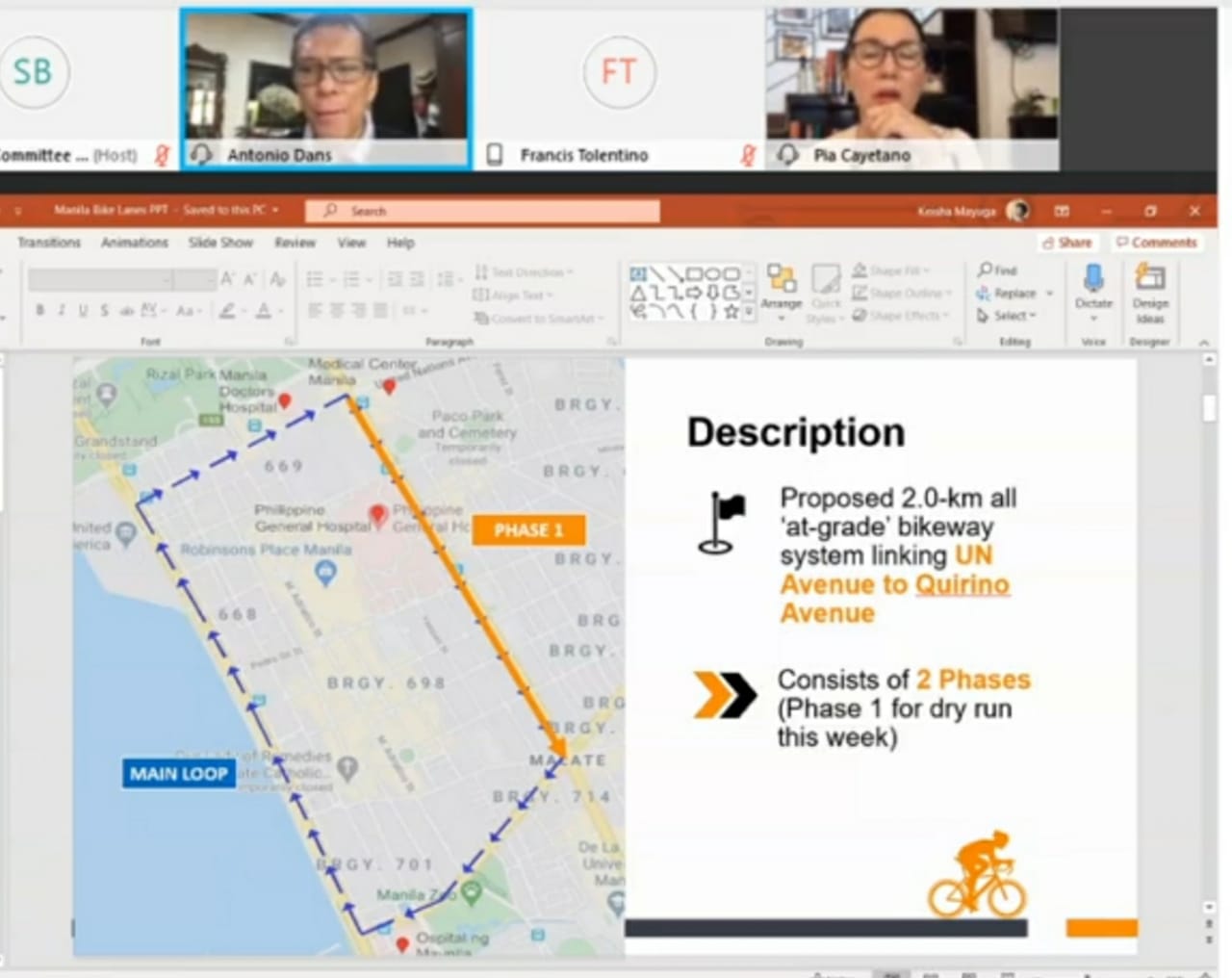
    The proposal seeks to benefit frontliners working in four hospitals in Manila: the Philippine General Hospital (PGH) along Taft Ave., the Ospital ng Maynila Medical Center along Quirino Ave., and the Manila Doctors Hospital and Manila Medical Center, both along United Nations Ave.

    The 6-kilometer hospital bicycle loop proposed by Dr. Tony Dans.


    The six-kilometer loop shall serve as a “safe haven” to ensure frontliners’ safety while going to work on their bikes. Dr. Dans said nearly a quarter of PGH’s hospital staff have requested for bicycles as their access to work had been limited due to the cancellation of public transport.


    “We hope that our policymakers, the local government units (LGUs), and even officials at the executive branch, would give us this option to get to work safely during the COVID-19 crisis and after,” he said.


    Cayetano, for her part, expressed her full support for the proposal, stressing that priority should really be given to initiatives that would ensure the safety of all frontliners who are leading our fight against the virus.


    “We need to protect the people that protect us. I want to help address this need to establish safe pathways for our frontline workers,” she stated, adding that similar hospital loops can be allotted in areas with a big concentration of hospitals like Quezon City.


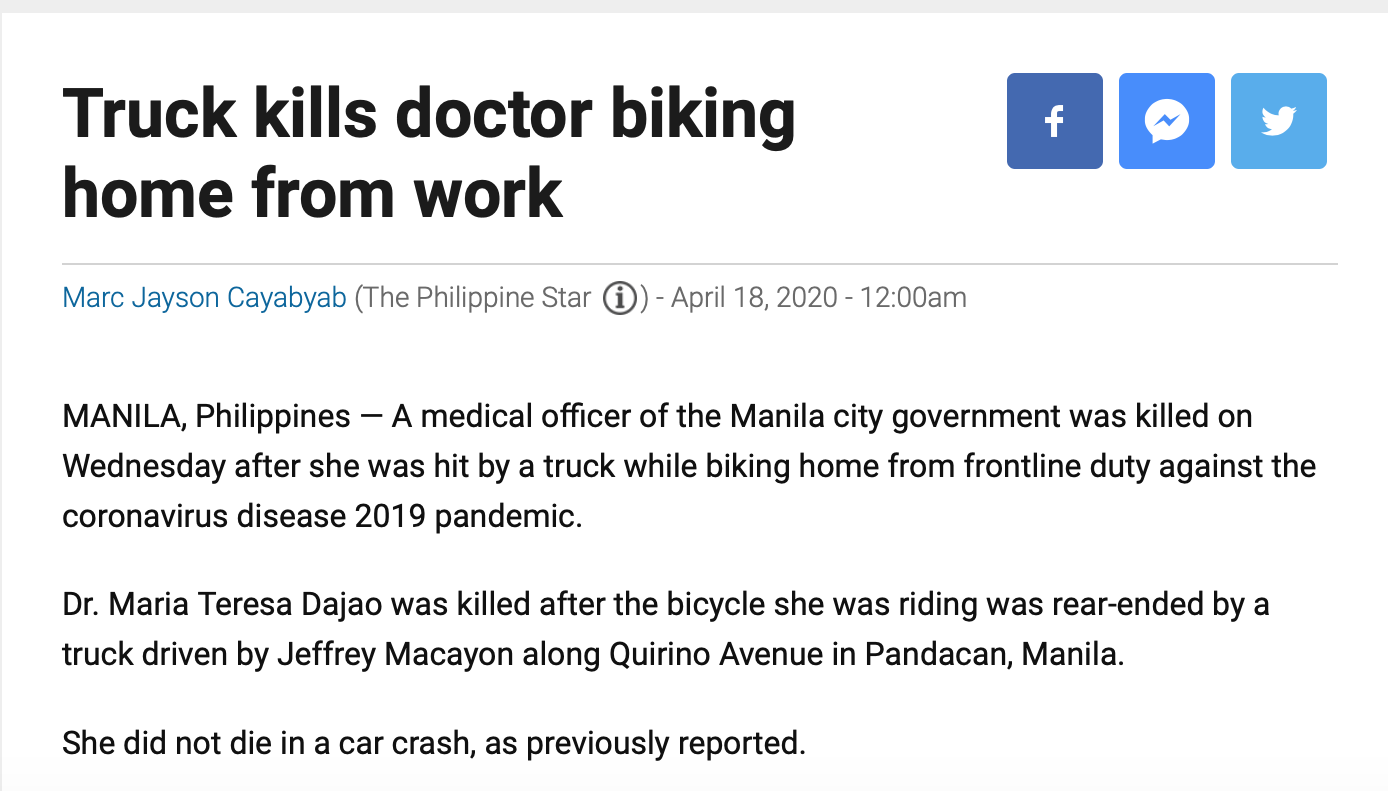
    It should be recalled that last month, Dr. Maria Teresa Dajao, a medical officer of the Manila city government, was killed after she was hit by a truck while biking home from frontline duty.

    Screengrab from the Philippine Star website

    Cayetano recently filed Senate Bill No. 1518 or the “Safe Pathways Act,” which shall create a network of pop-up bike lanes and emergency pathways to connect people to essential destinations during the pandemic, all while ensuring that physical distancing is maintained.


    She earlier said that the bill’s primary objective is to provide safe spaces and priority lanes for frontliners going to work through biking or walking. Some of these pathways may even directly lead to hospitals, Cayetano had earlier explained.


    “We want to be able to protect all of our frontliners; even the hospital staff exposed to admin work and cleaning services, the security personnel, the barangays workers, and so on. We need to keep finding ways to keep them all safe, which also means keeping our roads safe for them to travel on,” the senator said.


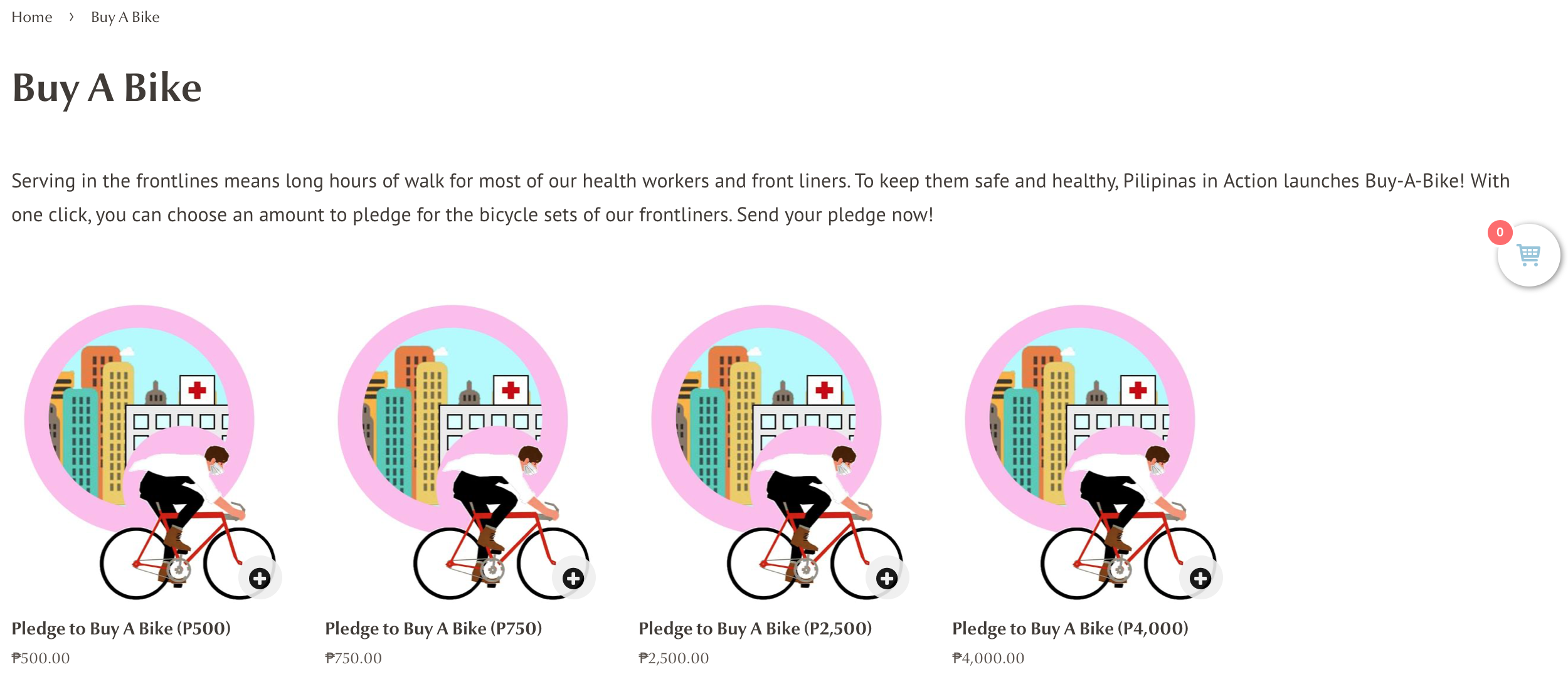
    Apart from her legislative work, Cayetano had started the Pilipinas In Action initiative, which recently launched the “Buy A Bike” project where donors can pledge for bicycle sets to be donated to COVID-19 workers. The initiative was able to donate bikes to PGH staff, in coordination with Dr. Dans.

    Screengrab from pilipinasinaction.ph


    Meanwhile, the senator also commended the PGH for its plan to construct its own bike parking lot for employees.


    “We really have to be able to promote these sustainable modes of transportation in the country with the right infrastructure. We should seize this moment brought about by the crisis to foster this change now,” said Cayetano, who is also the principal author of the National Bicycle Act (SBN 285), and the Sustainable Transportation Act (SBN 66). #


  • Statement on Inquirer reporter’s tweets

    “Never let a good crisis go to waste.” – Winston Churchill

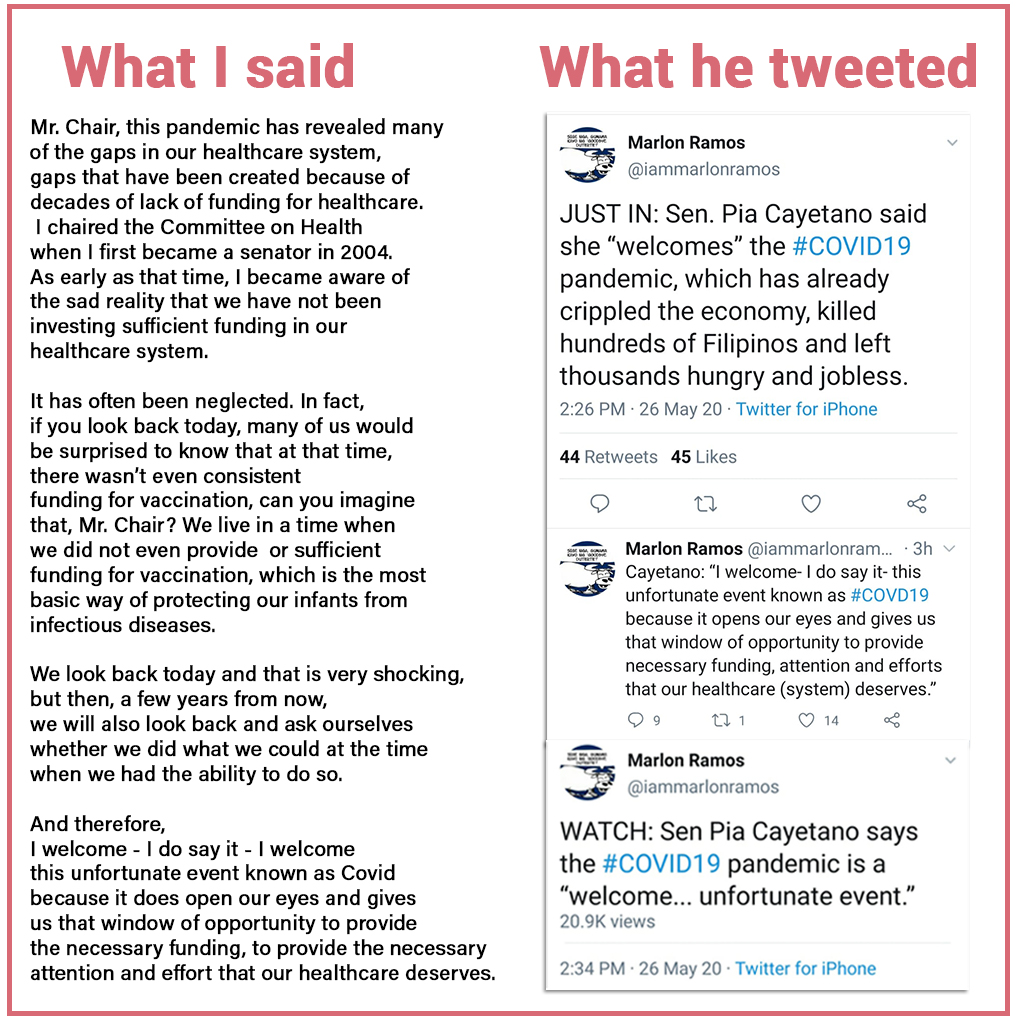
    I call out Mr. Marlon Ramos of the Philippine Daily Inquirer for his irresponsible & unethical tweet, wherein he twisted a statement I made during this morning’s Senate Committee on Health hearing.

    During my manifestation, I was explaining how urgent the health bills I filed were and was giving context by saying that historically, health infrastructure and health needs were not prioritized. But this time of COVID-19 opened people’s eyes and gave us the opportunity to use the crisis to improve our healthcare system.

    It doesn’t take a rocket scientist to understand my statement. But someone with a malicious mind like Mr. Ramos chose to use my words and give it a different meaning. Perhaps the Inquirer reporter did not bother to listen to my manifestation – which wasn’t even that long – or read the transcript, wherein I was referring to the improvement of healthcare, as attached to this post.

    Clearly he chose to maliciously twist the sense of my manifestation, when he tweeted that I “welcome” the negative impacts of the pandemic on our economy, as well as on Filipinos’ lives. Who in their right mind would wish this upon anyone?

    Years ago, I lost a child due to a genetic condition that he had since birth. I chose to cope with his death by helping other children in need. I ran and biked to raise funds for these kids. Despite the pain, I gave thanks to God and welcomed that time in my life because it brought so much good. Does it mean I’m happy I lost my son? Of course not.

    It saddens me and at the same time outrages me that a reporter would choose to twist words to confuse people and impute malice on a statement urging support for better health infrastructure all over the country. I trust that the intelligent Filipinos know better than to give value to his twisted words.