Official Website of Philippine Senator Pia Cayetano

Category: Tax Reforms

  • After sin tax passage: Pia seeks comprehensive approach vs binge drinking, smoking

    Following the landmark passage of the Sin Tax Reform Law last week, Senate Ways and Means Chairperson Pia S. Cayetano said she will push for a more comprehensive approach to continue protecting Filipinos’ health and well-being.

    President Rodrigo Roa Duterte signed into law last January 22 Republic Act No. 11467, which imposes heavier tax rates on alcohol, heated tobacco products (HTPs), and vapor products.

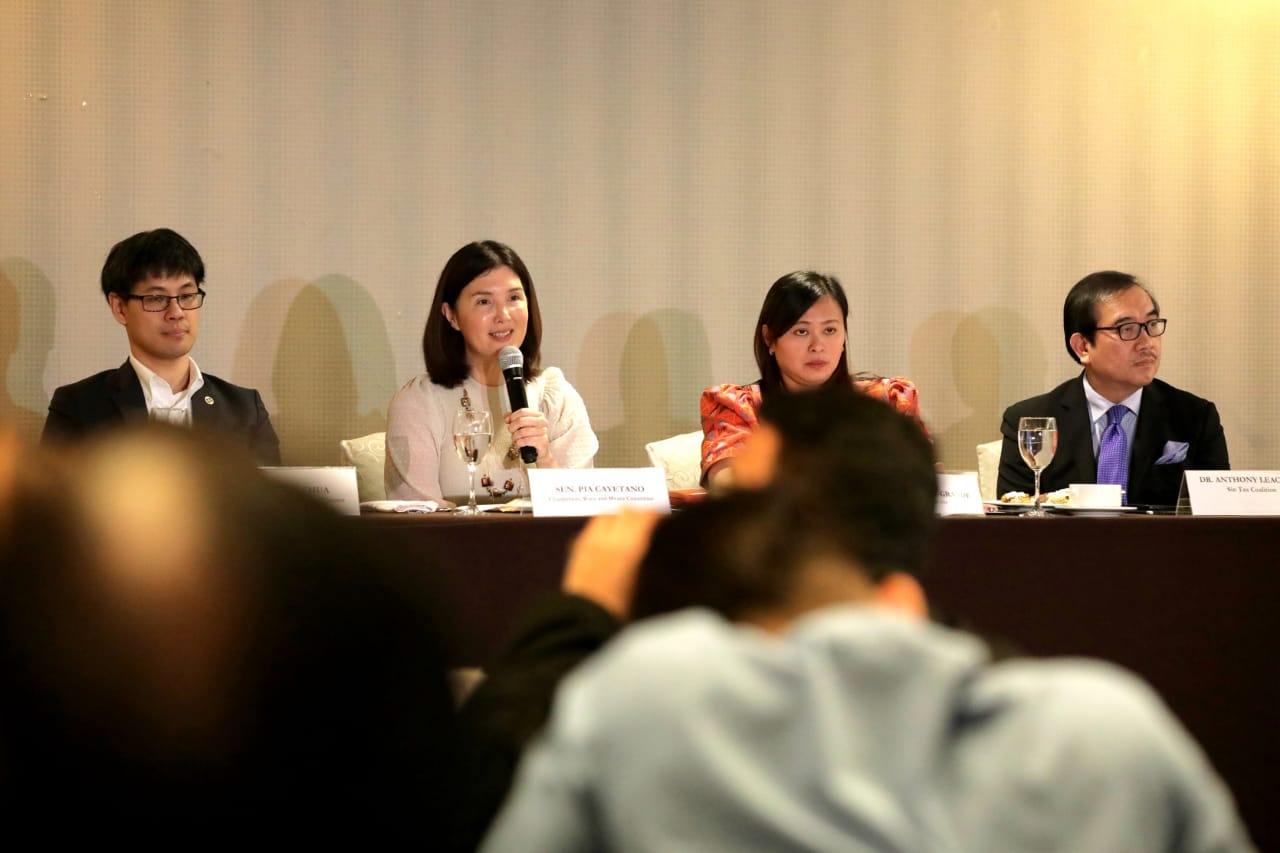
    “Part of the task is to get this law signed. We now have accomplished that. I thank all of the [health] advocates and everybody who spent so much time in helping us see this through,” Cayetano said during a press conference in Intramuros on Tuesday (January 28).

    The senator in particular thanked her colleagues in Congress for supporting the provision under the law that mandates the Food and Drug Administration (FDA) to regulate e-cigarette products.

    RA 11467 provides for the establishment of a framework for the regulation of HTPs & vapes by the FDA, including banning the sale to non-smokers and persons below 21 years old.

    “One of the successful provisions that we have been able to include in this law is for the FDA to regulate these products. And I am very happy about that… We have now provided the legal mechanism for FDA to take the lead,” she stressed.

    “The challenge is now with them. And I implore upon all the stakeholders, both on the side of the advocates and the industry, to support FDA to allow them to do their job,” she added.

    Meanwhile, Cayetano said the campaign to protect Filipinos from the dangers of sin products should not stop with imposing higher taxes. Taxation, she noted, should be complemented by a comprehensive public health strategy.

    “The journey is not over because the effectivity of the law is in its implementation,” she said.

    The senator then expressed her commitment to work with her fellow legislators as well as with government agencies and advocacy groups to assess and strengthen the country’s smoking- and drinking-cessation programs.

    “I would like to work with our Committee on Health in the Senate and our counterparts in the House to strengthen our existing regulations and, to the extent necessary, [implement] new laws for the protection of our youth against these harmful products – alcohol, HTPs, and vapes,” she stressed.

    “I am also calling on the education and health departments, community officials, and parents, [to guard the youth against e-cigarette products]… It is supposed to be for those who want to shift from cigarettes to another product. It is not there to encourage the youth to take on a brand new vice,” the senator concluded. #

    Sen Pia Cayetano on e-cigarettes: It is supposed to be for those who want to shift from cigarettes to another product. It is not there to encourage the youth to take on a brand new vice.
    Signed into law last January 22, Republic Act No. 11467 imposes heavier tax rates on alcohol, heated tobacco products, and vapor products.
  • Pia: My work continues to tax e-cigarettes for public health

    Transcript of interview with Senator Pia Cayetano on President Duterte’s directive to ‘ban’ e-cigarettes 

    Question (Q): What happens to the sin tax bill following the order of the President to ban vapes?


    Sen. Pia: The way I look at it is my work continues. Because our President has really just expressed – from my understanding – his disappointment and exasperation with the e-cig industry. And that’s why he made that statement na “i-ban na yan.”


    Because actually, all this time, he was waiting for all of us to do our job. And my job is to use taxation as a tool to protect the citizens, and of course, there’s also a fundraising measure as far as DOF is concerned.


    But we have to understand the background. The background is, DOH issued an Administrative Order regulating e-cigarettes. And they said it in my hearing, they said it in consultations na ayaw ng mga industry ang AO na yan. The industry players said that they were not happy with that AO.


    In fairness, there were also some industry players who said that they are happy to be regulated. Meanwhile, some of these people went ahead and filed cases to prevent FDA and DOH to regulate them. And these courts issued a TRO. So ngayon, we have products that are clearly harmful to the public [that are not being regulated]. We can debate and we can discuss it longer. But there is no doubt. I don’t know anyone in the business who will say safe na safe ito. There are health hazards there. And they are unregulated. Eh ‘di nabwisit si Presidente, so ang basa ko sa kanya, “Ah ganun ha? Ayaw niyo magpa-regulate, i-ban ko na lang kayo.”


    And that’s how I feel also. Ayaw niyo magpa-regulate? Eh ‘di lumabas na kayo sa bansang ito. We’re willing to, and that was the direction that I was going. Taxation to me is just a means, a tool to help make these products that are harmful less accessible to the vulnerable, especially the youth.


    Pero, meron din akong draft bill to regulate vaping and ecigs, etc. na ready rin akong isalang at i-defend as soon as mapasa ko na itong taxation portion. Kasi nauna lang naman yun because meron lang talaga tayong hinahabol na timeline.


    Q: How will the ban affect the revenue generation of DOF?


    Sen. Pia: Well, it’s very small compared to the overall collection. That is because e-cigs is still not widespread. It’s a new product. Bago lang yan. Ako nga hindi ko alam na may ganyang product until like a year ago na nakita kong may ganun.


    So it will not contribute greatly immediately. I remember, DOF had said at some point, kung walang mako-collect diyan, okay lang kasi DOF recognizes that health comes first.


    But I also understand that the President has also clarified his statement and I just have to push through with my part of the job. My job is to pass the taxation measure whether or not there’s an EO that comes out, if something comes out tomorrow, whether it’s a total ban or regulating, I have to be ready. Because this taxation measure has to be of a more or less permanent nature.


    Paano kung temporary lang ang ban, tapos walang taxation measure in place? So I have to have that in place. And just to clarify also, there is actually a taxation measure in place. This was the law that was already passed last June towards the end of the 17th Congress [Republic Act 11346]. So that will be the one that will come into effect in January if I don’t push through with this measure and there is no ban.


    So I have to push through in anticipation. I cannot assume na mato-total ban yan. I have to still do my job.


    Q: Legally speaking, is the EO powerful enough to stop the entry of vape products and use, etc.?


    Sen. Pia: You have to recognize, first of all, like I mentioned, again let’s go back.


    DOH issued an AO. DOH time and again, and FDA, has the power to protect the public from health risks. That is their inherent power. Kung lahat na lang ng risks, let’s say itong sa polio, aantayin nila ang legislature, mahirap yun. There are parts of the work of the Executive that require immediate action.


    So, DOH cannot always be waiting for the legislature to pass something. It is inherent in the Constitution, Article II Section 15 says that it is the State’s duty to protect the people’s health.


    So may powers and responsibility ang DOH diyan and that goes without saying ang DOH naman is just an arm of no less than the President. They are under the President, so the President will also act that way.


    But, I am not going to debate right now what is covered by the legislative powers and the executive powers. For me, you look at it on a case-to-case basis. Right now, the regulations that are supposed to protect the people from the harmful effects of e-cigarettes, vapes, heated tobacco products, otherwise known as HTPs, has been TRO’ed.


    Kung ako din ang Presidente, sasabihin ko sa kanila, “Ah ganun, ni-TRO niyo yung aking health arm? ‘Di sige, i-ban ko na lang kayo.”


    Q: Just to be clear, the bill you will push is just to regulate e-cigarettes or to institutionalize banning?


    Sen. Pia: Right now, on the floor is the taxation measure that you know. So as of now, as of the past few months, I was pursuing, I was going along the lines of the direction of the Executive, which is to highly regulate.


    The President and even DOF Secretary, DOH, have been very clear that there are harmful effects of ecigs. And I myself went to WHO and have confirmed this. Everything I heard in the hearings were confirmed during my trips abroad that we are dealing with a harmful product. So it must be regulated. And as I said, taxation is a means to regulate it for health purposes.


    Meanwhile, for the health side, there are bills – I looked at it, I am actually vice chair of the Committee on Health and as you all know, an advocate for health. There are pending bills but I intend to file a bill, which I believe is more comprehensive and is more reflective of the need to highly regulate a product that poses a health risk to the Filipinos.


    Wala pa ang bill na yun. It’s in the drafting stage. And if you recall, I’ve been busy as the chair of the Committee on Ways and Means, but my interest is always health. So my trip to WHO has given me more knowledge.


    Actually, during the budget, I was reviewing that bill on the side. I’d say it’s about 90% complete. I just really wanted a few more revisions. But I’ll be ready to file that anytime.


    Q: The filing will come after the taxation measure passes?


    Sen. Pia: Hindi naman. If may time naman ako to finalize that bill, I will file it. And that bill, as I said in answer to your question, is going along the direction of highly regulating.


    Si Senator Tolentino, whom I worked very closely with – he was in WHO – is for a total ban. Kasi for me, it’s a thin line. Ang aming understanding of the health risk is exactly the same. It’s more of the appreciation of what would work better in our country, a total ban or highly regulating [these products]?


    Part of me wants total ban. But the other part of me is okay with highly regulating. And this is where I want to share this conundrum that I face, because here you have industry players saying, “I-regulate niyo kami, mas gusto naming ma-regulate para ma-weed out natin ang mga fly-by-night diyan and those that might produce products that don’t comply with the safety standard.”


    But meanwhile, ni-TRO naman nila ang pagre-regulate ng FDA and DOH. ‘Di ngayon, unregulated. Paano ba yun?


    Q: Can you be more specific, ano ang ibig sabihin ng “to highly regulate”?


    Sen. Pia: What I mean by saying ‘highly regulate’ is, it can be sold but there are many -not just guidelines, but there are many dos and don’ts. And those dos and don’ts, I will enumerate.


    But offhand, you cannot sell to the youth and, in this case, I have expanded it to young people. Because ang brain, there is evidence that shows that the brain continues to develop until 25 years old. So at the age of 19, hindi ka na [minor], pero ang brain mo and decision-making skills mo are still very susceptible to persuasion, to advertisement and all that. So, that’s one way of regulating – that you ban the youth and even young people.


    Advertising, you highly regulate that. You either totally ban or you only allow it in limited spaces. So that’s what I mean, maybe we can have a separate discussion on that. But I am giving you a glimpse of what I mean by highly regulate. And even the places where you will sell.


    I’d love to give you this example. In the United Kingdom, where they actually allow e-cigs to be sold freely, the reason for that is because their cigarettes are highly regulated. You cannot enter a store and see cigarettes anywhere. So nag-drop na ang consumption ng youth nila.


    So now, with the e-cig business, it appears that their youth is not vulnerable to it the way the youth in the US is. Because there are no cigarettes around. You can’t enter a store and find it. In fact, I wanted to make a point of buying, I kept forgetting because every time I enter a convenience store, you won’t see it.


    So ang cigarette industry nila – I’m referring to cigarette industry – is highly regulated. And this allowed them to now look at what e-cigs can do for them. They are not allowing it na walang regulation, ha? Kasi for them, it is still a harmful product. Pero medyo liberal sila in allowing it as an alternative to cigarettes.


    Q: So the direction towards eventually banning the selling of e-cigs in convenience stores will be part of the bill?


    Sen. Pia: If you ask me, it should be included in the debates, because it’s a harmful products. And all across the world, connected pa rin kasi yan sa cigarettes. So, cigarettes in other parts of the world, very regulated na ang kanilang pagbebenta.


    So si e-cigs, saan pumapasok diyan? Eh parang tayo, nafa-fast forward. Hindi pa nga natin totally nare-regulate ang cigarettes, nandito na si e-cigs.


    So gusto ni e-cigs, “Huwag niyo naman kami masyadong i-regulate, ang cigarettes nga hindi niyo nire-regulate.” That’s not an excuse, eh ‘di i-regulate kayo pareho ng mas matindi. Dapat naman talaga ma-regulate silang pare-pareho.


    Q: Does the order to ban e-cigs have an effect on the President’s directive to certify the sin tax bill as urgent?


    Sen. Pia: No. I don’t believe so, because like I mentioned, the President is very vocal about his concerns, ang ideas niya, he will really just say it. So my understanding is, just like me, when he says, “I-ban na lang yan,” it’s because of the facts that he’s faced with. It’s because of the annoying reality that these people don’t want to be regulated and then there are courts that actually felt that the business interest of these vaping companies are more important than the welfare and health of the Filipinos.


    It boggles my mind. At si Presidente din, takang taka kung bakit ganyan sila magdesisyon. ni-TRO nila ang Department of Health and FDA.


    Q: Will the sin tax bill be approved before the year ends?


    Sen. Pia: I hope so. I have been having more detailed discussions with my colleagues. And I have expressed the request of DOF that we expedite this. So napapag-usapan na yan. And I have requested na magkaroon ng caucus right after the budget and that we prioritize the debates. Kasi ready naman ako.


    Q: Does the caucus have a schedule already?


    Sen. Pia: Sinabi ko naman kay SP [Senate President Vicente Sottto III] na gusto ko sana mag-caucus right after. Syempre, ayaw ko naman makagulo dahil hilong hilo na kaming lahat sa long hours ng budget. But hopefully. Kasi period of amendments na lang naman kami. So kung masisingit ko yun during one afternoon, para ma-explain ko na and ma-discuss din itong effects ng ban, baka iba-iba din ang ideas nila.


    Ako, I want to say that tuloy natin ito. Kasi it’s just a question of rates. I don’t think anyone is not for taxing these sin products, it’s just a question of rates. So I wanna just sit down and discuss with them, “Saan tayo ngayon?” kasi ako, I stand by the rates that I propose.


    Thank you! #
  • To tax or ban e-cigarettes? Pia to wait for President’s EO banning e-cigs

    Reaction to President Duterte’s directive to ban e-cigarettes
    By Senator Pia S. Cayetano  
    Chairperson, Senate Committee on Ways and Means
    .
    Over the months,  I’ve read numerous studies and reports on e-cigarettes, conducted hearings, had discussions with health advocates, including experts in WHO, and listened  to the industry  and the speakers they arranged for me to meet. All of these led me to conclude that:


    – We are dealing with products that clearly  have health risks despite industry and their supporters saying the risks are less than smoking and that they are an effective device to help smokers quit;

    – These health risks are still being documented and studied;

    – Some of these products have caused deaths and severe illnesses in various forms.

    What this means is that we must really assess if this is a product that should be outright banned, as has been already done in some countries like Australia, Singapore, Brazil, etc., or strictly regulated, which was the direction I was taking as Chairperson of the Senate Ways and Means Committee.

    Meanwhile, the President’s recent pronouncement to ban e-cigarettes is an assertion of the authority of the State to restrict the use of any consumer product that endangers public health. I agree that when the people’s health is at risk, public interest must always take precedence over any business or commercial interest.

    As a backgrounder, it is important to note that the e-cigarette industry was previously given the opportunity to work and thresh out issues with the government. The Department of Health (DOH) issued Administrative Order (AO) 2019-0007 last August precisely to lay down regulations for e-cigarette products. Unfortunately,  members of the industry chose to question the AO in court instead of welcoming government regulation.

    In the meantime, the very first case of electronic cigarette- or vaping-associated lung injury (EVALI) was reported in the country last weekend, involving a 16-year-old girl.

    No issue can be resolved if members of the industry would insist on shunning any form of regulation by constantly suing the DOH and Food and Drugs Administration (FDA)! With this attitude,a  ban is really in order.

    I await the EO from the President. Until then, these products that everyone, even those in the industry, recognize as harmful are in the market, and should be taxed. And it is still my job to see this bill through.#
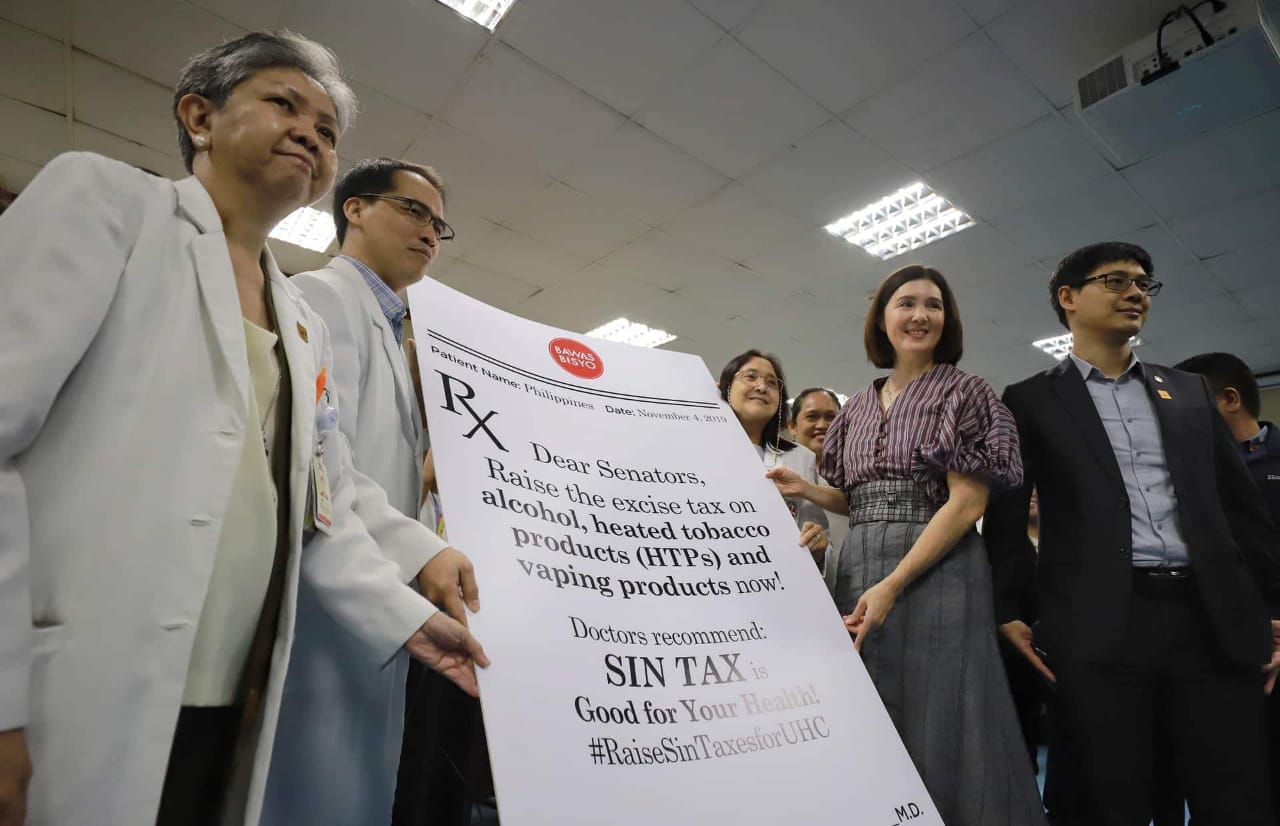
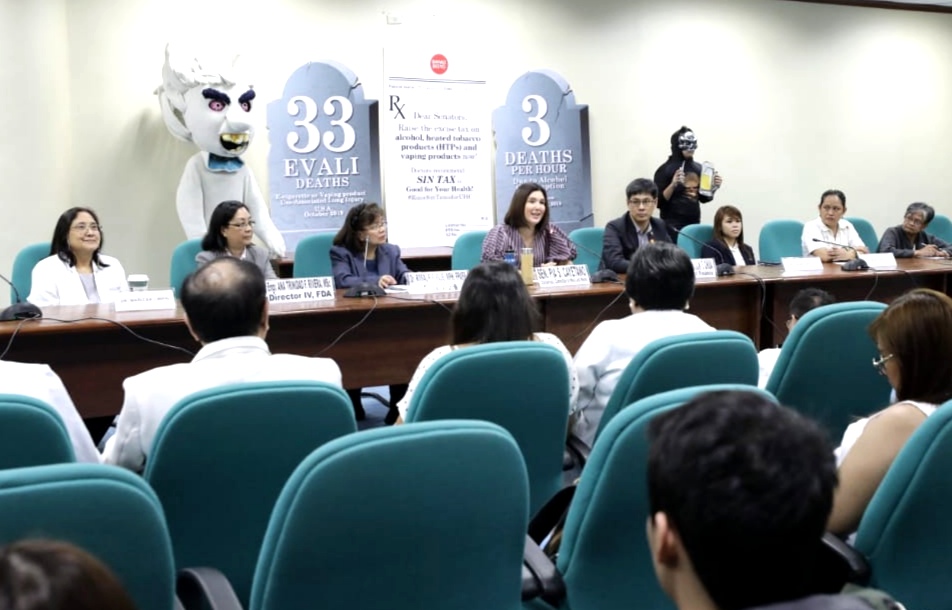
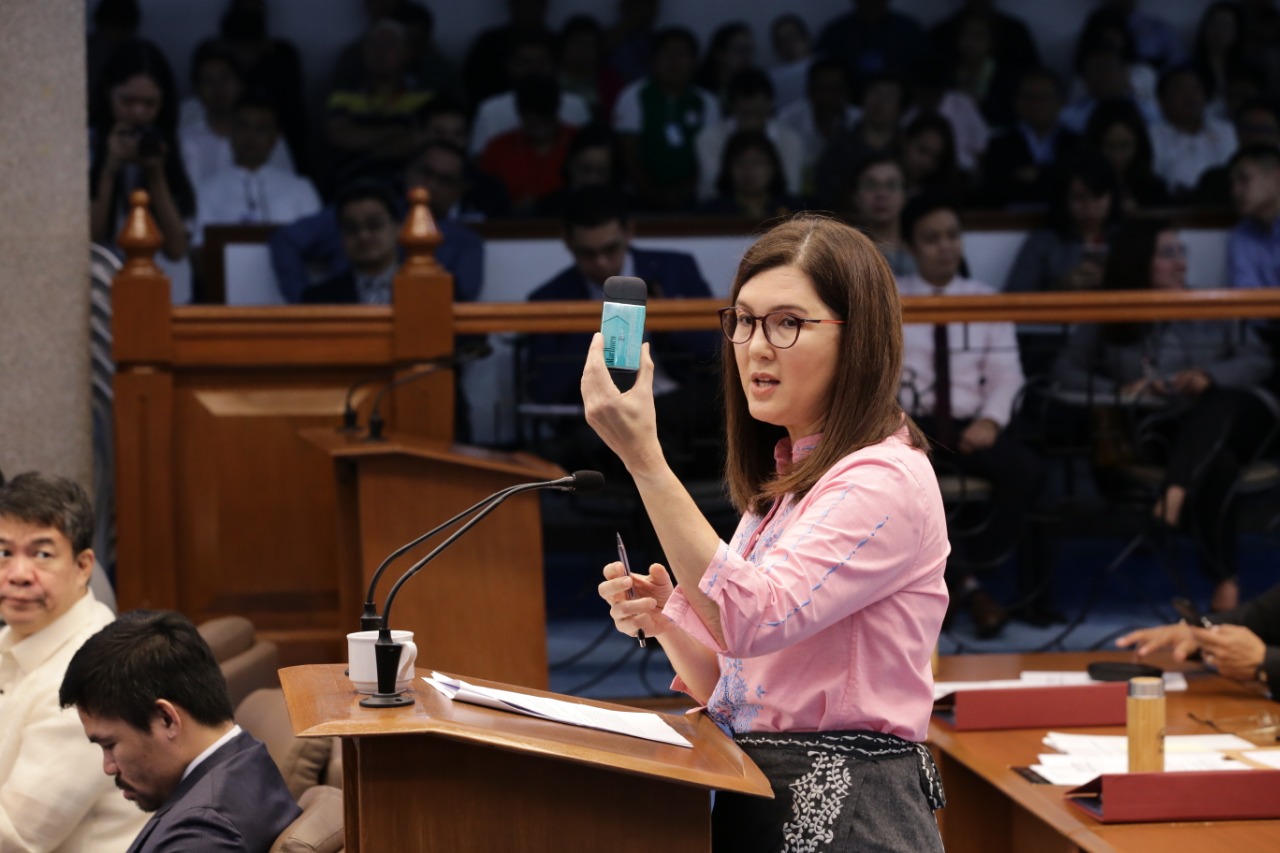
    Senate Ways & Means Chair Pia Cayetano holds a giant prescription with health experts during the Sin Tax Coalition’s press conference in the Senate. The coalition had called on other senators to pass the bill seeking to raise taxes on e-cigarettes & alcohol. (Photo: Senate PRIB)
  • Pia welcomes President’s certification of sin tax bill (SB 1074) as urgent

    Senator Pia S. Cayetano today welcomed President Rodrigo Duterte’s certification of the Senate’s version of the sin tax bill as urgent.
    “I have always known that the President and I are aligned when it comes to regulating cigarettes, e-cigarettes, and alcohol products. But this certification is much appreciated because it sends a message to all the members of the Senate that this is a priority measure,” the senator said.
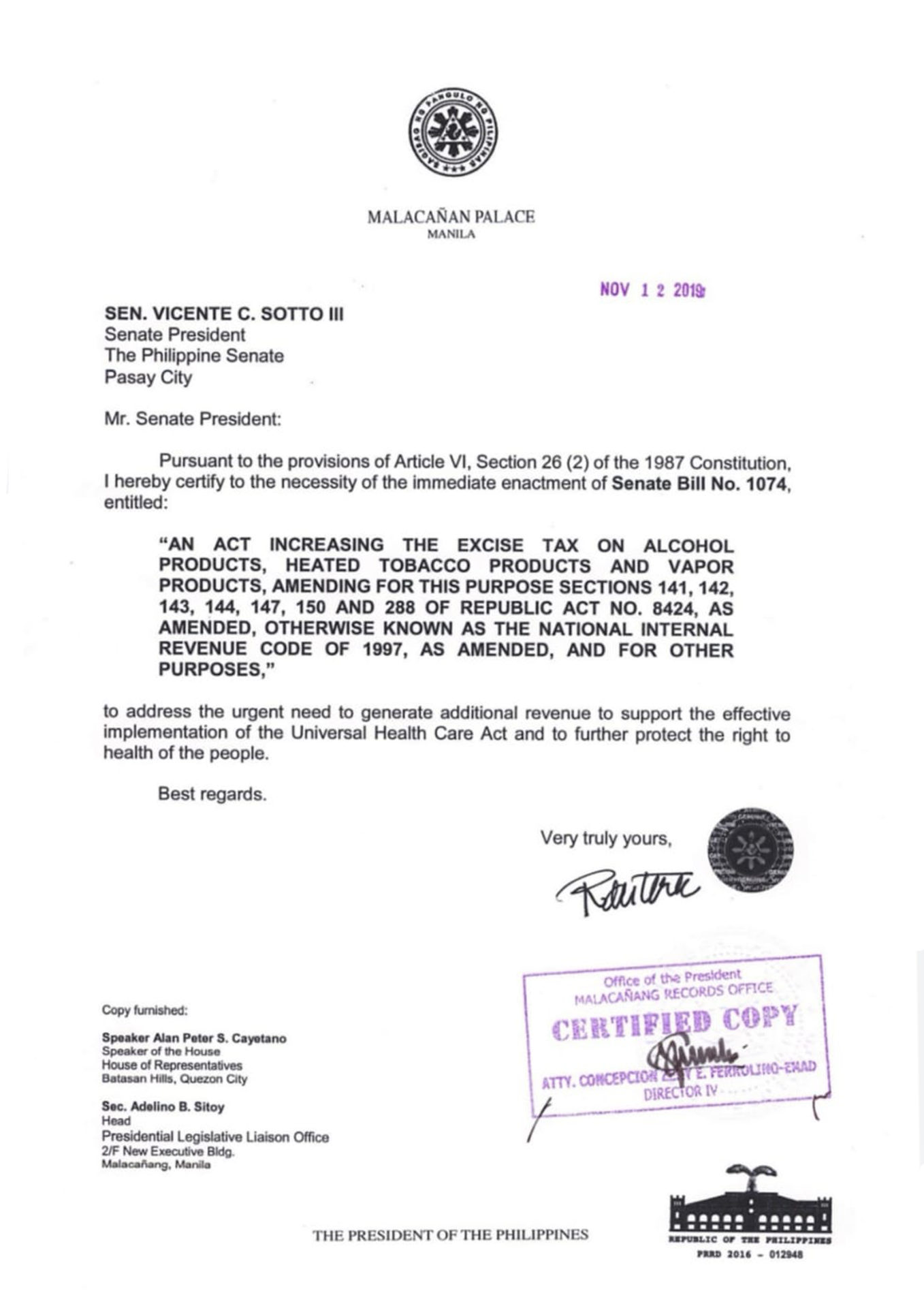
    Issued on Tuesday, November 12, the certification signed by President Rodrigo Duterte cited the urgent need to pass SB 1074 to generate additional revenue to support the implementation of the Universal Health Care (UHC) Act.
    Cayetano is the sponsor of Senate Bill (SB) No. 1074, which seeks to increase excise taxes on alcohol and e-cigarettes, including heated tobacco products (HTPs) and vapes. The measure is currently in the period of interpellations.
    Cayetano is hopeful that her fellow senators would likewise welcome the urgency of passing higher sin taxes to protect the right to health of Filipinos.
    “A vote for sin tax is a vote for our people’s health and wellbeing,” she noted, while adding that she remains committed to respond to her colleagues’ concerns on SB 1074.
    Certification of SB 1074 as urgent by President Rodrigo R. Duterte.
    “I am pushing for a version that recommends higher tax rates than those approved by the House of Representatives for two reasons: first, it will provide proper funding for the delivery of health services to all Filipinos; and second, it will effectively reduce the consumption of sin products,” the senator said.
    “There is a need to increase sin taxes substantially for it to have any health impact. Otherwise, we will fall short at meeting our health objectives,” she added.
    “We cannot save lives by increasing the price of a sin product by a negligible amount. We can only make this an effective measure when the price increase is substantial enough that people would think twice on the volume of the products they will purchase and consume,” Cayetano concluded.
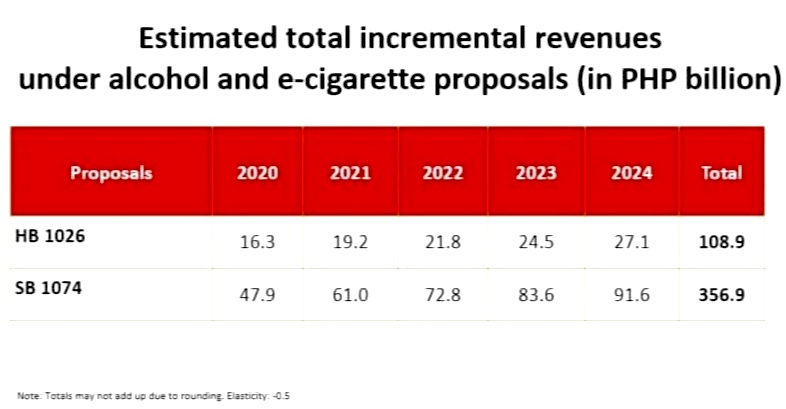
    The Department of Finance (DOF) estimates that Cayetano’s proposed rates would generate P47.9 billion for UHC next year, and a total of P356.9 billion for the program over the next five years. #
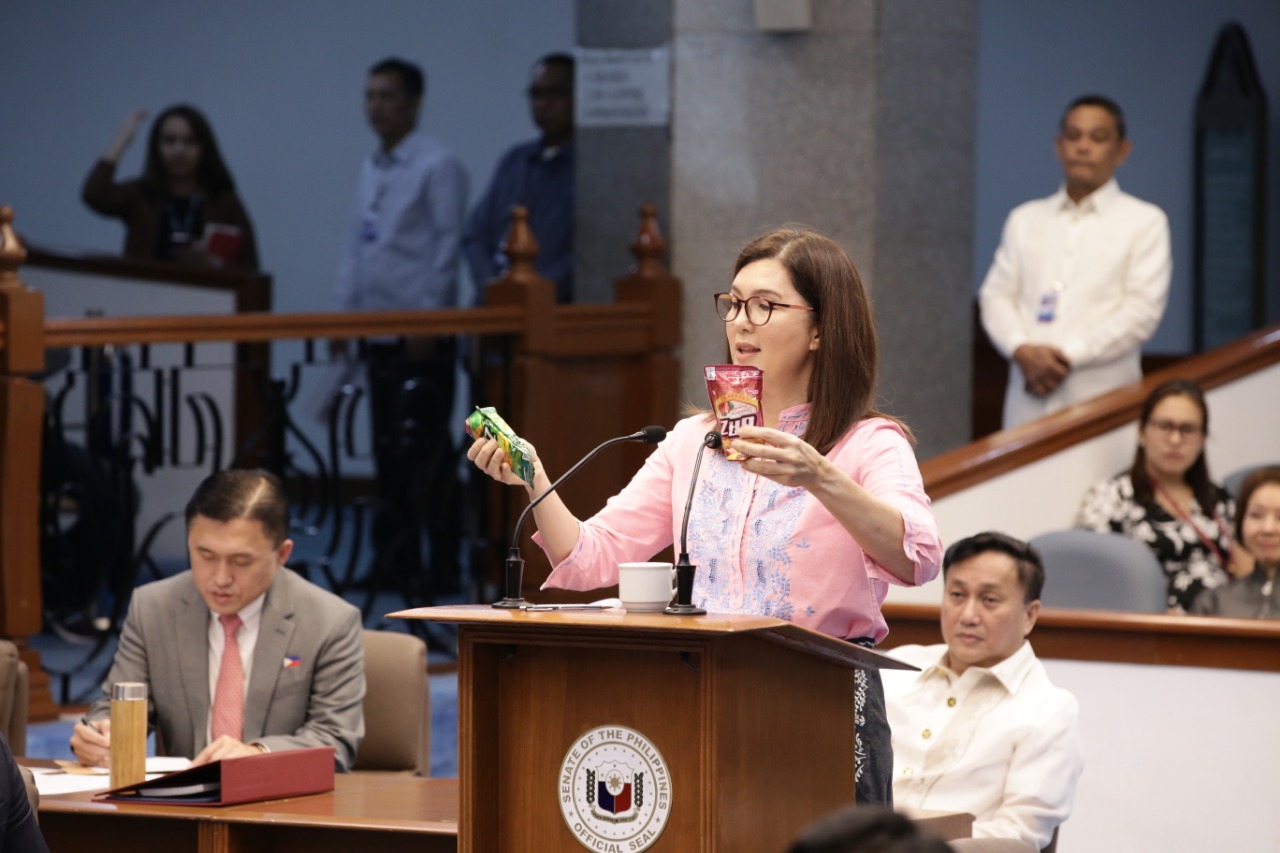
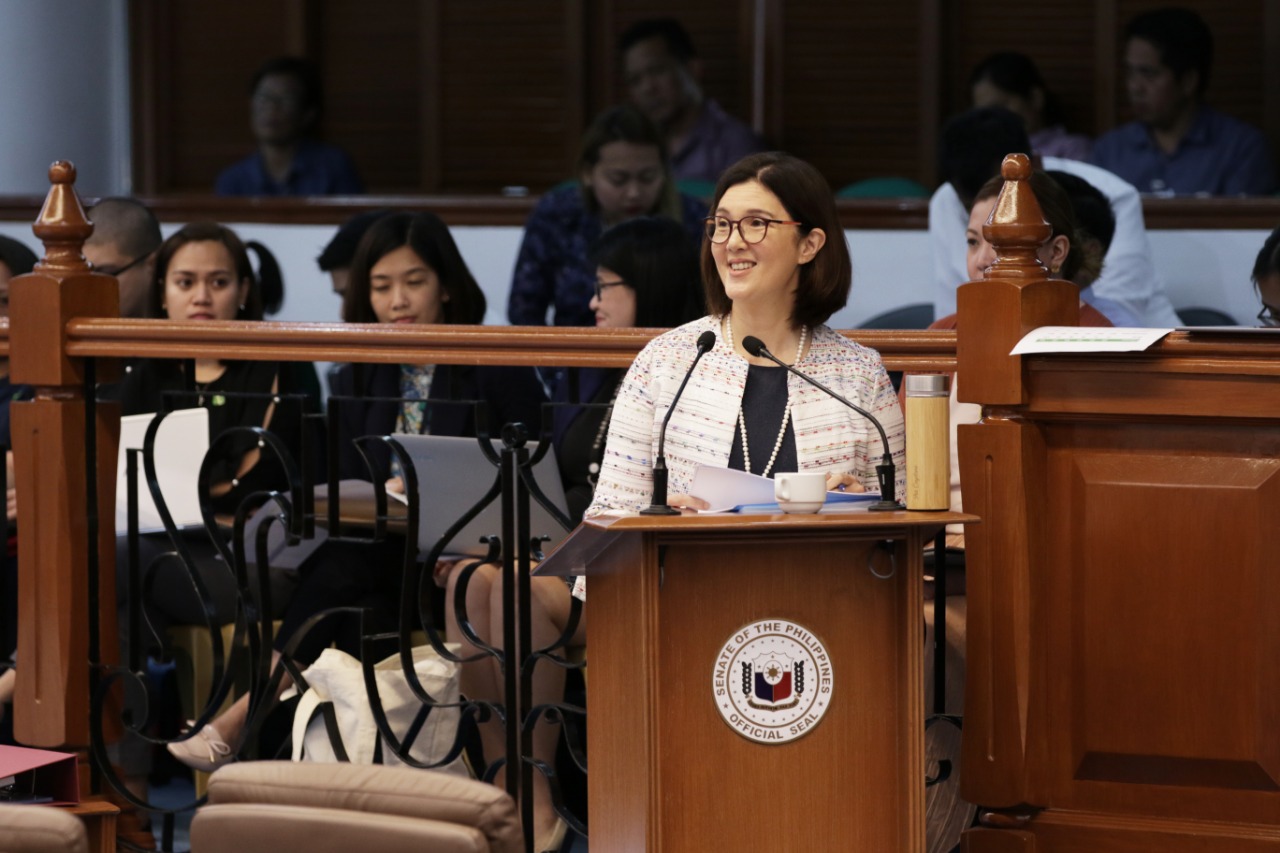
    Senate Ways and Means Committee Chair Pia S. Cayetano shows samples of alcopops to fellow senators during her sponsorship speech on Senate Bill No. 1074.
  • Pia: Higher sin taxes to make alcohol less accessible to the youth

    One of the primary objectives of increasing sin taxes is to make alcoholic beverages less accessible to the country’s youth, Senator Pia S. Cayetano said on Tuesday (November 5).

    The chairperson of the Senate Ways and Means Committee stressed this point at the resumption of plenary debates on Senate Bill No. 1074, which seeks to raise the excise taxes on alcoholic beverages and e-cigarettes, including heated tobacco products and vapes.

    Responding to the interpellation of Senator Manny Pacquiao, a co-author of SB 1074, Cayetano noted, “What we want to achieve is [to significantly raise alcohol prices] so that these are not so accessible to the most vulnerable: the children and youth.”

    “Hindi po tayo naniniwala na kailangan affordable ang alak sa ating mga kabataan. For example, sa isang bote ng gin, ang karagdagang presyo lang dito ay P2.00 per shot [under SB 1074]. Nasa P6.00 ang isang shot [based on the current price of gin],” she explained.

    Cayetano also defended the tax rates proposed under SB 1074, which are notably higher than the rates approved by the House of Representatives and those recommended by the Department of Finance (DOF).

    “What I have proposed is a rate that is higher than that passed in the House of Representatives. In fact, it is also higher than that initially showed to me by DOF. But both the DOF and DOH [Department of Health] now support my version,” she said.

    The senator explained that, even with the P47.9 billion additional revenues that can be generated under her proposal, there would still be an P11.8 billion gap in the funding for government’s Universal Health Care (UHC) program.

    Even if this gap is bridged, she said the UHC would only be able to deliver bare minimum services because of the program’s huge funding requirement. As such, she said any additional health revenue should be welcomed to grant Filipinos better access to basic and specialized health services.

    “Kailangan lang natin bumisita sa isang healthcare center para maintindihan natin na malayo pa ang patutunguhan natin… Yung mga nakikita nating mga ospital na dilapidated, hindi pa lahat ora-orada magagawa,” Cayetano pointed out.

    “Items like catastrophic illnesses, including cancer, hindi pa po covered ng mga packages natin sa UHC. In fairness to DOH and PhilHealth, every year they are increasing and improving their packages. But that is the nature of the problems they face because of the lack of funding… And because we are a country with more than 7,000 islands, it’s going to be very difficult to readily provide the kind of health care we dream of,” she added.

    Meanwhile, Cayetano clarified that taxation alone cannot address the country’s problems on alcoholism and cigarette addiction, stressing that it is just part of a more comprehensive plan to protect Filipinos’ health and wellbeing.

    “Taxation is not meant to be used as a lone preventive tool, but should be [implemented] along with other measures including education campaigns and advocacies,” she said. #

    Cayetano: Even with P47.9 billion additional revenues from SB 1074, there would still be an P11.8 billion gap in the funding for government’s Universal Health Care program.
  • Pia gears up for daily debates on Sin Tax

    “Sin tax reform is not just about numbers. It’s really about changing lives. And the work that we do will pave the way for a safer future for our children.”

    Thus said Senate Ways and Means Committee Chair Pia S. Cayetano, as she prepares to defend her proposed tax rates under Senate Bill (SB) No. 1074, which seeks to raise excise taxes on alcoholic beverages and electronic cigarettes, including heated tobacco products and vapes.

    The Senate is set to resume floor debates on the tax reform measure on Tuesday (November 5).

    “I am ready and I will make myself available every day in my effort to get this bill approved as soon as possible,” according to Cayetano.

    “I would really like to address the concerns of my colleagues about sin tax. We hope to put on record a very interesting discussion,” she added.

    The senator said she is prepared to present all the data to back her proposed tax rate hikes under SB 1074. “I understand that those from the industries and even some of our colleagues find the rates that we are proposing on a high end, but we stand by those rates.”

    Cayetano said the chances of the tax reform measure being approved in the Senate this year are high. She clarified, however, that fellow senators would be given sufficient time to raise their concerns during the plenary debates.

    “As long as there is enough time for my fellow senators to prepare their questions, it’s a reasonable expectation [that the bill will get approved]. We really give each other enough time to ask those questions. So I am making myself available in the next few months for interpellation.”

    The Department of Finance (DOF) has estimated that SB 1074 would generate P47.9 billion for the Universal Health Care (UHC) program next year, and a total of P356.9 billion for the program over the next five years.

    The senator particularly stressed the need to increase the country’s tax rates on alcohol, citing that the Philippines has among the lowest prices of beers, hard liquors, and wines in the ASEAN region.

    “Ang baba ng presyo ng ating mga alak kumpara sa ibang bansa sa ASEAN. Kaya talagang panahon na po na taasan natin ito,” she stressed.

    The Philippines has the third lowest price of a 330-ml beer in the entire region, next to Vietnam and Cambodia. It also has the second lowest prices of a 700-ml bottle of gin and a 750-ml bottle of wine in ASEAN, next to Vietnam and Brunei, respectively.

    “If we want to make taxation an integral part of our comprehensive [health] package, then it should be a meaningful kind of taxation. I will never be comfortable with proposing a measure just for the sake of it,” Cayetano asserted.

    Meanwhile, the senator acknowledged growing public support for higher sin tax rates.

    At the resumption of session on Monday (November 4), doctors, youth and civil society groups held a mobilization and press conference in the Senate to express support for Cayetano and urge other senators to approve SB 1074.

    “I feel it’s very important that you continue your advocacy on the ground. We will do our part, but in the community level, your work is truly vital. We’re very happy that there are young people who are also taking the initiative to support our proposal,” Cayetano told the coalition members.

    She said the ultimate goal of Sin Tax is to reduce deaths, sickness, and other hazards caused by excessive drinking, as well as to address social problems linked to alcoholism like domestic violence, crimes against women, and road accidents resulting from drunk driving.

    Moreover, she said the measure seeks to protect Filipinos, especially the youth, from the dangers of vaping. #

    Senator Pia Cayetano gives updates on SB 1074 before members of the Sin Tax Coalition at a press conference held in the Senate.
  • Pia: Congress has jurisdiction to tax e-cigarettes

    Amid rising concerns in many countries about the health risks of electronic cigarettes and vapes, Senator Pia S. Cayetano reiterated that Congress has the jurisdiction to impose higher taxes on these products as a means to regulate their use.


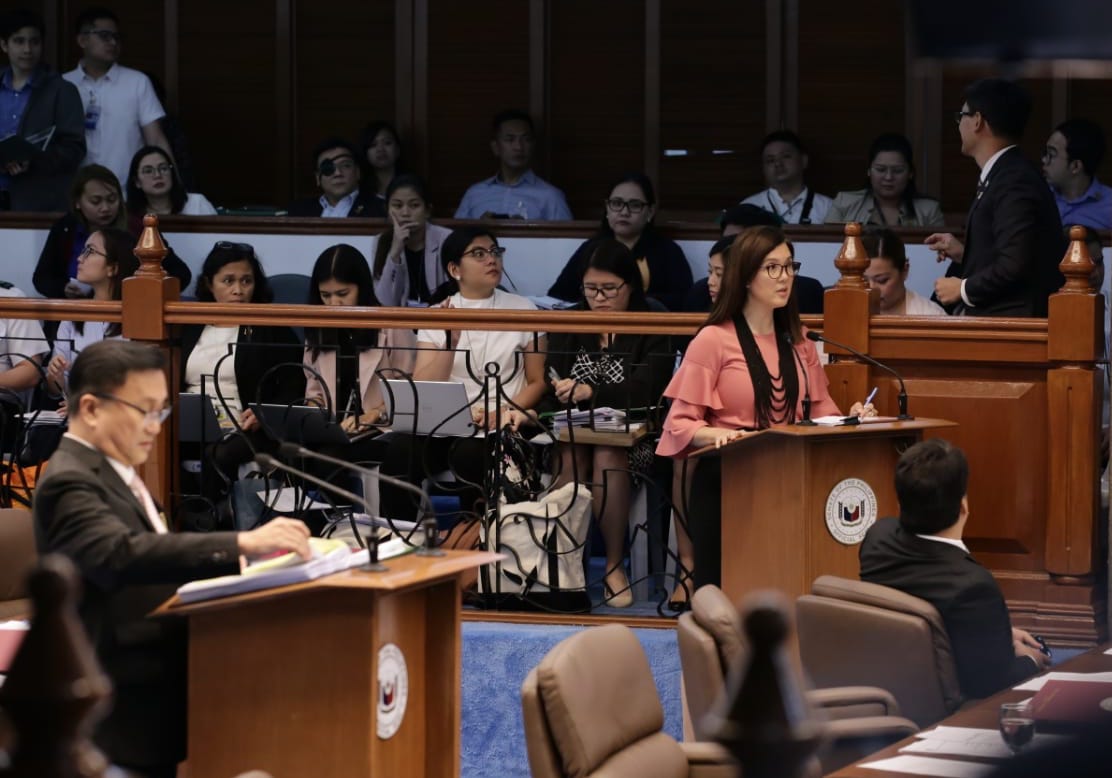
    The chairperson of the Senate Committee on Ways and Means, Cayetano made the assertion at the start of plenary debates on Senate Bill No. 1074, which seeks to raise ‘sin’ taxes on alcohol and vaping products. 

    Responding to the questions of Senator Francis Tolentino, Cayetano clarified that Congress has already imposed taxes on e-cigarettes since the enactment of Republic Act 11346 earlier this year. 

    Tolentino had asked Cayetano whether Congress can impose a tax on e-cigarettes, even if these products have yet to be given certification by the government through the Food and Drug Administration (FDA). 

    “As to whether we can tax a product that’s not been given permission to be sold, let me point out that under RA 11346, we (lawmakers) have already taxed e-cigarettes,” Cayetano noted. 

    “So this committee is not proposing a new kind of tax. It’s already recognized by Congress under its jurisdiction. This committee is just increasing that tax,” she added. 

    Cayetano pointed out that taxation is “just one tool” that would help curb these new kinds of vices. She said other pro-health initiatives should be put in place to complement the sin tax bill. 

    “Taxation is not the end-all, be-all. So we must help our health department come up with measures to provide a health approach to the problem of smoking and drinking,” she said, while expressing her plan to push for additional regulatory measures on e-cigarettes.

    The senator said she is in the process of drafting a bill mandating the government to “look into the harmful effects of e-cigarettes,” which shall be referred to the Committee on Health. 

    She also intends to draft a measure that would regulate the marketing and ban the advertising of e-cigarettes in the country. 

    “Exposure to these products will be dangerous because the science is not yet clear about its dangers. I’m concerned for the young people in general as these products can easily entice them,” she explained. 

    “Our goal is to reduce people’s consumption of these sin products, on top of generating more revenues to finance our Universal Health Care program,” she stressed.

    A total of 42 countries worldwide have already banned the use of e-cigarettes, while 10 countries banned the use of heated tobacco products (HTPs) due to growing evidence that such products are dangerous to people’s health.

    Earlier this year, the FDA gave manufacturers, importers, and retailers of e-cigarettes three months to register and comply with specific regulations before they could sell their products legally.

    These include a license to operate and the issuance of a certificate of product registration. The three-month period is set to end this October. #

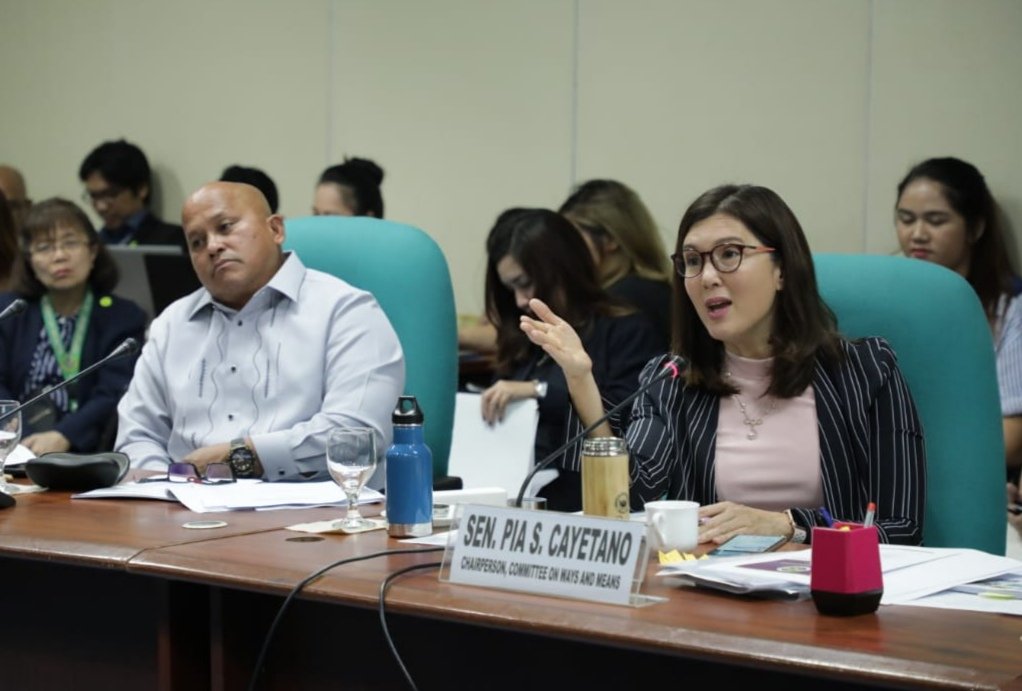
    Senator Pia Cayetano: Taxation is “just one tool” to help curb new kinds of vices. She said other pro-health initiatives should be put in place to complement the sin tax bill. 
  • Pia: PH is global ‘inuman’ champion; Sin Tax Reform to save lives

    The Senate Ways and Means Committee, under the chairmanship of Senator Pia S. Cayetano, has presented to the plenary Senate Bill No. 1074 seeking to increase excise taxes on sin products, with the objective of augmenting funds for universal health care and protecting citizens, particularly the youth, from the harmful effects of drinking and electronic cigarettes. 

    Delivering her sponsorship speech on Wednesday (September 25), Cayetano stressed the need to impose “significantly higher” tax rates on alcohol, e-cigarettes, and heated tobacco products (HTPs) in order to safeguard Filipinos’ health and wellbeing.

    Cayetano’s committee is proposing the following excise tax rates for the different types of alcohol products:

    Distilled spirits: an ad valorem tax of 20% and a specific tax of Php 90 per proof liter on Year 1, to be increased by  Php10 every year until Year 4, and by 10% every year thereafter.

    For fermented liquor and alcopops: a specific tax rate of Php 45 per liter on Year 1, to be increased by Php10 every year until Year 4, and by 10% every year thereafter. 

    For wine products: a specific tax of Php 600 per liter for sparkling wines and Php 43 per liter for still and carbonated wines, to be increased by 10% every year thereafter.

    The Ways and Means Chair explained that the specific tax rate on distilled spirits was raised to Php 90 because they have the highest alcohol content among the different types of alcohol products, and as such are the most harmful to people’s health. 

    Furthermore, the Committee proposed to tax e-cigarettes, HTPs, and vape products the same rate as conventional tobacco products.   

    The Committee proposed to tax HTPs at P45 per pack of 20 in 2020, increasing such rate to P5 per pack per year like regular cigarettes. For vape products, the recommendation is to tax those containing freebase nicotine at P45 per 10ml or a fraction thereof; and those containing nicotine salts at P45 per 1ml or a fraction thereof. 

    Alcohol

    In pushing for higher taxes on alcohol, Cayetano said there is “glaring evidence” that the excessive use of such products endangers people’s health. 

    “Alcoholism is associated with at least 39 main diseases, including liver cirrhosis, cancer, pancreatic disease, hypertensive disease, tuberculosis, diabetes, and even behavioral and psychotic disorders,” she said, citing a report by the Global Burden of Disease Study.

    Also, World Health Organization data revealed that in 2016, 4,431 per 100,000 population of Filipinos died from liver cirrhosis; while 16,418 died from hypertensive diseases; and 8,526 from tuberculosis. 

    “All of which were due to the excessive use of alcohol,” Cayetano pointed out. 

    “The impact of our problem on alcoholism is not felt by the drinker alone,” she further stressed, adding that excessive drinking is also a common cause of road crashes and a contributor to family violence.

    The senator lamented that, with these products becoming more accessible to vulnerable sectors, there is a risk that these numbers and incidents would continue to grow. Hence, the need to increase their prices and make them less affordable.

    Cayetano said the measure seeks to address the high drinking prevalence among Filipinos, who on average are already consuming 11 liters of hard alcoholic beverages per year. This is higher than the global and ASEAN averages of below 10 liters. 

    “Global champion na po tayo, sa inuman.  But that is not something we should be proud of,” the senator said, adding that the prices of alcohol in the country should not be so cheap as to allow Filipinos, especially the young people, to easily have access to them.

    E-cigs and HTPs

     “For the sake of our children, we must regulate and tax e-cigarettes at parity with regular tobacco products. Other countries are already doing this. We should at least keep pace.  Vaping is not cool when it leads our kids to the path of new addictions,” Cayetano said about e-cigarette products.

    The senator questioned the position of manufacturers and distributors who claimed that e-cigarettes are a viable and less harmful alternative to conventional smoking.

    “The industry claims that it is a safer product but medical experts have pointed out that safer does not mean safe or risk-free. We have already seen and heard an avalanche of news of people who died because of lung failure in the United States – people who were consistent users of these vape products,” she said.

    “Thus, Mr. President, this representation asks that we err on the side of caution,” she added during her speech.

    Apart from the sin tax bill, Cayetano said she plans to file more measures seeking to address the country’s problems associated with alcoholism and the dangers of vaping among the youth.

    “This Committee is tasked with the taxation of these products. But this, in no way, limits DOH [Department of Health] and Congress to undertake steps to protect the health of the people,” she said.

    “We remain cognizant that taxation is just one tool and that a comprehensive strategy is necessary. We urge DOH [Department of Health] to work with our medical community on this through aggressive interventions and policies.” #

    Senator Pia Cayetano: “Global champion na po tayo, sa inuman.  But that is not something we should be proud of.”
    Senator Pia Cayetano: “For the sake of our children, we must regulate and tax e-cigarettes at parity with regular tobacco products.
  • Ways and means panel tackles ‘sin’ taxes on alcoholic drinks

    Senate Ways and Means Committee Chair Pia S. Cayetano will lead on Tuesday (August 20) the panel’s second public discussion on the government’s Comprehensive Tax Reform Program (CTRP). 

    Discussions will focus on Package 2+ of the CTRP, which imposes higher excise taxes on alcoholic beverages. E-cigarettes, including heated tobacco and vapor products, are also covered by the proposal, but these will be taken up separately in a future hearing. 

    Cayetano said Package 2+ of the CTRP aims to discourage consumption of various ‘sin’ products among Filipinos, especially the youth and poor. At the same time, the proposal ensures the financial sustainability of government’s Universal Health Care (UHC) program.

    “In the Ways and Means Committee, it’s my job to look for funding for our health programs, because I am very familiar with the needs of Filipino families,” stressed Cayetano, one of the Senate sponsors of the original Sin Tax Reform Act of 2012 (RA 10351).

    “When it comes to sin products, these are taxed high in several countries all over the world. Sadya hong hindi mura ang mga nakakamatay na produkto sa maraming bansa. At binubuwisan natin ito dahil ayaw po natin na mamatay ang mga Pilipino sa mga sakit, aksidente, at peligro na dulot ng mga produktong ito. Ayaw din natin na mura ang alak at sigarilyo para hindi nabibili ng kabataan,” explained Cayetano. 

    The government’s official position will be presented by officials from the Department of Finance and the Department of Health. 

    Representatives from various agencies were invited to give their position on the proposal, including the Department of Transportation (DOTr), Metropolitan Manila Development Authority, Philippine National Police’s Highway Patrol Group, Land Transportation Office; World Health Organization; Motorcycle Federation of the Philippines; and ImagineLaw, Inc.

    Civil society and medical organizations were also invited, including Health Justice; Action for Smoking and Health; Action for Economic Reforms; Public Services International; University of the Philippines College of Medicine; Independent Health Advocate Manila Doctors Hospital; Kalusugan ng Mag-Ina; Southeast Asia Tobacco Control Alliance; Philippine Medical Association; Philippine Society of Gastroenterology; Hepatology Society of the Philippines; Philippine College of Physicians; Philippine Academy of Family Physicians; Philippine College of Chest Physicians; 

    Philippine Pediatric Society; Philippine Society of Clinical and Occupational Toxicology; Philippine College of Addiction Medicine; The Society of Adolescent Medicine of the Philippines; Philippine College of Occupational Medicine; Philippine Psychiatric Association; Philippine Mental Health Association; Philippine Neurological Association; Philippine Society of Medical Oncology; Philippine Heart Association; Philippine Society of General Internal Medicine; Philippine Society of Hypertension; Philippine Society of Nephrology; and Philippine Society of Endocrinology, Diabetes, and Metabolism.

    Also asked to join the hearing were women and children groups – Child Protection Unit of the Philippine General Hospital; Safe Kids Worldwide Philippines; Commission on Women; and Child’s Rights Coalition.

    Tax reform measures form an integral component of the Duterte administration’s strategy to achieve its growth targets under AmBisyon 2040 and the United Nations’ Sustainable Development Goals (SDGs). #

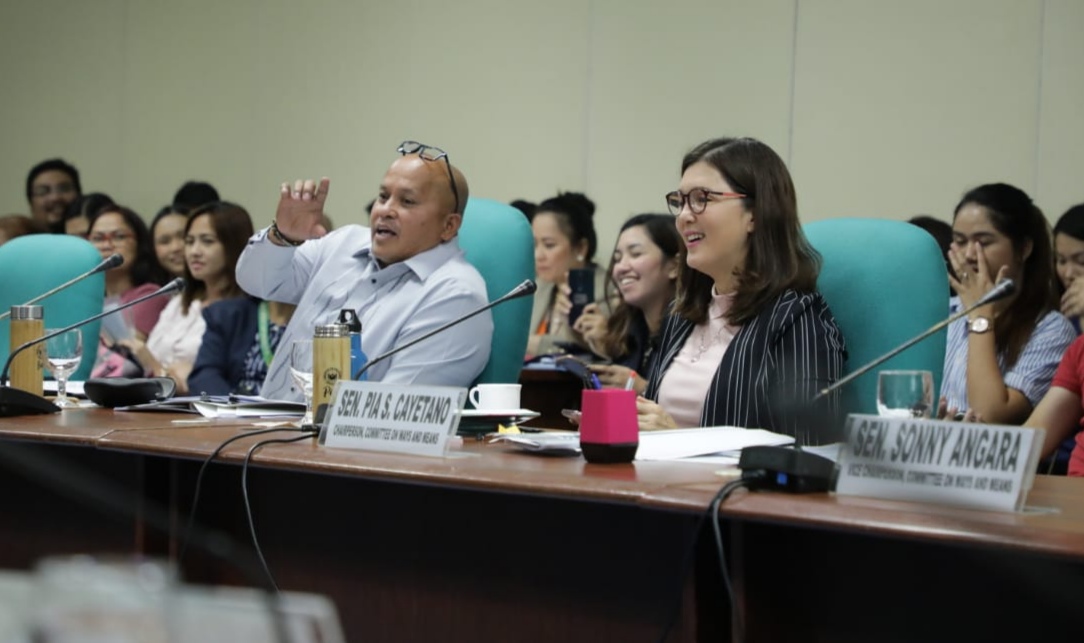
    Senators Pia Cayetano and Ronald Dela Rosa at the organizational meeting of the Senate Committee on Ways and Means.
  • Pia: Time to re-study PH corporate tax rates

    “The time is right to re-study our tax rates and incentives.”
    Senate Ways and Means Committee Chair Pia S. Cayetano said this on Thursday (August 15), following the panel’s organizational meeting to discuss the Duterte government’s Comprehensive Tax Reform Program (CTRP).
    Cayetano heads the Senate body tasked to tackle the remaining tax proposals under CTRP, including Package 2, which seeks to lower corporate income taxes (CIT) and rationalize incentives given to investors. 
    “I do believe that the time is right to study the rationalization of our corporate holidays and various incentives so that we can prioritize the corporations that are really contributing to our sustainable economic growth,” she stressed.
    The senator said the ultimate goal is to come up with a measure that would generate the needed funds for programs that will benefit Filipino families, especially those belonging to the vulnerable sectors. 
    Furthermore, she said ensuring the people’s access to basic social services would allow the country to fulfill its commitment to the United Nations’ Sustainable Development Goals (SDGs), which serves as a blueprint in achieving a more sustainable future for the country.
    Package 2 of the CTRP proposes to lower the country’s CIT rate from 30 to 20 percent. It also seeks to rationalize incentives being given to companies investing in the country, to ensure that such advantages granted to them can generate domestic growth and employment for Filipinos.
    “Very clear naman ang presentation ng Department of Finance (DOF). Compared to other countries in the region, the Philippines has a high taxation rate. The objective is to lower that rate to make us more competitive and so that we will have more jobs,” Cayetano stressed. 
    “We should also not grant incentives to businesses that are not really contributing to our economy,” she further said.
    On the other hand, the senator assured all concerned sectors that her committee would consider all positions, including those of her fellow senators, before finalizing the committee report and passing a tax reform bill in the Senate.  “We intend to have weekly hearings [to discuss all tax measures]. Kailangan mag-double time kaming lahat,” she said.
    The Ways and Means committee is set to conduct its second hearing on Tuesday (August 20), which will primarily focus on Packages 2 and 2+ of the tax reform program.#

    Senator Pia Cayetano: Lowering corporate income tax rates will make us more competitive in the ASEAN region.