Official Website of Philippine Senator Pia Cayetano

Category: Education

  • “The Most Powerful Investment We Can Make” — Sen. Pia Cayetano Welcomes AHEAD Grant for Healthcare Students

    “The Most Powerful Investment We Can Make” — Sen. Pia Cayetano Welcomes AHEAD Grant for Healthcare Students

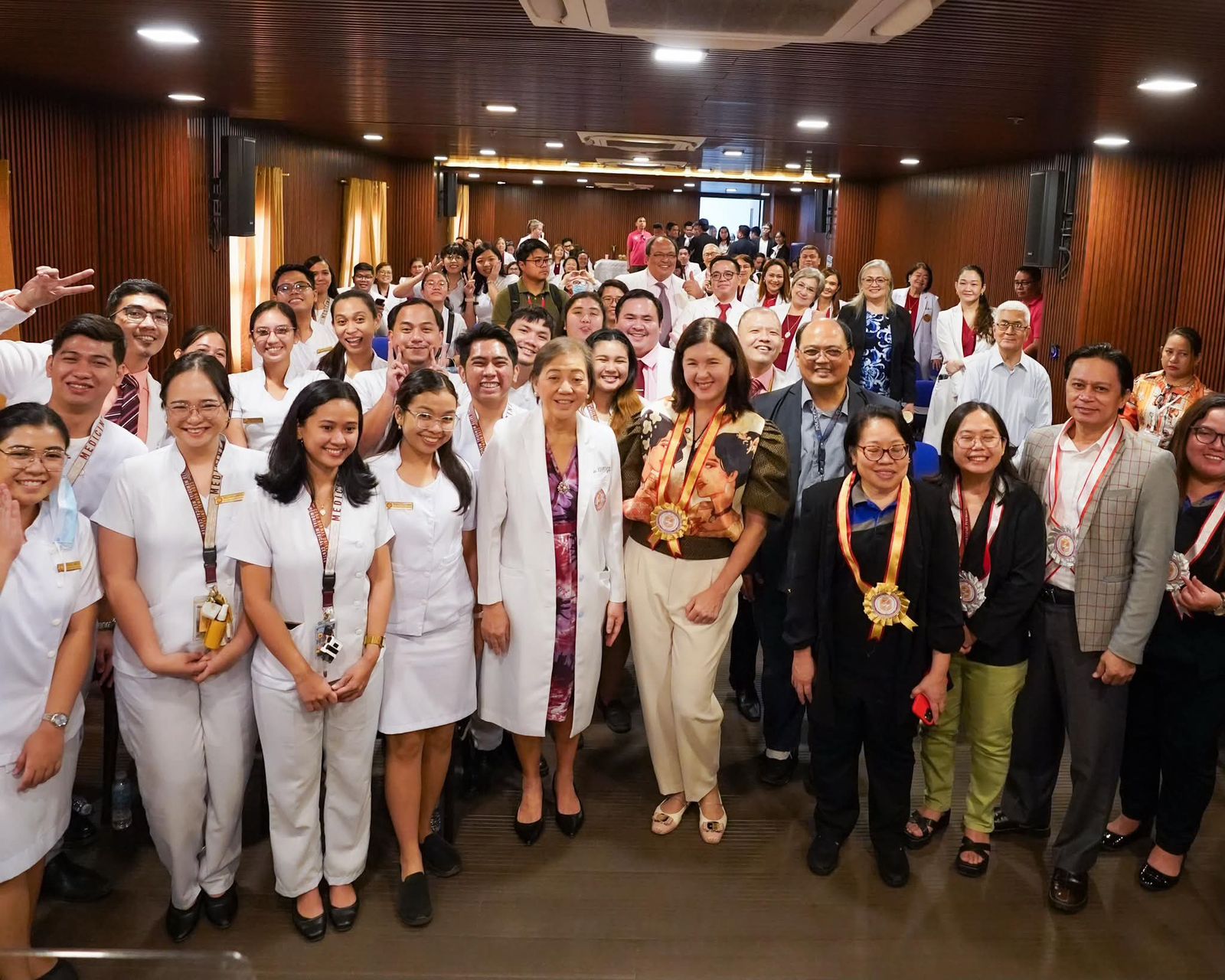
    Senator Pia S. Cayetano welcomed the launch of the Commission on Higher Education’s (CHED) Allied Health Experiential Assistance for Deserving Students (AHEAD) Grant, which will provide financial assistance to around 19,000 healthcare students completing their mandatory clinical and field-based training nationwide.

    “This is exactly the kind of investment we need to make for our future. The most powerful investment we can make for our country is in our education and healthcare sectors, and this program does both at once,” Cayetano said. “I am happy to see that our efforts to strengthen healthcare education are bearing fruit for our students and for the Filipino people.”

    As Senior Vice-Chairperson of the Senate Committee on Finance, Senator Pia Cayetano has long championed the expansion of medical and allied health education. She consistently lobbied for the rightful share of education and health in the national budget, as well as funding for the Doktor Para sa Bayan Act. These efforts helped lay the foundation for programs like the AHEAD Grant, which provides more opportunities for aspiring healthcare professionals to pursue their education and serve Filipino communities.

    Cayetano noted that the AHEAD Grant directly addresses a long-standing burden on healthcare students, many of whom come from families that struggle to afford the cost of clinical training on top of regular tuition.

    “We cannot build a strong healthcare system without first investing in the people who will run it,” she said. “Every health worker who graduates because of programs like this is one more person who will serve Filipino families in their most vulnerable moments. There is no quick fix, but every step we take toward making healthcare education accessible is a step toward a healthier Philippines for all of us.”The grant covers students enrolled in priority allied health programs including nursing, medical technology, physical therapy, occupational therapy, pharmacy, radiologic technology, respiratory therapy, nutrition and dietetics, speech-language pathology, dental medicine, optometry, and veterinary medicine, all tied to the Human Resources for Health Philippine Masterplan 2020-2040.


    ”The Most Powerful Investment We Can Make” — Sen. Pia Cayetano tungkol sa AHEAD Grant para sa mga Healthcare Students

    Mainit ang naging pagtanggap ni Senadora Pia S. Cayetano sa paglulunsad ng Allied Health Experiential Assistance for Deserving Students (AHEAD) Grant ng Commission on Higher Education (CHED), na magbibigay ng pinansyal na tulong sa humigit-kumulang 19,000 healthcare students na kumukumpleto ng kanilang mandatory clinical at field-based training.

    “This is exactly the kind of investment we need to make for our future. The most powerful investment we can make for our country is in our education and healthcare sectors, and this program does both at once,” sabi ni Cayetano. “I am happy to see that our efforts to strengthen healthcare education are bearing fruit for our students and for the Filipino people.”

    Bilang Senior Vice-Chairperson ng Senate Committee on Finance, matagal nang isinusulong ni Cayetano ang pagpapalawak ng medical at allied health education. Patuloy niyang ipinaglaban ang nararapat na bahagi ng edukasyon at kalusugan sa pambansang badyet, gayundin ang pondo para sa Doktor Para sa Bayan Act. Ang mga pagsisikap na ito ay nakatulong sa pagtatayo ng pundasyon para sa mga programang tulad ng AHEAD Grant, na nagbibigay ng mas maraming pagkakataon sa mga nagnanais na maging healthcare professionals na ituloy ang kanilang pag-aaral at maglingkod sa ating mga komunidad.

    Para kay Cayetano, ang AHEAD Grant ay tumutugon sa matagal nang pasanin ng mga healthcare students, kung saan ang marami sa kanila ay nagmumula sa mga pamilyang nahihirapang bayaran ang gastos ng clinical training bukod pa sa regular na matrikula.
    “We cannot build a strong healthcare system without first investing in the people who will run it,” sabi pa niya. “Every health worker who graduates because of programs like this is one more person who will serve Filipino families in their most vulnerable moments. There is no quick fix, but every step we take toward making healthcare education accessible is a step toward a healthier Philippines for all of us.”

    Ang nasabing grant ay para sa mga estudyante na naka-enroll sa mga priority allied health programs, kabilang dito ang nursing, medical technology, physical therapy, occupational therapy, pharmacy, radiologic technology, respiratory therapy, nutrition and dietetics, speech-language pathology, dental medicine, optometry, at veterinary medicine, na lahat ay sumasailalim sa Human Resources for Health Philippine Masterplan 2020-2040.
  • Senator Pia Cayetano Backs CHED’s Call to Defer Tuition Increases, Urges HEIs to Prioritize Student Welfare

    Senator Pia Cayetano Backs CHED’s Call to Defer Tuition Increases, Urges HEIs to Prioritize Student Welfare

    Senator Pia S. Cayetano expressed strong support for the Commission on Higher Education’s (CHED) call urging Higher Education Institutions (HEIs) to defer planned tuition increases, emphasizing the need to protect Filipino families already grappling with rising costs of living.

    “I fully support CHED’s call for universities to hold off on tuition increases. Many families are already struggling with rising costs across the board. We must ensure that education remains accessible, especially during these challenging times,” Cayetano stated.

    The Senator, who serves as Senior Vice Chair of the Senate Committee on Finance and has handled the education budget for six years, stressed that accessible education is fundamental to breaking cycles of poverty and ensuring intergenerational equity.

    Cayetano noted that the government has been working to strengthen support for higher education through the Tertiary Education Subsidy and increased funding for State Universities and Colleges. She emphasized that private institutions play a vital role in keeping education within reach of Filipino families, and expressed hope that, in this challenging time, they can work together with the government in exploring ways to ease the burden on students while sustaining the quality of education they provide.

    Cayetano also commended CHED for maintaining an open dialogue with institutions while balancing the need to ensure that students and their families are not overburdened during this time. “I appreciate that CHED is engaging with HEIs on this matter. It’s important that we balance the operational needs of institutions with the capacity of families to afford education.”

    The Senator called on higher education institutions to explore alternative means of addressing operational challenges without passing the burden to students and their families. She emphasized that investing in education is investing in the nation’s future, and accessibility must remain a priority.

    “Education is the great equalizer. We cannot allow it to become a privilege that only the wealthy can afford,” Cayetano concluded.


    Sen. Pia, Suportado ang Panawagang Ipagpaliban ang Tuition Hike

    Sinusuportahan ni Senador Pia S. Cayetano ang panawagan ng Commission on Higher Education (CHED) sa mga Higher Education Institutions (HEIs) na ipagpaliban ang planong pagtaas ng matrikula, habang binibigyang-diin ang pangangailangang protektahan ang mga pamilyang Pilipinong nahihirapan na sa mabilis na pagtaas ng pang-araw-araw na gastusin.

    “I fully support CHED’s call for universities to hold off on tuition increases. Many families are already struggling with rising costs across the board. We must ensure that education remains accessible, especially during these challenging times,” pahayag ni Cayetano.

    Si Cayetano na nagsisilbing Senior Vice Chair ng Senate Committee on Finance at humawak ng badyet sa edukasyon sa loob ng anim na taon, ay nagpaliwanag na ang accessible na edukasyon ay susi sa pagwakas ng kahirapan at pagsisiguro ng intergenerational equity.

    Binanggit ni Cayetano na nagsusumikap ang gobyerno na palakasin ang suporta sa mga programa sa higher education sa pamamagitan ng Tertiary Education Subsidy at pagtaas ng pondo para sa mga State Universities and Colleges. Binigyang-diin din niya ang mahalagang papel na ginagampanan ng mga pribadong institusyon sa pagpapanatiling abot-kaya ang edukasyon para sa mga pamilyang Pilipino. Nanawagan si Cayetano na magtulungan ang pribadong sektor at ang gobyerno upang pagaanin ang pasanin ng mga estudyante, lalo na sa panahon ngayon.

    Pinuri rin ni Cayetano ang CHED sa pakikipag-dayalogo sa mga HEIs habang binabalanse ang pangangailangang tiyakin na ang mga estudyante at ang kanilang mga pamilya ay hindi lalong mahirapan sa kasalukuyan. “I appreciate that CHED is engaging with HEIs on this matter. It’s important that we balance the operational needs of institutions with the capacity of families to afford education.”

    Hinimok ng Senador ang mga HEIs na humanap ng alternatibong paraan sa pagtugon sa mga hamon sa kanilang operasyon nang hindi ipapasa ang pasanin sa mga estudyante at kanilang mga pamilya. Naniniwala si Cayetano na ang pamumuhunan sa edukasyon ay pamumuhunan sa kinabukasan ng bansa, at ang accessibility ay dapat manatiling priyoridad.

    “Education is the great equalizer. We cannot allow it to become a privilege that only the wealthy can afford,” pagtatapos ni Cayetano.

  • Pia Cayetano Urges Great Caution on Full Online Classes, Warns CHED of Impact on Students and Learning Gaps

    Pia Cayetano Urges Great Caution on Full Online Classes, Warns CHED of Impact on Students and Learning Gaps

    Statement on the Commission on Higher Education’s (CHED) policy allowing  higher education institutions (HEIs) to shift to 100% online classes amid the fuel and power crisis

    Families are experiencing difficulties because of the ongoing global fuel and power crisis. These are not easy times, and government agencies, including our education institutions, are being asked to adapt quickly.

    CHED’s move to allow schools to shift to 100% online classes is clearly intended as a temporary solution to ensure learning continuity while supporting energy conservation efforts.

    As Senior Vice Chairperson of the Senate Committee on Finance, where I handled the education budget for six years, and as a former EDCOM II Commissioner, I feel strongly that we must approach this challenge with great caution.

    Recent assessments show that learning gaps remain a serious concern across the education system, and with any shift in modality, we must first ensure that our students are truly learning. 

    We cannot ignore the risk that prolonged or widespread reliance on fully online modalities may further widen existing learning gaps, especially for students who may not have equal access to technology, stable connectivity, or a conducive learning environment at home.

    Moreover, there is a real concern that what is intended as a temporary measure may gradually become normalized. We saw this emerge after the pandemic, when emergency learning modalities persisted longer than necessary. We must be vigilant to ensure that this does not happen again.

    We also cannot forget that face-to-face learning remains essential, not just for academic outcomes, but for discipline, engagement, and overall development. This is why we must carefully balance the need to respond to the crisis with our responsibility to protect our students’ learning experience.

    I urge CHED and all HEIs to establish concrete benchmarks, including measurable learning outcome indicators and a defined review timeline, so that this policy remains a genuine emergency measure and does not quietly become the new standard.

  • Cayetano urges action on growing classroom gap

    Cayetano urges action on growing classroom gap

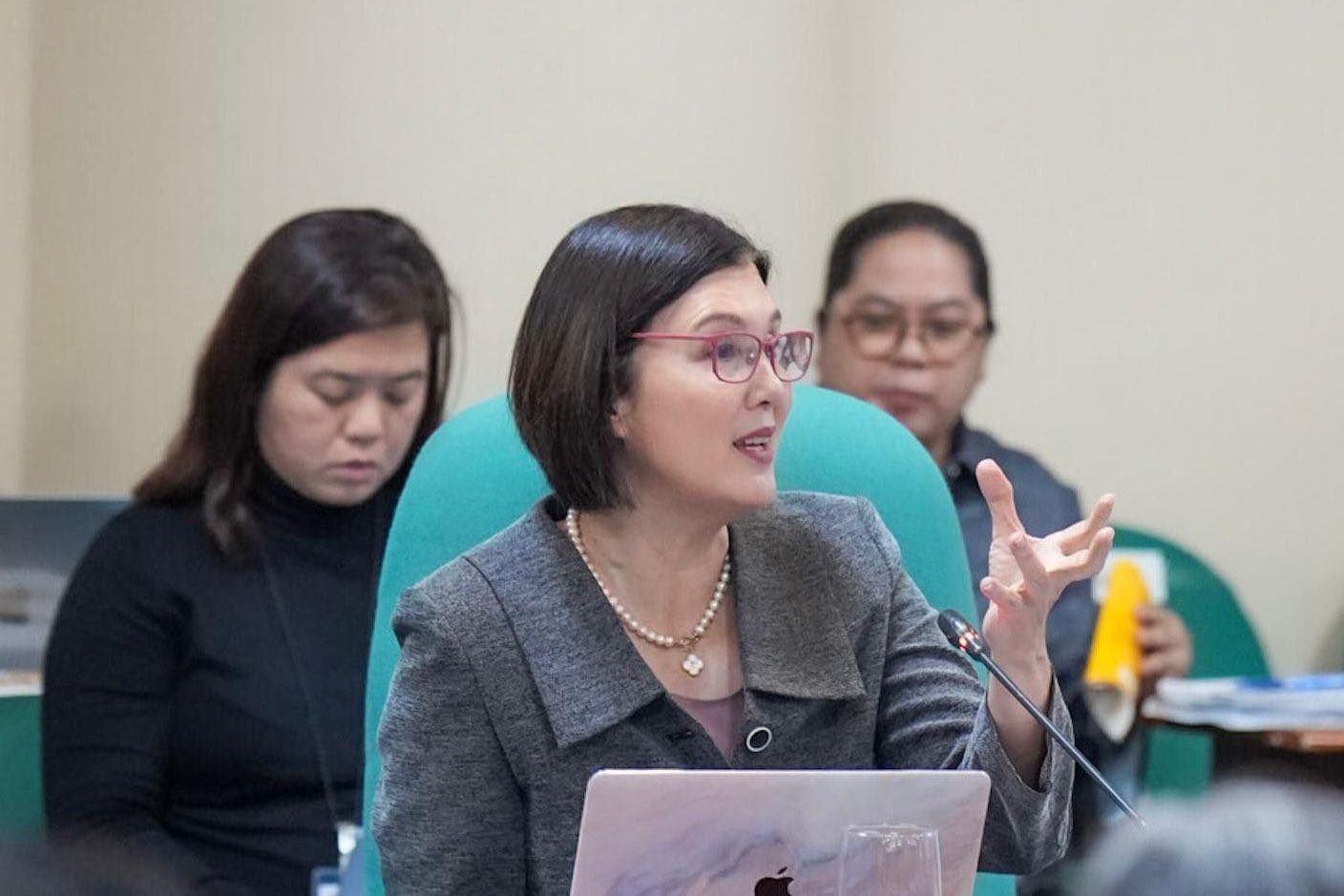
    Finance Senior Vice Chairperson Senator Pia S. Cayetano pressed for urgent action to close the country’s classroom gap during the hearing on the proposed 2026 budget of the Department of Education. She cited the P400 billion needed to build enough classrooms, emphasizing the importance of efficient budget use, stronger DepEd–DPWH coordination, and LGU support for minor repairs to make more facilities usable.

    She also highlighted the need to support school sports clubs, align higher education programs to produce needed professionals, embed digital wellness and mental health in lessons, and sustain feeding and reading initiatives. Cayetano stressed the importance of preparing students with the 4 Cs: critical thinking, communication, collaboration, and creativity. Finally, she urged her fellow Senators to safeguard education funds at every stage of the budget process.

  • Strengthen Higher Education policies — Cayetano

    Strengthen Higher Education policies — Cayetano

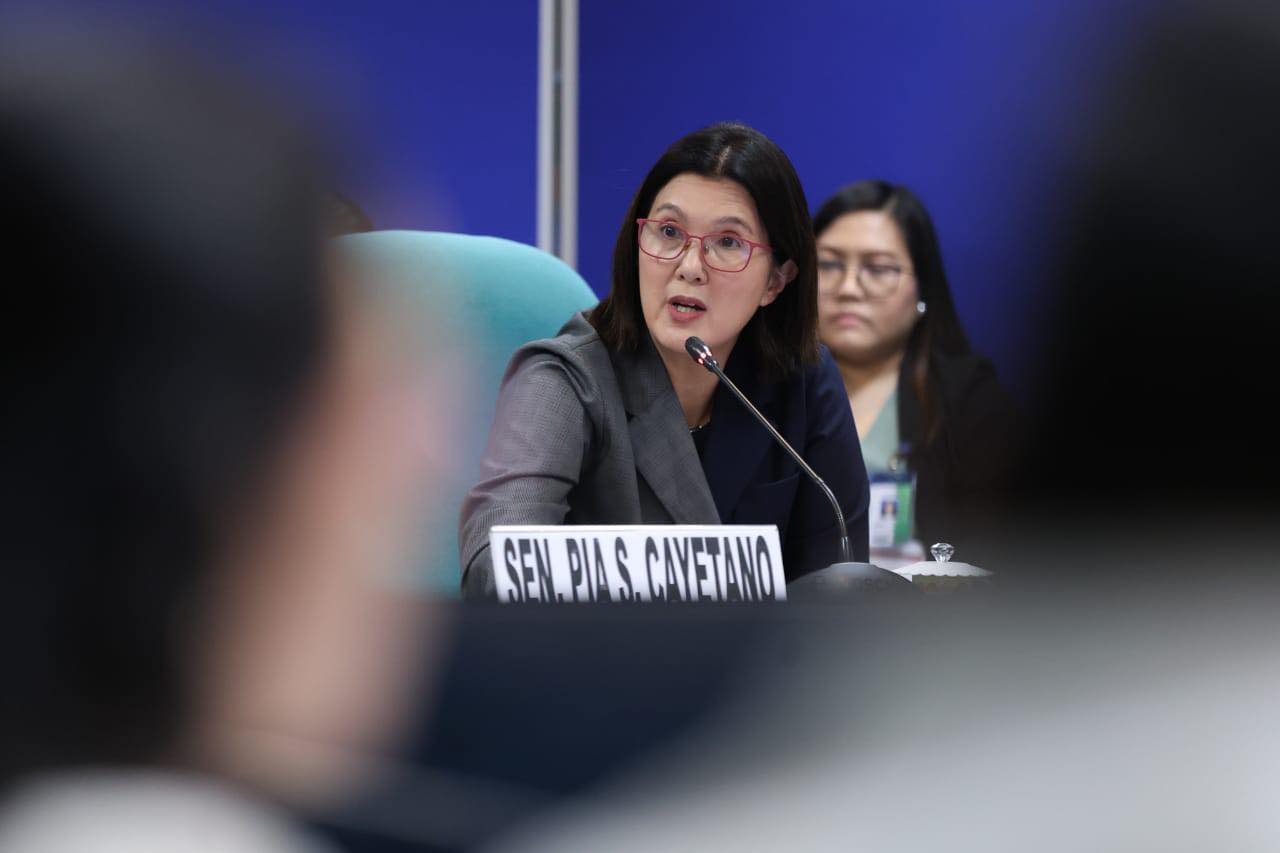
    Senator Pia S. Cayetano highlighted the importance of strengthening higher education policies to better prepare graduates for employment during the organizational meeting of the Senate Committee on Higher, Technical, and Vocational Education.

    Drawing from her experience as former Chair of the Senate Committee on Education in the 16th Congress and as Senior Vice Chair of Finance handling the education budget for six years, she raised concerns on job readiness, job mismatch, and unfair hiring practices.

    She reminded employers that age-based hiring restrictions are banned under the Anti-Age Discrimination in Employment Act, which she authored, and urged the public to report violations to DOLE.

    Cayetano also noted that if LGU spending for education is included, our total expenditure for the sector may surpass 4% of our GDP, a benchmark set under UNESCO’s Education 2030 Framework for Action. She emphasized, however, that investments in the sector must keep growing in order to bridge the remaining gaps.

  • Preparing PH for the futures of education

    By Senator Pia S. Cayetano
    Chair, Committee on SDGs, Innovation, and Futures Thinking

    I rise today to report on and sponsor the findings and recommendations of the Committee on Sustainable Development Goals, Innovation and Futures Thinking, jointly with the Committee on Basic Education, Arts and Culture, under Committee Report No. 643, on the Futures of Education.

    This Committee Report examines the country’s current situation, problems, aspirations, and gathers the recommendations of experts and stakeholders during the Committee’s hearings and further study, in order to secure the best possible future for education. Interestingly, the pandemic gave us the opportunity to invite foreign experts who attended our hearings online.

    Mr. President, we have filed a lengthy committee report, and also prepared a detailed sponsorship speech, but in the interest of time, I will just be quoting certain highlights of the Committee Report.

    Like many countries around the world, we remain stuck in the factory model of education, a one-size-fits-all model that merely gauges the worth of students according to their test scores. The ideal future of education must instead value, recognize, and hone the individuality of each learner.

    According to Dr. Peter Bishop, Founder and Executive Director of Teach the Future in Houston, Texas, “most educators and the society at large believe that the mission of education is to transmit knowledge and experience” to the next generations.

    However, he noted that this view means that… “knowledge and experience is useful only to the extent that [what] the students [will] have in the future is the same as the world of the past” but in fact, “much of what schools teach their learners might actually be irrelevant if the world of the future is not the same as the past.”

    (more…)

  • Education for all

    By Senator Pia S. Cayetano

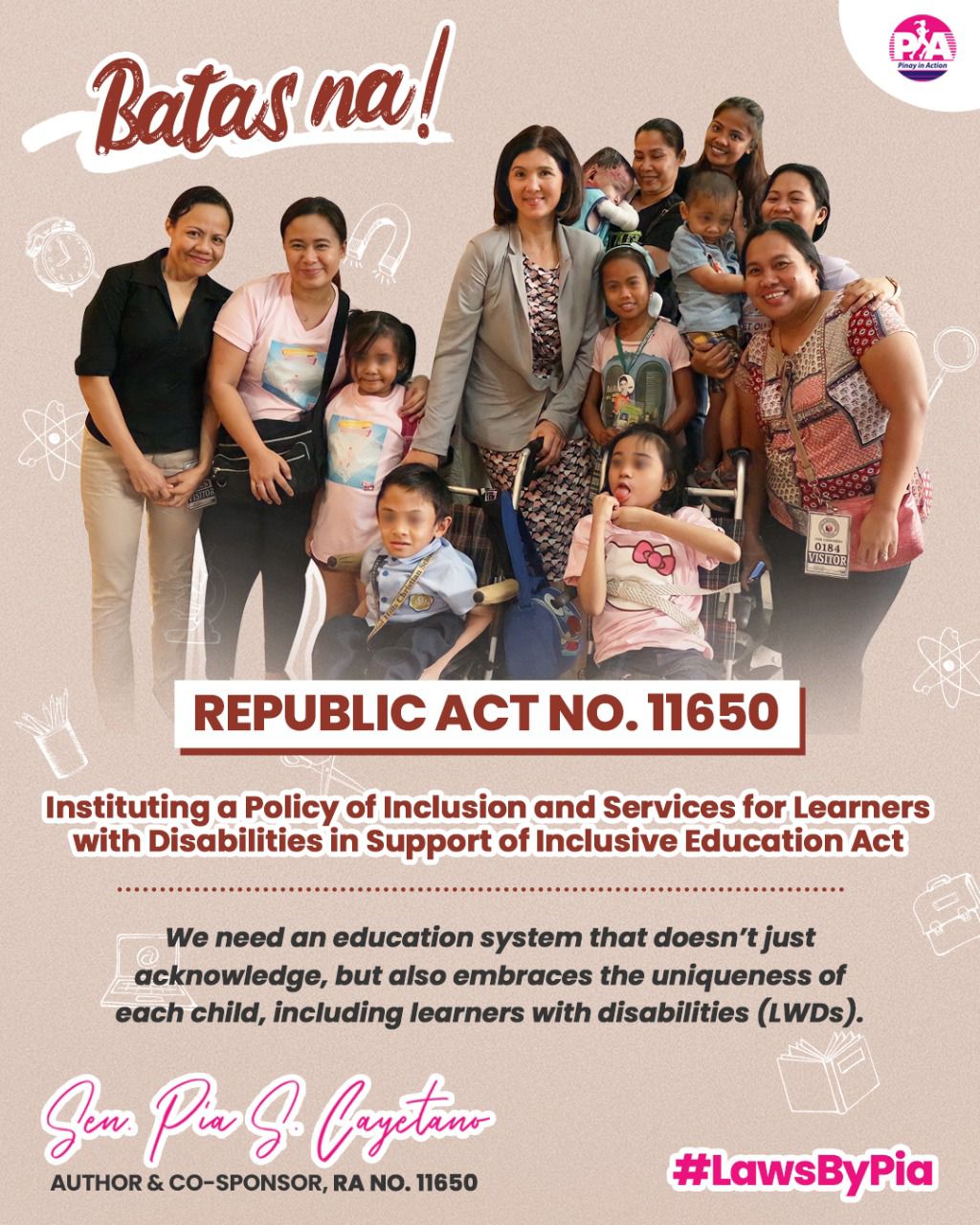
    Author and Co-sponsor, RA 11650, ‘Instituting a Policy of Inclusion and Services for Learners with Disabilities in Support of Inclusive Education Act’

    Every child deserves an education.

    Finally, we have a law that recognizes the needs of learners with disabilities.

    Although there are such schools around the country, they are not enough to meet the needs of all the children.

    I have been a supporter of schools for kids with special needs even before I became a senator. That’s because my son, Gabriel was born with multiple disabilities. And though he died before he turned one, I often wondered how he or kids like him would cope in schools, many of which don’t have the training to deal with kids with learning disabilities.

    This law will also create job opportunities in the education and health fields.

    And of course, this can only be a success with the cooperation of the entire community.#


  • Strengthening partnerships in education

    Speech for the Coordinating Council of Private Educational Associations of the Philippines (COCOPEA)

    By Senator Pia S. Cayetano

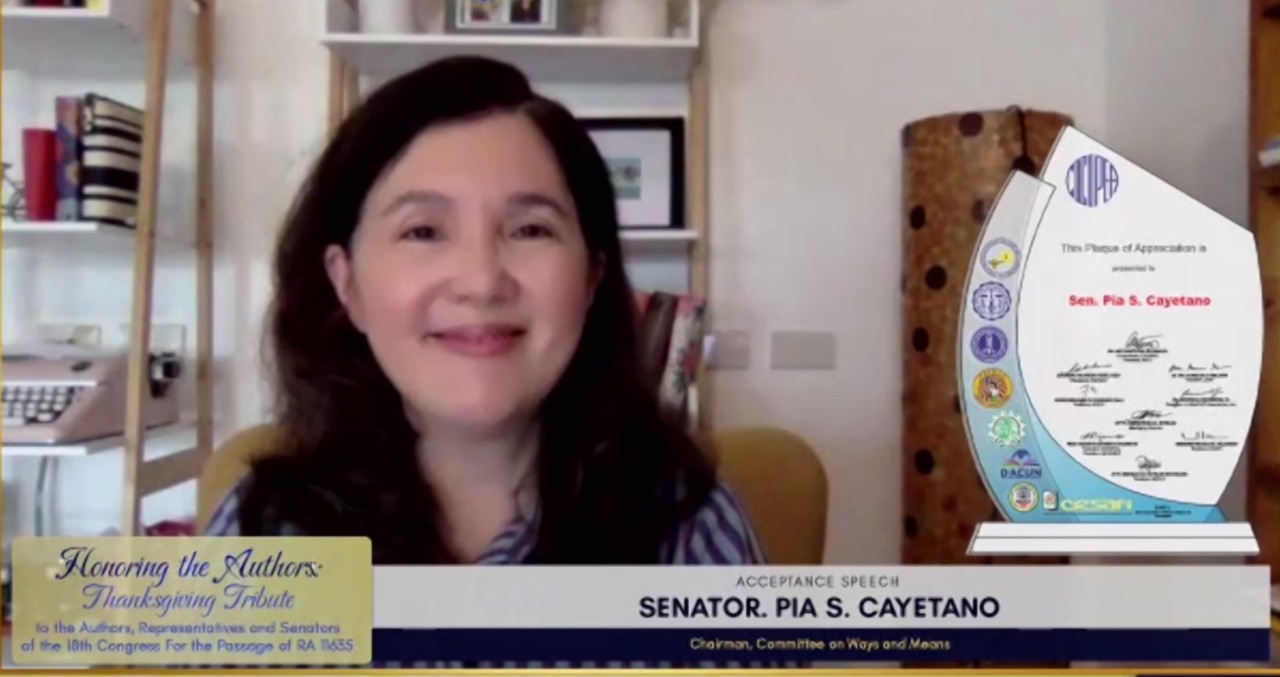
    Chair, Senate Ways and Means Committee
    Sponsor, Republic Act No. 11635, granting preferential tax rates for proprietary educational institutions

    Good afternoon, everyone! Thank you for having me and taking time to include me in this event, where you are taking note of the work that we’ve done. Thank you for the very kind introduction.

    There’s not much really to say for me on this topic. I won’t go through it as you all know what the law is about. I think what I’d like to do now is to focus on the need for further collaboration between COCOPEA and the legislative side of government.

    In my case, there are just so many laws that I feel can be implemented better. Obviously, we would like your input on how we can improve the delivery of education on these issues as well.

    This law that we have just passed is evidence of our ability to work together and to address the concerns that you have. I have always said that the private sector, and of course, COCOPEA, is at the lead in terms of the group of members that you have. The private sector is our partner in the delivery of education to the Filipino people.

    So your wellbeing is important to us. Because your being able to deliver your mandate effectively also allows us to also deliver our mandate as provided by the Constitution.

    I’d like to point out a few issues which I feel are important, because this is just what we have done in the past months. And the outcome of that is really, like I said, just one of the many things that we can do together if we put our minds to it.

    I’ll just mention some of these concerns that I have personally taken note of:

    •Teen pregnancy

    It’s very important that we address this concern. Not just in our country, but all over the world, teen pregnancy is still a big issue. And we already know that when we have teen pregnancies, the victim here is usually the girl because she carries out that pregnancy and her whole future is put on the line. So we must be able to educate our young people and even our teachers. The delivery of education should have that confidence and the ability to address this concern.

    •Youth’s exposure to vices

    The other item that I wanted to discuss is exposure to vices. Cigarettes and the new hazards, which is vaping, I hope that you can all be on board in raising awareness on the dangers of these products. Vapes are not the safer alternative for young people. There is no safer alternative to young people. It is not correct that I see so many young people thinking that this is safer for them than cigarettes, that is not the case. So I hope you can also be on board in bringing awareness to this. And of course, there is still alcohol and drugs that we need to be conscious of.

    •Inclusive learning

    And then, of course, there is equal access to those students who have special needs. I know that in a developing country, this really entails costs that are not part of our regular budgeting process. But I hope in due time, we can continue to strengthen our institutions so that we can address the needs of these children with special needs.

    •Futures thinking for education

    And then very important to me, for those who may not know, I chair a new committee in the Senate, it’s the Committee on Sustainable Development Goals, Innovation, and Futures Thinking. And it is because of my exposure to experts in this field that my knowledge has grown, I continue to be a student in search of more knowledge. But I really embrace the belief that we need to change our system of education. We can’t do it overnight, but every day we must be making steps towards the realization of our goals for these children. And really, there is no one size fits all. The more we can customize the delivery of education for the special talents and (for) the full potential of young learners, the closer we will be to really having a productive next generation.

    So that is really the goal, that we are able to shift from the more traditional delivery of education to more understanding of what the special talents are, and the interests and talents these young children are born with, that we develop their skills in communication, collaboration, creativity, and so on and so forth.

    •Mental health

    And then the awareness on mental health issues. I know we have all become more conscious of it during this time of COVID. These had always been concerns, but there is more acceptance now on the importance of mental health, and not just physical health.

    •Sports and fitness

    And speaking of physical health, as many of you know, I am an avid sports advocate. I love sports myself, I engage in sports, I encourage sports among everyone of all ages, and I do believe that there is room to increase the role of sports in our curriculum, in our day-to-day life in schools. I know some schools may not have facilities that can provide a venue for all kinds of sports, but in one way or another, there are ways that we can make our children fall in love with physical activities, with being active. Especially in our country, which is gifted with beautiful outdoors. We should be able to do more of that.

    So those are just a few of my top-of-mind concerns that I think we can all work with, not necessarily legislation, but really just either implementing existing laws, implementing existing policies, and if there are best practices out there, by all means, share them. We would really like to highlight these best practices in any of the areas that I’ve mentioned, and even more.

    So on that note, once again, it’s been a pleasure. I always like working with associations that are very organized, that have their data. Maraming salamat for also making my work easier. So on that note, again thank you for this opportunity to serve our country better. Thank you. #

    Education leaders
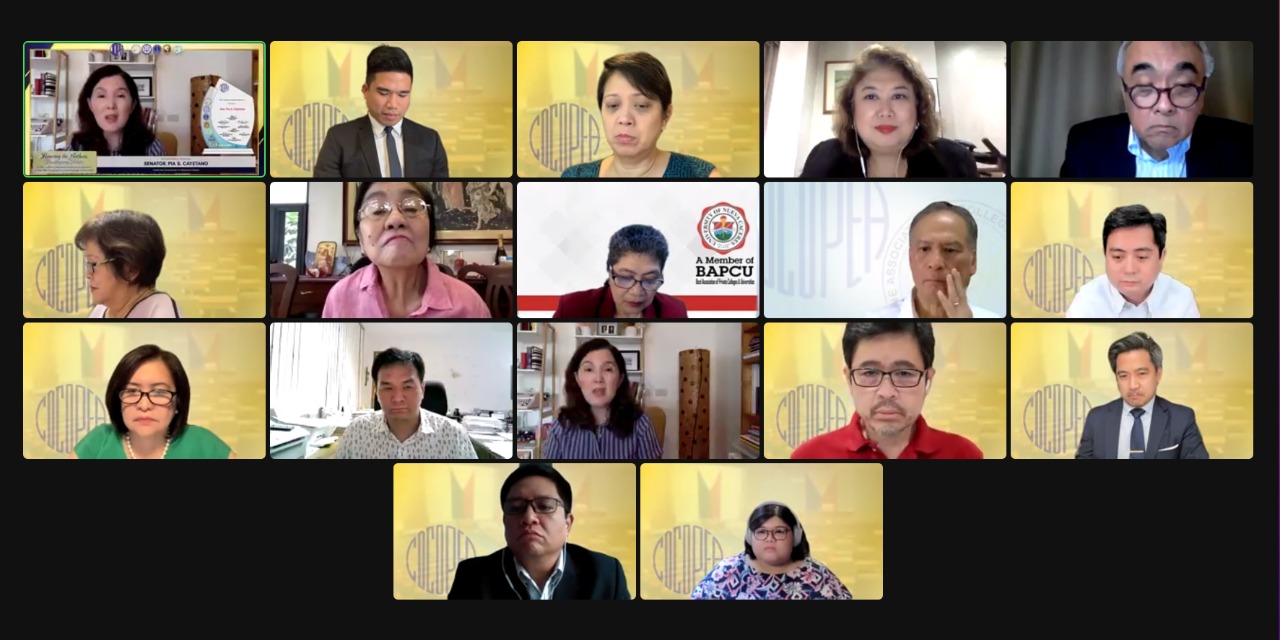
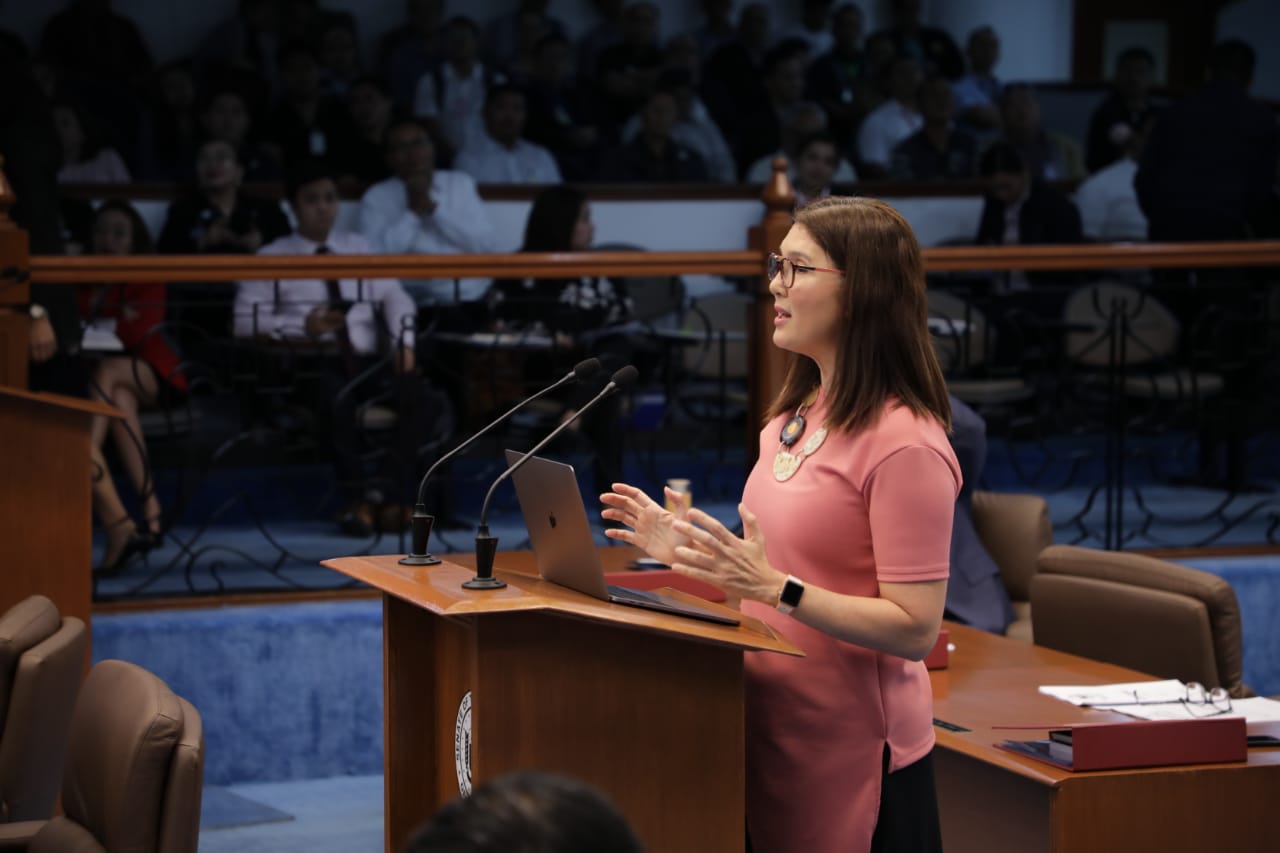
    Senator Pia Cayetano stresses the importance of stronger partnerships in education in her speech before the assembly of private school organizations.

    Senate Ways and Means Chair Sen. Pia Cayetano sponsored RA 11635, the law entitling all private schools to the preferential tax rate.

  • Private schools deserve full support as our partners in education

    RA 11635 brings much-needed reprieve to private schools

    Statement of Senator Pia S. Cayetano
    Chair, Senate Ways and Means Committee
    Principal sponsor, RA 11635

    Private schools are the government’s partners in education. In this time of pandemic, they need as much assistance as they can get to continue delivering quality education to Filipino learners.

    Thus, the enactment of Republic Act (RA) 11635 comes as a welcome development for them amid the uncertainties of the times, as rising COVID-19 cases forced us to restrict face-to-face classes to start the New Year.

    This timely measure, which I sponsored, amends Section 27(B) of the National Internal Revenue Code, to clearly indicate that all proprietary educational institutions, whether for profit or non profit, shall enjoy the 10% preferential tax rate.

    This shall also allow them to be covered by a provision under the Corporate Recovery and Tax Incentives for Enterprises (CREATE) Act, which reduced the tax rate of such institutions from 10% to 1% starting July 1, 2020 to June 30, 2023.

    With this measure, private schools would be given much-needed reprieve to cope with the continuing challenges caused by the pandemic, starting with their own financial viability and sustainability.

    It must be emphasized that this law resulted from continuous dialogue and cooperation among the various stakeholders. We worked with the Bureau of Internal Revenue (BIR) and the private schools, led by the Coordinating Council of Private Educational Associations of the Philippines (COCOPEA), to root out the issues and find a common solution.

    We need to continue working with our partners in education for long-term solutions in terms of policy and budget, using strategic foresight and futures thinking to help this sector recover from the pandemic, and beyond.

    This is part of our country’s commitment under Sustainable Development Goal No. 4, which is  to ensure inclusive and equitable quality education for all by year 2030. #

    The new law will allow all private schools to be covered by a provision under the Corporate Recovery and Tax Incentives for Enterprises (CREATE) Act, which reduced the tax rate of such institutions from 10% to 1% starting July 1, 2020 to June 30, 2023.

  • Pia: Bill clarifies private schools’ tax rates under CREATE

    Senator Pia S. Cayetano welcomed the passage of Senate Bill No. (SBN) 2407 on third and final reading on Monday (September 27), saying that the measure will clarify that all private schools – both ‘non-profit’ and ‘for profit’ – are entitled to the 1 percent preferential tax rate under the Corporate Recovery and Tax Incentives for Enterprises (CREATE) Law, which was enacted last March.

    The Senate Ways and Means Committee Chair and sponsor of SBN 2407, Cayetano acknowledged private school institutions as the government’s “partners in delivering quality education for the youth, and in molding them to become changemakers and responsible leaders of the future.”

    “This partnership is even more crucial today as our nation struggles with COVID-19, which has disrupted educational systems and the formal learning of our current generation of students,” Cayetano added.

    She noted that many private schools are in a critical state, citing data from the Coordinating Council of Private Educational Associations of the Philippines (COCOPEA) showing that enrollment among its member-schools has declined to 60 percent this school year, compared to 2020.

    It may be recalled that in her sponsorship speech, Cayetano recounted the circumstances that led to the filing and approval of the tax relief measure:

    •The passage of CREATE (RA 11534) on March 26, 2021, brought reprieve to proprietary educational institutions by lowering their 10% preferential tax rate to 1% for a period of 3 years, specifically from July 1, 2020 until June 30, 2023.

    •On April 8, 2021,  the Bureau of Internal Revenue (BIR) issued Revenue Regulation No. (RR) 5-2021, which specifically stated that only ‘non-profit’ proprietary educational institutions can avail of the preferential tax rate under CREATE – basing its policy on previous Supreme Court rulings.

    •This then prompted the filing of SBN 2272 by Senator Sonny Angara, which sought to clarify the issue. In the hearing held by the ways and means panel on June 30, 2021, senators asked the Department of Finance (DOF) to suspend implementation of BIR’s RR 5-2021 to avert its impending ill-effects on “for profit” private schools.

    •In response, DOF, through a letter to the Senate dated July 21, 2021, gave its commitment to issue the appropriate revenue regulations suspending the relevant provisions of BIR’s RR 5-2021.

    •As a result, the BIR issued RR 14-2021, which suspended the inclusion of “for-profit” private schools in the regime of regular income tax.

    Cayetano said that it is important to give the public a fair and full picture of the circumstances that led to the filing of Sen. Angara’s SBN 2272, which was substituted by SBN 2407 under her committee report.

    She concluded by saying that SBN 2407 will help the Philippines keep track with its goal to ensure quality education, which is part of the government’s commitments to the Sustainable Development Goals (SDGs), particularly SDG 4.

    “This is the power of dialogue at work, involving all stakeholders,” said Cayetano, who also chairs the Senate Committee on the SDGs, Innovation, and Futures Thinking.#

    Senate session hall
    Senator Pia Cayetano: SBN 2407 will clarify that all private schools are entitled to the 1 % preferential tax rate under CREATE